
A crypto faucet gives away tiny amounts of cryptocurrency for free, usually in exchange for a captcha, a short wait, or a simple task. In 2018, Google banned advertising for cryptocurrencies, ICOs, and related products worldwide, a policy shift confirmed on Google’s own advertising policy pages, and it cut off the ad revenue that funded most of the faucet economy overnight. Community discussion on Bitcointalk in mid-2025 still described faucets as “things of the past,” with users pointing to high mainnet fees and vanished ad income as the reasons the category shrank.
Key Takeaways
- The AltQuick web3 faucet pays out small amounts of eight cryptocurrencies, including Bitcoin, Bitcoin Signet, and two Bitcoin testnets, roughly every ten minutes per coin.
- Most classic crypto faucet sites shut down after Google’s 2018 advertising ban cut off their main revenue source, and community forums still describe the category as largely dead.
- A web3 faucet is not the same as a testnet faucet: AltQuick pays altcoins with real, if tiny, market value, while services like the Google Cloud Web3 Faucet only issue worthless Sepolia or Holesky test tokens.
- AltQuick requires no KYC to claim from the faucet, but the linked exchange account carries mixed Trustpilot reviews and its own history of support delays.
- Faucet payouts are best treated as a way to test a platform’s mechanics, not as an income source, since claim amounts on almost every web3 faucets list are worth a fraction of a cent.
The AltQuick web3 faucet is one of the few multi-coin faucets that forum users still mention as active, tied to the AltQuick.com altcoin exchange. This review walks through how the AltQuick faucet actually works, what a web3 faucet is compared with a developer-focused testnet faucet, what the exchange behind it looks like, and what the wider community says about using faucets at all in 2026.
What Is a Web3 Faucet?
A web3 faucet distributes small, free amounts of a cryptocurrency or token directly to a user’s wallet or exchange account. The term covers two very different things that get lumped together online:
- Consumer faucets – reward-style sites and exchange add-ons, like the AltQuick faucet, that pay real (if minimal) altcoins to registered users.
- Developer testnet faucets – tools that issue worthless test tokens on networks like Ethereum’s Sepolia or Holesky testnets so developers can deploy and debug smart contracts without spending real ETH.
The Google Cloud Web3 Faucet is the clearest modern example of the second category. It drips free testnet ETH and other tokens on Ethereum Sepolia, Holesky, and several EVM-compatible testnets, and Google explicitly states the tokens exist “to deploy smart contracts, debug transactions, and experiment on Web3 testnets” – not to be traded or cashed out. That distinction matters: a web3 faucet aimed at developers has zero resale value by design, while a consumer-facing crypto faucet like AltQuick’s pays coins that trade on that exchange’s own markets, however small the amounts.
Why So Many Crypto Faucets Disappeared
Long-running Bitcointalk threads from mid-2025 give a fairly consistent picture of what happened to the faucet economy. One user summed it up simply: “faucets aren’t much of a thing these days since most coins have soared all the way to the moon,” pointing out that fees on networks like Bitcoin and Ethereum made tiny payouts impractical, while coins with negligible fees, such as Solana, XRP, Litecoin, and IOTA, were named as the exceptions where faucets could still work.
Several forum posters linked the decline directly to advertising. One wrote that “Since Google Ads banned faucets, the industry started dying,” adding that even the long-running Freebitco.in faucet had grown “shady” and untrustworthy in their view. Google’s own advertising policy documentation confirms cryptocurrency ads were treated as restricted or banned outright starting in 2018, with the rules only loosening gradually – first for regulated exchanges and wallets, later for a narrow set of certified products – which lines up with the timeline the forum describes.
Other complaints raised in the same threads: faucet owners quietly shut down popular Dogecoin variants like Freedoge.co.in, MoonBitco.in, and MoonDogeco.in; remaining faucets often pay out in an internal points currency with a minimum exchange threshold of 2,000 points at 10 points per claim, far slower than the direct micro-payouts faucets offered in the early Bitcoin era; and several users flagged that low-quality faucets are frequently “full of malicious pop-ups and links which can infect your device.”
What Is the AltQuick Web3 Faucet?
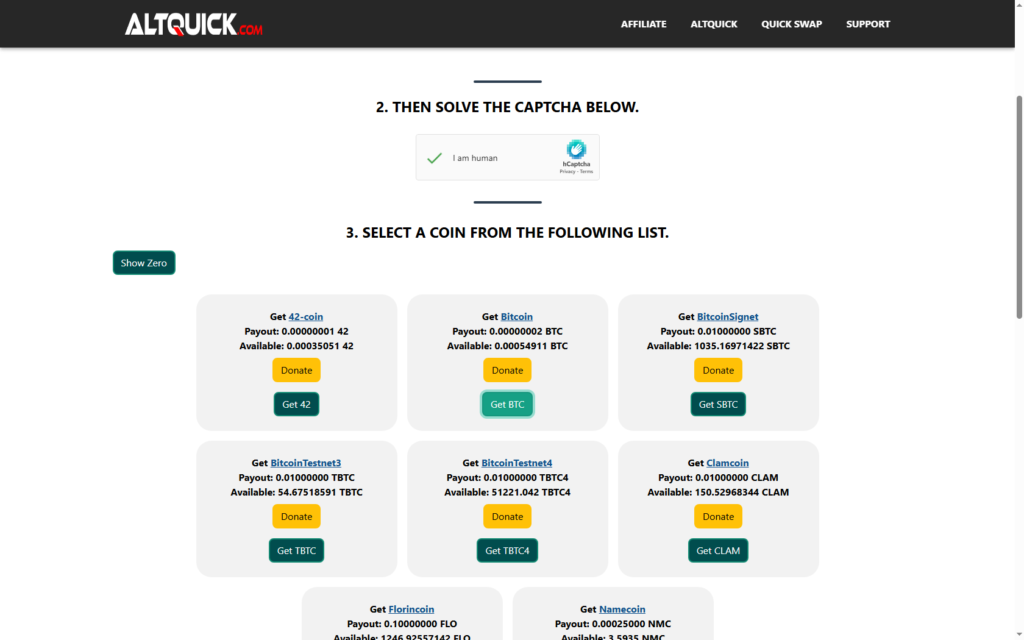
The AltQuick web3 faucet is a free faucet tool built into the AltQuick.com altcoin exchange. A Bitcointalk user recommended it directly in a July 2025 faucet discussion thread, describing AltQuick as “a tiny exchange… that has a faucet which gives out various altcoins.” To use it, a visitor first creates a free AltQuick account (username, optional email, and password), then enters that username on the faucet page and completes an hCaptcha check before selecting a coin to claim.
Each coin on the faucet has its own payout amount and its own remaining pool balance, and each has an independent claim cooldown – the site’s own tagline promises new coins “every ten minutes,” and the faucet interface shows a live countdown (for example, a message reading “You must wait 6 minutes and 48 seconds longer before requesting”) once a claim has been made. New accounts are restricted to the Bitcoin Testnet faucet for the first 24 hours, a limit AltQuick’s own support team has confirmed in response to user questions.
People also like: OnlyFaucet Review: Is This Web3 Faucet Worth Your Time in 2026
Coins Available on the AltQuick Faucet
The table below reflects the coin list and payout structure shown on the live AltQuick faucet page.
| Coin | Payout per Claim | Approx. Pool Available | Type |
|---|---|---|---|
| 42-coin | 0.00000001 42 | ~0.00035 42 | Altcoin |
| Bitcoin (BTC) | 0.00000002 BTC | ~0.00055 BTC | Mainnet coin |
| Bitcoin Signet (SBTC) | 0.01000000 SBTC | ~1,035 SBTC | Signet test coin |
| Bitcoin Testnet3 (TBTC) | 0.01000000 TBTC | ~54.7 TBTC | Testnet coin |
| Bitcoin Testnet4 (TBTC4) | 0.01000000 TBTC4 | ~51,221 TBTC4 | Testnet coin |
| Clamcoin (CLAM) | 0.01000000 CLAM | ~150.5 CLAM | Altcoin |
| Florincoin (FLO) | 0.10000000 FLO | ~1,247 FLO | Altcoin |
| Namecoin (NMC) | 0.00025000 NMC | ~3.6 NMC | Altcoin |
Note the distinction inside AltQuick’s own faucet: Bitcoin Signet, Bitcoin Testnet3, and Bitcoin Testnet4 are test networks with no independent monetary value outside the exchange’s own internal markets, while Bitcoin, Clamcoin, Florincoin, Namecoin, and 42-coin are live mainnet assets, however illiquid some of them are.
How to Claim From the AltQuick Web3 Faucet
- Register a free account on AltQuick.com with a username, an optional email address, and a password.
- Open the AltQuick faucet page and enter the exact, case-sensitive username used at signup.
- Complete the hCaptcha “I am human” check to confirm the request is not automated.
- Choose a coin card and click its claim button (for example, “Get BTC” or “Get SBTC”).
- Wait out the cooldown timer before claiming that same coin again; different coins can typically be claimed on separate timers.
- Log into the AltQuick account to see the claimed balance, which can then be held, swapped on the exchange’s own markets, or withdrawn once above the minimum threshold.
The AltQuick Exchange Behind the Faucet
AltQuick.com is a no-KYC altcoin exchange that pairs every listed coin against Bitcoin. Its public markets page lists roughly two dozen assets, including 42-coin, Avalanche, Bitcoin Cash, Bitcoin Signet, both Bitcoin testnets, Clamcoin, Curecoin, Dash, DigiByte, Dogecoin, Florincoin, Gapcoin, Litecoin, Mazacoin, Monero, Namecoin, Particl, Peercoin, Qtum, Rhombus, Solana, Wownero, and Zcash, each with live bid, ask, and weekly volume figures.
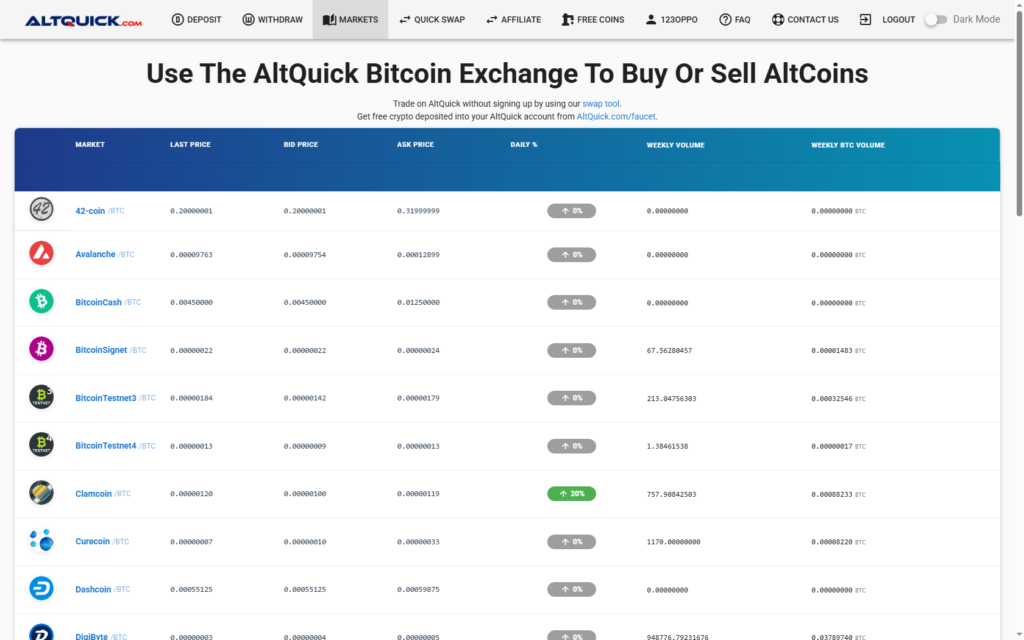
The exchange also runs a separate no-signup Quick Swap tool, though the platform states plainly that this “Swap service exclusively uses our own trade markets liquidity” rather than routing through outside liquidity providers.
On several of the thinner markets – 42-coin, Avalanche, Bitcoin Cash, Dashcoin – weekly volume shown on the exchange sits at 0.00000000 BTC, meaning there has been no recent trading activity on those specific pairs. Higher-volume pairs on the same markets page, such as DigiByte and Dogecoin, show tens of thousands of coins in weekly volume, so liquidity varies sharply from one listed asset to the next.
Is the AltQuick Faucet and Exchange Legit? What Reviews Say
AltQuick’s Trustpilot page (listed under its sister brand, freebitcoins.com) carries a 3.6 out of 5 average from 19 reviews as of mid-2025, per Trustpilot’s own listing. The pattern in those reviews is mixed rather than uniformly negative: several long-time users praised fast withdrawals and responsive support, while a handful of one- and two-star reviews describe stuck transactions, confusion over case-sensitive usernames, and a faucet that occasionally runs dry for the more obscure coins.
AltQuick’s own support responses on that same review page repeatedly stress that usernames are case-sensitive and that sensitive account details should only go through the official support portal rather than public review sites – a reasonable security practice, though it also means some negative reviews stemmed from user error rather than platform failure. On Bitcointalk, the exchange’s founder has been active in the same threads recommending the faucet, which is useful transparency but also means that endorsement is not independent.
The practical takeaway for anyone evaluating whether the AltQuick web3 faucet is worth using: it appears to be a genuinely operating faucet tied to a small, low-volume, no-KYC exchange, not a payout scam, but it carries the ordinary risks of any small centralized platform – limited liquidity on thin pairs, and support that moves at the pace of a small team rather than a large company.
Web3 Faucets vs Testnet Faucets: What’s the Difference?
It is easy to confuse a consumer web3 faucet with a developer testnet faucet because both use the word “faucet” and both give tokens away for free. The Google Cloud Web3 Faucet is the clearest large-scale example of the developer category: it distributes free test ETH on Ethereum’s Sepolia and Holesky testnets (plus other EVM-compatible networks) so builders can deploy and debug smart contracts, and Google is explicit that these tokens have no resale value and exist purely for testing.
Community forum users echo the same split. One Bitcointalk poster explained that ETH testnet coins claimed from a faucet can be bridged and swapped at a low rate via services like “testnetbridge,” using LayerZero infrastructure to connect Sepolia to mainnet and various L2s – a workaround that exists precisely because ordinary testnet tokens are not meant to carry real value on their own.
A long debate on the same forum about Bitcoin’s own testnets (Testnet3, and the newer Testnet4) reached a similar conclusion: developers deliberately want a valueless, disposable network for testing so that arbitrary experiments do not carry tax, accounting, or security implications, even though some users still trade those coins informally on niche platforms like AltQuick.
Quick Comparison
| Consumer Web3 Faucet (e.g. AltQuick) | Developer Testnet Faucet (e.g. Google Cloud) | |
|---|---|---|
| Purpose | Onboarding, small rewards, exchange testing | Smart contract deployment and debugging |
| Token value | Small but real, tradable on exchange markets | None; explicitly worthless by design |
| Sign-up | Free account, captcha | Google account or wallet address, rate limits |
| Typical claim cooldown | Roughly every 10 minutes per coin | Rate-limited per address per network |
Risks and Downsides of Using a Crypto Faucet
Community discussion around faucets in 2025 and 2026 consistently raises the same set of concerns worth weighing before spending time on any crypto faucet, including AltQuick’s:
- Payout size – claims are frequently worth a fraction of a cent; one forum user noted that on some remaining faucets the minimum exchange threshold is 2,000 internal points at only 10 points per claim every 20 minutes, which adds up slowly.
- Security – lower-quality faucet sites have been described by community members as carrying malicious pop-ups and infected links; sticking to platforms with a visible track record, like an established exchange’s own faucet, reduces that exposure.
- Liquidity – on a small exchange, some coin pairs may show zero weekly trading volume, meaning claimed coins might be difficult to sell at a fair price even after meeting a withdrawal minimum.
- Platform risk – no-KYC, small-team platforms carry more counterparty risk than large regulated exchanges; independent trust-score aggregators have flagged AltQuick with a mixed risk rating even while its direct Trustpilot reviews remain largely positive, so it is worth treating any balance held there as a small, disposable amount rather than a savings account.
- Advertising and discoverability – because Google’s advertising policy still restricts most cryptocurrency promotion to certified, regulated advertisers, small independent faucets have little formal marketing reach, which is part of why so many that started in the 2013-2018 era quietly went offline.
You may also like: Vie Faucet Review: Is This Web3 Faucet Worth Using in 2026?
How to Use Web3 Faucets Safely in 2026
- Treat every faucet claim as a learning exercise, not income, and never deposit funds into a faucet-linked exchange beyond what is comfortable to lose.
- Use a separate wallet or a small sub-account for faucet coins rather than mixing them with a primary holding wallet.
- Double-check that a username or wallet address is entered exactly as registered, since most faucets, including AltQuick’s, are case-sensitive.
- Confirm whether a coin is a live mainnet asset or a test network coin before assuming it carries any resale value.
- Move any accumulated balance out to cold storage or a swap once it clears the platform’s minimum withdrawal threshold, rather than letting it sit indefinitely on a small exchange.
Final Thoughts on the AltQuick Web3 Faucet
The AltQuick web3 faucet is a niche but functioning example of a category that mostly disappeared after Google’s crypto advertising ban squeezed out ad-funded faucet sites. It pays real, if very small, amounts across eight coins on a roughly ten-minute cooldown, sitting on top of a low-volume, no-KYC exchange with mixed but broadly workable reviews. For anyone curious about how a web3 faucet or a crypto faucet actually behaves day to day, it is a reasonable, low-stakes way to see the mechanics firsthand – just without expecting it to be a meaningful source of free money.
Frequently Asked Questions
A web3 faucet is a tool that distributes small, free amounts of cryptocurrency or test tokens. Consumer faucets like AltQuick’s pay tradable altcoins to registered users, while developer testnet faucets like Google Cloud’s issue worthless tokens purely for smart contract testing.
Yes. Claiming from the AltQuick web3 faucet only requires a free account registration and passing an hCaptcha check; no deposit is needed to claim.
AltQuick advertises claims roughly every ten minutes per coin, with a live cooldown timer shown on the faucet page once a claim has been made. New accounts are limited to the Bitcoin Testnet faucet for their first 24 hours.
Community discussion suggests most large-scale faucets disappeared after losing ad revenue in 2018, and remaining ones pay very small amounts. They can still be useful for learning wallet and exchange mechanics, but they are not a realistic income source.
Both are Bitcoin test networks with no independent monetary value outside a platform’s own internal markets. Testnet4 is the newer network, introduced after Testnet3 had been in use for roughly a decade, according to developer discussion referenced on Bitcointalk.
