
If you have tried to grab free test ETH lately and hit an empty tank, you already know the problem Chainstack web3 faucets were built to solve. This is a Web3 infrastructure provider that runs nodes and RPC endpoints across more than 70 blockchains, and its faucet is a small but genuinely useful side product: a single page where developers can pull small amounts of test tokens across a dozen networks without connecting a social account.
Key Takeaways
- Chainstack runs a multi-chain testnet faucet covering 12 networks, from Sepolia and Hoodi to Solana devnet, Base Sepolia, Monad, and TON, all dispensing free tokens with no real-world value.
- Claiming works through faucet.chainstack.com: you generate a Chainstack API key, paste your wallet address, and submit, or you can request funds through the Chainstack MCP server if you are working inside an AI coding agent.
- Most networks gate claims behind a minimum 0.08 ETH balance on Ethereum mainnet plus a history of holding funds, an anti-bot check rather than an identity check.
- Chainstack already dropped Holesky from its network list and routes builders to Sepolia and Hoodi instead, matching the testnet map the Ethereum Foundation recommends since Holesky’s 2025 retirement.
- Bot and AI-agent draining is a well-documented, industry-wide problem in 2026, and a mainnet-balance check like Chainstack’s is one of several competing defenses, alongside newer proof-of-humanity systems.
The need for a reliable web3 faucet keeps growing alongside the developer base building on these chains. Ethereum alone attracted more than 16,000 new developers between January and September 2025, according to Electric Capital’s 2025 Developer Report, and every one of them needs somewhere to get gas before they can touch a testnet contract. That is the gap a web3 faucet fills: a way to fund a wallet with worthless-but-usable tokens so code can be tested without risking real money.
This article breaks down exactly how the faucet works: which networks it covers, what you have to do to claim, why it asks for a mainnet balance before it will pay out, how it fits into the post-Holesky testnet map, and where its approach sits next to other web3 faucets in 2026.
What a Web3 Faucet Actually Does
A web3 faucet is a service that hands out small amounts of a blockchain’s native token on a testnet, a parallel version of the network that mirrors mainnet behavior but carries no financial value. Testnet tokens exist for one reason: they let developers pay gas, deploy contracts, and run transactions while they debug, without spending real ETH, SOL, or BNB in the process.
Chainstack’s version of this is its multi-chain faucet, hosted separately from the main node dashboard at faucet.chainstack.com. It is positioned as a companion to the company’s core business, which is renting out blockchain nodes and RPC endpoints, so the logic is straightforward: get a developer’s test wallet funded, then let them point that wallet at a Chainstack-hosted node to actually build.
Read also: AltQuick Web3 Faucet Review: How This Crypto Faucet Works in 2026
Which Networks the Chainstack Faucet Covers
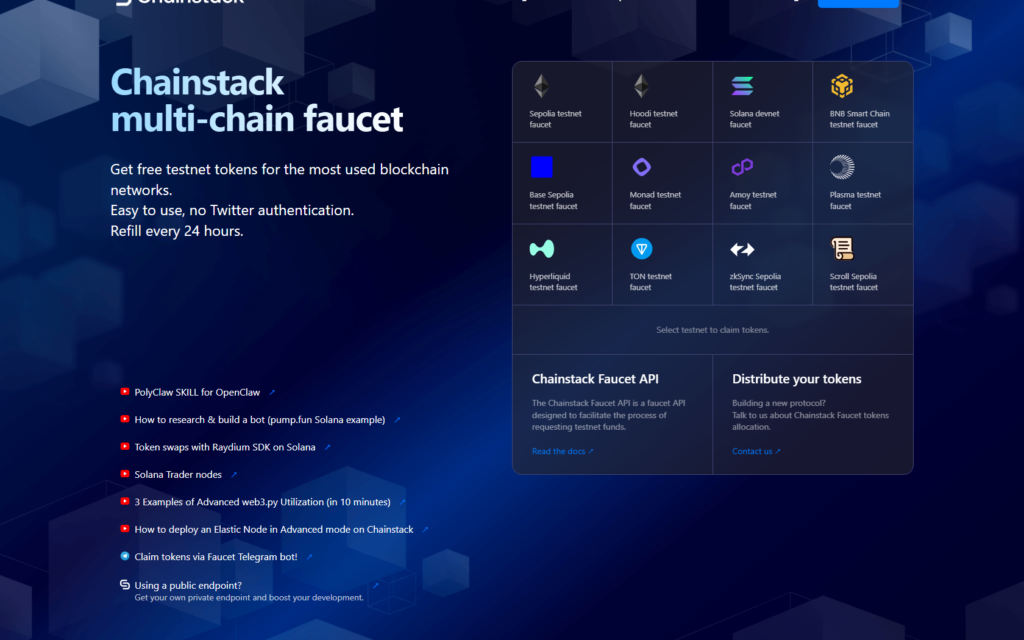
As of mid-2026, the the faucet network lists 12 supported testnets, spanning Ethereum-adjacent chains, Solana, and a handful of newer layer-1 and layer-2 testnets. Each network has its own daily cap, and the app tops up a wallet to that cap rather than adding a flat amount on top of whatever balance the wallet already holds.
| Network | Testnet token | Daily cap (per address) |
| Sepolia | ETH | Up to 0.5 ETH / 24h |
| Hoodi | ETH | Up to 0.5 ETH / 24h |
| Solana devnet | SOL | Up to 1 SOL / 24h |
| BNB Smart Chain testnet | BNB | Up to 0.5 BNB / 24h |
| Base Sepolia | ETH | Up to 0.5 ETH / 24h |
| Monad testnet | MON | Up to 0.5 MON / 24h |
| Amoy testnet (Polygon) | POL | Up to 0.01 POL / 24h |
| Plasma testnet | XPL | Up to 0.05 XPL / 24h |
| Hyperliquid testnet | HYPE | Up to 1 HYPE / 24h |
| TON testnet | GRAM | Up to 1 GRAM / 24h |
| zkSync Sepolia testnet | ETH | Up to 0.05 ETH / 24h |
| Scroll Sepolia testnet | ETH | Up to 0.5 ETH / 24h |
Two things stand out in that list. First, the Amoy testnet cap is unusually small at 0.01 POL, which is worth knowing before you plan a gas-heavy Polygon test around it. Second, Plasma and Monad sit on the list alongside long-established chains, showing that Chainstack keeps adding faucet support as new testnets launch rather than treating the faucet as a fixed, legacy feature.
How to Claim Tokens From the Chainstack Web3 Faucet
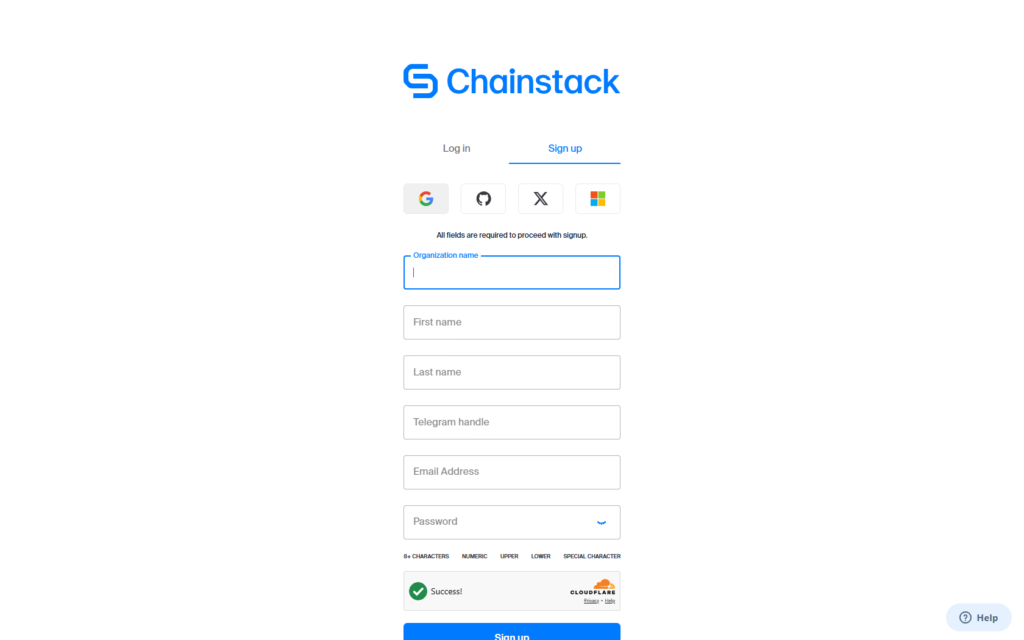
Claiming from a Chainstack web3 faucet is not anonymous. Unlike faucets that only ask for a wallet address, this network ties every claim to a Chainstack account and an API key, which is how it enforces the daily cap per user rather than per wallet alone. The flow looks like this:
- Create a free Chainstack account and sign in to the Chainstack console.
- Go to Settings > API keys and copy an active API key.
- Open faucet.chainstack.com and select the testnet you need from the grid of 12 networks.
- Paste your wallet address into the address field.
- Paste the API key into the key field and click Claim tokens.
The page confirms the request immediately and the tokens land in the wallet within a short delay, matching how most independent testnet faucets describe their claim latency: near-instant under normal load, slower if the network is congested.
Claiming Through the Chainstack MCP Server
Because so much smart contract work now happens inside AI coding tools, Chainstack also exposes a request_testnet_funds tool through its MCP server (mcp.chainstack.com). This lets an AI agent working inside Claude, ChatGPT, Cursor, Windsurf, Antigravity, or Gemini fund a testnet address without the developer leaving their editor, authenticating with the same Chainstack API key used on the web faucet. It is the same eligibility logic under the hood, just called from a different interface.
The Chainstack Faucet API
For teams that need to hand out their own protocol’s testnet tokens rather than pull from Chainstack’s supported list, Chainstack also offers a separate Faucet API for token distribution at scale, available on request through Chainstack’s contact channel rather than as a self-serve product.
Why Chainstack Asks for a Mainnet Balance Before It Pays Out
This is the part of the faucet that trips people up most. Before disbursing funds, Chainstack runs two checks on most EVM-based networks:
- The requesting address must hold a minimum balance of 0.08 ETH on Ethereum mainnet.
- That address needs a history of holding ETH on mainnet, meaning it should not have been recently empty.
A brand-new, never-used wallet will fail both checks and get nothing, even though the request looks otherwise valid. This is not a KYC or identity gate; it is an anti-Sybil, anti-bot filter, built on the assumption that a wallet with real transaction history on mainnet is more likely to belong to a genuine developer than to a disposable script.
Two networks break from that default pattern. On Solana devnet, the equivalent check is a minimum of 0.8 SOL held on Solana mainnet, not ETH, which makes sense given the different chain. On TON testnet, the eligibility logic is different again: the wallet must already be initialized, and the requested amount cannot push the balance over the network’s cap.
Worth flagging as an honest quirk: on some non-Ethereum faucet pages, including the BNB Smart Chain testnet claim panel, the eligibility copy Chainstack displays still references a 0.08 ETH mainnet balance rather than a BNB-specific check, which reads like boilerplate carried over from the Ethereum-based rule set. If a BNB testnet claim behaves unexpectedly, that mismatch between the displayed text and the actual chain is worth checking first.
This kind of gate is not unique to Chainstack. It reflects a problem the whole web3 faucet ecosystem is dealing with in 2026: automated scripts and AI agents now drain public faucets within minutes of a refill, which has pushed most operators toward some form of balance check, rate limit, or verification step rather than a plain, open request form.
How Chainstack’s Approach Compares to Other Web3 Faucets
Chainstack is not the only infrastructure provider running a web3 faucet, and the anti-abuse method varies by operator. A few points of comparison worth knowing:
- Chainstack’s approach: a mainnet balance and history check, applied per wallet, with claims capped once every 24 hours per network.
- Google Cloud Web3 and Self Protocol: in January 2026, the two launched zero-knowledge proof-of-humanity on the Celo Sepolia testnet faucet, letting developers verify they are real people without sharing personal data, and rewarding verified users with up to 10 times more tokens on their second claim.
- Multi-chain aggregator faucets: some providers pull drips for 80-plus chains into one dashboard behind a single wallet connection, trading network breadth for a lighter eligibility check than Chainstack’s mainnet-balance rule.
The tradeoff is consistent across all of them: the more a faucet tightens its gate, the less likely it is to run dry from bot traffic, and the more friction a genuine first-time developer has to clear before their first claim goes through.
Where Chainstack’s Faucet Sits in the Post-Holesky Testnet Map
One detail confirms that this network keeps its faucet current rather than letting it go stale: Holesky is nowhere on the network list. Holesky was Ethereum’s largest public testnet from 2023 until the Ethereum Foundation formally retired it, two weeks after the Fusaka network upgrade finalized on it in late 2025, following inactivity leaks that piled up a large validator exit queue after the earlier Pectra upgrade.
In its place, the Foundation recommends a three-testnet split, and Chainstack’s faucet already reflects it:
- Sepolia for smart contract and application testing, the recommended default for most dapp work.
- Hoodi, launched in March 2025, for staking and validator infrastructure testing.
- Ephemery, a throwaway testnet that resets to genesis every 28 days, for quick validator-lifecycle experiments.
Chainstack’s faucet offers both Sepolia and Hoodi, which matches the current recommendation exactly. Ephemery is not on its faucet list, which is a minor gap for anyone specifically testing the full validator lifecycle, but not a problem for the far more common case of testing a contract or a dapp.
What You Can Actually Do With the Tokens
Testnet tokens claimed from a Chainstack web3 faucet are only useful for a narrow set of tasks, but those tasks matter before anything goes to mainnet:
- Paying gas for contract deployments and function calls on a test network.
- Testing stablecoin settlement or payment flows before they touch real funds.
- Simulating DeFi activity like swaps, lending, and liquidation checks.
- Running bots or automated scripts against live RPC responses without financial risk.
- Stress-testing an AI agent or keeper process under bursty request patterns.
None of this has monetary value. Testnet ETH, testnet SOL, and every other token this faucet distributes cannot be sold, bridged to mainnet, or converted into anything spendable. Treat a Chainstack web3 faucet claim purely as a development tool, not as a source of free crypto.
You may also like: FaucetEarner Review 2026: Free XRP, Real Risks, and What Users Actually Experience
Limitations to Know Before You Rely on the Chainstack Faucet
The faucet itself is simple and free, but it is worth being realistic about where it can go wrong, especially since the underlying platform has a mixed public track record. Reviews on Trustpilot and G2 skew positive overall, with recurring praise for support responsiveness, node reliability, and predictable pricing, but a smaller set of reviewers on Trustpilot describe billing disputes, refund friction, and, in a few cases, dropped node connections.
- Eligibility can block first-time users: a wallet with no mainnet history gets nothing, which is a real barrier for a genuinely new developer testing their very first contract.
- Caps are strict and per-network: you cannot stack claims across two different testnets to get a bigger effective balance on one chain.
- The Faucet API for custom protocol tokens is not self-serve: teams need to contact Chainstack directly rather than configuring it from the dashboard.
- Account-tied claims mean less anonymity: unlike faucets that ask only for a wallet address, Chainstack requires a signed-in account and an active API key for every claim.
None of this makes the faucet unreliable for its intended purpose, funding a testnet wallet for development work, but it does mean a Chainstack web3 faucet claim is not the frictionless, anonymous tap some competing faucets offer.
Frequently Asked Questions
It is a free service at faucet.chainstack.com that distributes small amounts of testnet tokens, such as Sepolia ETH or Solana devnet SOL, so developers can test smart contracts and dapps without spending real money.
No. Testnet tokens from any web3 faucet, including Chainstack’s, only exist on their respective test networks and cannot be sold, bridged to mainnet, or exchanged for anything of value.
Chainstack tops up each address to its per-network cap once every 24 hours. If your balance is already at or above the cap, a new claim will not add anything until the balance drops or the window resets.
The 0.08 ETH mainnet requirement and wallet-history check are anti-bot measures, not identity verification. They make it harder for scripts to mass-claim testnet tokens and drain the faucet for everyone else.
No. You need a Chainstack account and an active API key to submit a claim, which ties each request to a specific user rather than just a wallet address.
