
An autofaucet is one of the oldest ways to collect small amounts of free cryptocurrency without spending any money, and it remains a recurring topic on beermoney and crypto forums. Global interest in this kind of low-effort earning has grown alongside crypto ownership itself with industry analysts projecting that by the end of 2026, crypto will have more than 800 million users. A share of that growing audience is not trading or staking at all – it is claiming faucets, rolling dice games and grinding offerwalls for pennies at a time.
Key Takeaways
- Dutchy Autofaucet (branded Final Autoclaim, hosted at autofaucet.dutchycorp.space) is an autofaucet that claims small amounts of over 70 cryptocurrencies automatically once it is fueled with its internal DUTCHY token.
- Real earnings reported by users are small: passive setups earn cents per day, while active users combining offerwalls, surveys and the weekend booster describe totals closer to $5 to $10 over a weekend.
- Progress is driven by a level system, loyalty streaks and a balance mode bonus, so long-term, consistent use pays meaningfully more than a single visit.
- Independent reviews are mixed: Trustpilot ratings for the platform sit in the low-to-mid 2 out of 5 range, with recurring complaints about account bans, KYC requests and delayed withdrawals once balances grow.
- Despite the label, an autofaucet like this is a Web2-style GPT platform that happens to pay in crypto – it is not the same thing as a genuine web3 faucet used to fund testnet wallets.
This guide focuses specifically on Dutchy Autofaucet, also branded Final Autoclaim, running at autofaucet.dutchycorp.space. It is one of the longest-running platforms in this niche, and it is frequently confused with other, unrelated autofaucet sites that share a similar name or layout. This article does not cover those other platforms – it walks through how Final Autoclaim’s faucet system, DUTCHY token and level structure actually work, what real users report earning, what independent reviews say about its reliability, and how the term web3 faucet is often used loosely to describe sites like this one.
What Is a Crypto Faucet, and Where Does Final Autoclaim Fit In?
A crypto faucet is a website or app that gives away small, fixed amounts of cryptocurrency – historically measured in satoshis, the smallest unit of Bitcoin (one hundred millionth of a BTC) – in exchange for a simple action such as solving a captcha, watching an ad, or waiting out a timer. A satoshi faucet specifically refers to this Bitcoin-denominated version, though the same model has since been copied across dozens of other coins.
An autofaucet is the automated evolution of that idea. Instead of clicking a claim button every few minutes, users fuel an automatic claiming system that fires off small payouts on a timer – typically every 1, 5, 10 or 30 minutes – while the tab stays open in the background. Dutchy Autofaucet is one of the more feature-heavy examples of this model, layering an internal token, a leveling system and multiple side activities on top of the basic auto-claim mechanic.
A Brief History of the Crypto Faucet Model
The concept did not start as a get-paid-to scheme. According to reporting from MIT Technology Review, Bitcoin core developer Gavin Andresen launched the original Bitcoin Faucet in June 2010, handing out 5 BTC to every visitor who solved a captcha, funded by a pool of roughly 1,100 BTC. The goal was to get a then-worthless, unfamiliar currency into people’s hands so they would actually try using it. Andresen scaled the payout down as Bitcoin’s price rose and shut the site down in 2012.
That original faucet gave away Bitcoin worth cents at the time; the same amount would be worth a life-changing sum today, which is often cited as one of crypto’s more famous cautionary tales about giving away coins too early. Modern autofaucets like Dutchy operate on the opposite logic: payouts are calibrated to be worth fractions of a cent per claim, funded by advertising and offerwall revenue rather than a developer’s own coin stash.
What Is Final Autoclaim?
Dutchy Autofaucet, publicly branded Final Autoclaim on its interface, is hosted at autofaucet.dutchycorp.space. According to WHOIS domain registration data, the domain was first registered in August 2018, making it roughly seven years old as of 2026 – old by faucet-industry standards, where many competitors launch and disappear within a year or two.
The platform itself claims (self-reported figures shown on its registration page) more than 1.3 million registered users, over 415 billion tokens paid and over 210 billion autoclaims processed since launch. These numbers come directly from the platform and have not been independently audited, so they should be read as marketing figures rather than verified statistics.
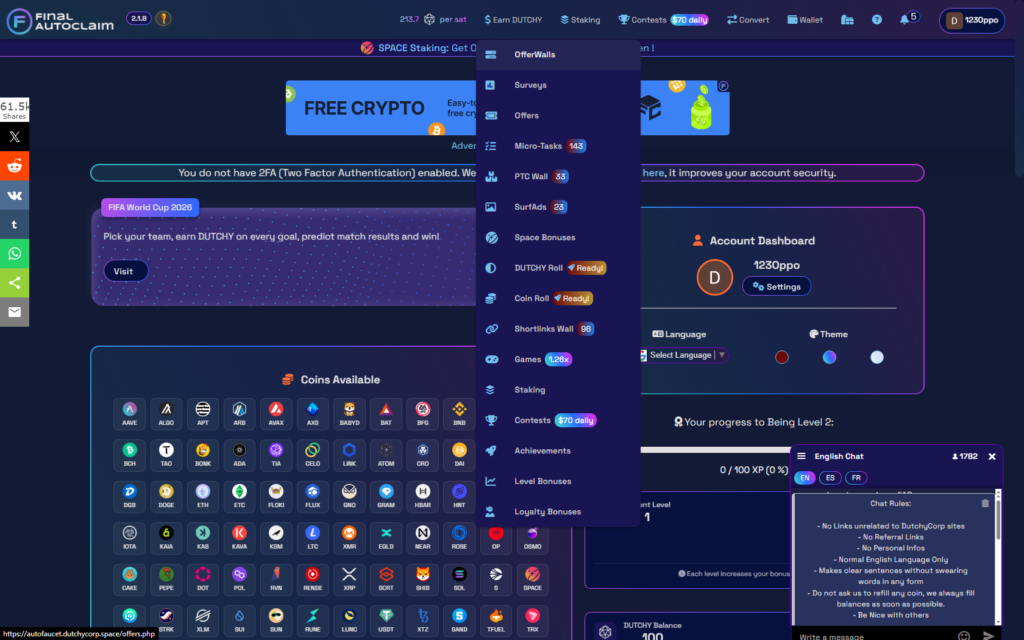
The dashboard supports withdrawals for around 73 to 78 different cryptocurrencies depending on the counting method used, spanning major coins like Bitcoin, Ethereum and Litecoin alongside long-tail tokens such as Algorand, Osmosis, Shiba Inu and Zcash. Users select which coins they want to claim and the autofaucet rotates payouts across their chosen list.
How the Final Autoclaim System Actually Works
The DUTCHY Token and Claim Intervals
Everything on the platform runs through DUTCHY, an internal token that has no value outside the site itself. Users earn DUTCHY through offerwalls, surveys, shortlinks, PTC (paid-to-click) ads and a free dice roll available roughly every 30 minutes. That DUTCHY balance is then spent to power the autofaucet, which claims a chosen cryptocurrency automatically at a set interval.
Users can choose intervals such as 1, 5, 10 or 30 minutes. A 10-minute interval with a 5x multiplier, run in balance mode for an extra 10%, is the setup most frequently recommended in community guides, because it stretches a limited DUTCHY balance over more hours while still paying a meaningful amount per claim.
Weekend and Loyalty Boosts
The platform runs a recurring Friday-to-Sunday bonus that several users describe as adding roughly 20% extra to claims during that window. A separate daily login and roll streak adds a small percentage bonus for each consecutive day of activity, up to a stated cap of 50% after enough consecutive days. Combined, these mechanics reward users who log in daily rather than those who claim once and disappear.
Levels, Energy and Withdrawal Fees
Progress is tracked through XP and a level system that unlocks tangible benefits: larger auto-claim payouts, access to more offerwalls, and – according to third-party reviews of the platform – lower withdrawal fees at higher levels. New accounts start at Level 1 with the smallest claim sizes and the highest fees, which is a common source of frustration in early reviews from first-time users who expect faster payouts.
People also read: Chainstack Web3 Faucets: How They Actually Work
Ways to Earn DUTCHY Before Running the Autofaucet
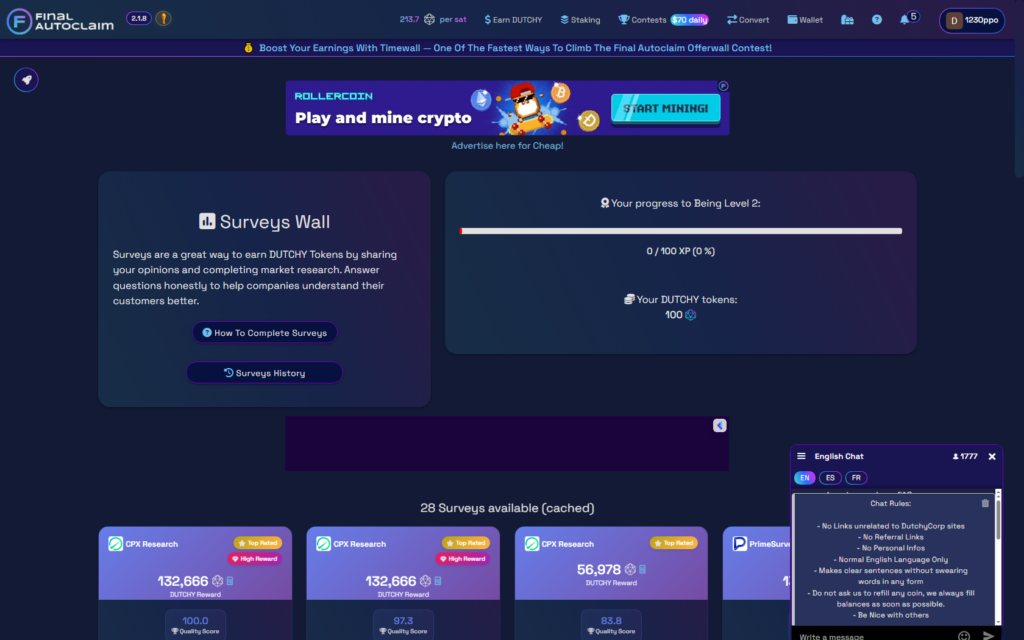
Because the autofaucet consumes DUTCHY to run, most of the actual work on the platform happens before the auto-claim ever starts. The main earning methods, based on the platform’s own dashboard and repeated community guides, are:
- Offerwalls – completing app installs, sign-ups or short tasks through third-party offerwall providers, generally described as the fastest way to build a large DUTCHY balance.
- Surveys – market-research surveys that typically pay more per completion than offerwalls, but come with frequent disqualification.
- Shortlinks – viewing a linked page for a short countdown; low individual payout but useful early on for reaching Level 10 and unlocking offerwalls.
- PTC and SurfAds – paid-to-click advertising units that pay a small, fixed DUTCHY amount per view.
- DUTCHY Roll and Coin Roll games – a free dice-style claim available roughly every 30 minutes, one paying DUTCHY and one paying a rotating community-voted coin.
- Browser mining – an optional CPU-based miner that reviewers consistently describe as producing negligible returns relative to electricity cost.
Realistic Autofaucet Earnings: What Reddit Users Actually Report
Community discussion around Dutchy Autofaucet and similar autofaucets is consistent on one point: this is a micro-earning activity, not an income source. On beermoney-focused subreddits, one long-time user described treating the ten-minute, 5x-multiplier, balance-mode setup as a weekend-only routine, running it Friday through Sunday to take advantage of the loyalty boost and reporting roughly £5-8 for the weekend.
Another user gave a similar figure closer to $10 for a weekend, explaining that daily survey completions during the week are used to stockpile enough DUTCHY to fund a full three-day run.
Other community members are more skeptical about the math. One commenter pushed back directly on the $10-50-a-week figures posted by autofaucet enthusiasts elsewhere in the thread, pointing out that a single roll on a comparable faucet paid a fraction of a cent, meaning even 24 rolls a day added up to only a couple of cents without offerwall or survey activity layered on top.
A separate long-time Dutchy user reported needing roughly three years of daily two-hour sessions to accumulate only about $4 worth of the platform’s internal token, underscoring how much the payout depends on active task completion rather than the autofaucet alone.
A more optimistic long-term user, self-reported at a high level on the platform, described earning about $3 a day per coin once leveled up significantly, which is a meaningfully different outcome from a brand-new Level 1 account. The gap between these reports is the single most important thing to understand about this autofaucet: outcomes scale heavily with account level, task-completion effort and region, not with the autofaucet timer alone.
Withdrawing From Dutchy Autofaucet
Withdrawals are processed either through FaucetPay, a micro-wallet service built specifically to aggregate small faucet payments, or through direct wallet transfers. FaucetPay is generally recommended for smaller balances because it has lower minimum thresholds; direct wallet withdrawals make more sense for coins with low network fees, such as Dogecoin, Tron or Litecoin, since Bitcoin and Ethereum network fees can consume a large share of a small payout.
Minimum withdrawal thresholds differ by coin and are shown directly on the wallet dashboard alongside a live balance-status bar for each currency. Higher account levels reduce the withdrawal fee percentage, which several reviewers flag as one of the platform’s more meaningful long-term incentives compared to competing faucets that charge a flat fee regardless of loyalty.
Is Dutchy Autofaucet Legit? What Independent Reviews Say
Dutchy Autofaucet is a functioning, long-running platform rather than an outright scam, but reviews are genuinely mixed rather than uniformly positive. On Trustpilot, the platform’s review profile shows roughly 99 reviews with an aggregate score that has fluctuated between roughly 2.2 and 2.9 out of 5 depending on when the score is pulled, split fairly evenly between five-star praise for smooth, on-time payments and one-star complaints about the platform’s handling of larger balances.
Positive reviewers consistently mention fast, low-fee withdrawals through FaucetPay and a large selection of claimable coins as the platform’s strongest points. Several long-term users describe using it for multiple years without major payment issues, treating the small payouts as a low-effort side activity rather than an income source.
Recurring Complaints
- Account restrictions – a number of reviewers report being told their trust score is too low to log in or withdraw after years of use, without a clear explanation.
- KYC requests – some users report being asked for identity verification once a balance grows, which several reviewers say felt disproportionate for a micro-earning platform.
- Withdrawal delays – a subset of recent reviews describe pending withdrawal requests that took days or longer to process, with some users reporting no response from support.
- Heavy advertising – the interface carries a high density of banner ads, pop-ups and chat-window promotions, which multiple reviewers say slows the site down and makes navigation frustrating.
- Shortlink quality – the shortlinks feature, required to reach higher levels quickly, is frequently singled out as the least pleasant part of the platform, with some reviewers linking it to redirects toward unrelated advertising.
It is worth separating Dutchy Autofaucet clearly from other, unrelated autofaucet-named sites that circulate in the same communities. Several similarly named platforms and Telegram bots referencing BTC Claimer schemes have been reported by users as requiring a deposit or a set number of referrals before any withdrawal is approved – a pattern widely recognized as a red flag for a pyramid-style scheme rather than a genuine faucet. Dutchy Autofaucet’s core model does not require a deposit to participate, which is a meaningful structural difference from those schemes.
Autofaucet vs Web3 Faucet: Why the Terminology Gets Confused
The phrase web3 faucet is used loosely across the internet, and it is worth separating two genuinely different things that share the same name. In its original, technical sense, a web3 faucet is a tool built by a blockchain project to hand developers small amounts of a testnet token – for example, a Sepolia ETH faucet or a Solana devnet faucet – purely so they can pay gas fees while testing smart contracts. These tokens have no real-world monetary value and cannot be withdrawn to an exchange.
An autofaucet like Dutchy is a different category entirely: a GPT (get-paid-to) rewards platform that pays real, withdrawable mainnet cryptocurrency in exchange for viewing ads, completing offers and waiting out claim timers. It has more in common with survey and cashback sites than with a developer testing tool, even though both are colloquially called a web3 faucet in casual conversation because both distribute crypto for free. Understanding which type of faucet a link points to matters, because the two serve completely different purposes and carry different expectations around value and withdrawal.
You may also like: AltQuick Web3 Faucet Review: How This Crypto Faucet Works in 2026
Dutchy Autofaucet: Pros and Cons
| Pros | Cons |
|---|---|
| Supports withdrawals for roughly 73-78 cryptocurrencies | Earnings are consistently described as very small per hour |
| No deposit required to participate | New accounts start at the lowest level with the highest fees |
| FaucetPay integration keeps withdrawal minimums low | Some reviewers report account bans or ‘low trust score’ lockouts |
| Level system and loyalty streaks reward long-term users | Heavy ad density and frequent pop-ups on the interface |
| Platform has operated since 2018, unusually long for this niche | Some reviewers report KYC requests once balances grow |
Tips for Using an Autofaucet Like This Safely
- Withdraw regularly rather than letting a large balance accumulate, since several reviews describe losing an unclaimed balance after a long period of inactivity.
- Use a dedicated wallet address for faucet withdrawals rather than a primary exchange or cold-storage address, to isolate any platform-side issues.
- Treat the weekend booster as the main event, stockpiling DUTCHY through the week via surveys or offerwalls and running the autofaucet during the Friday-to-Sunday bonus window.
- Avoid shortlinks you do not trust, since this is the feature most often linked to unwanted redirects in user reviews.
- Never pay to unlock a withdrawal. Any faucet, bot or claimer service that asks for a deposit, referral count or ‘key’ purchase before releasing funds is following a pattern associated with scams, not with how Dutchy Autofaucet’s own withdrawal system works.
Frequently Asked Questions
No. Final Autoclaim (Dutchy Autofaucet) operates at autofaucet.dutchycorp.space and is a separate platform from other similarly named autofaucet sites. Confusing the two is common because the names and site layouts are similar, but they are run independently with different track records.
Based on user-reported figures, expect roughly a few cents a day from a purely passive setup, and somewhere in the $5-10 range over an active weekend if you combine surveys, offerwalls and the boosted claim window. Figures well above that reported anywhere online should be treated with skepticism.
No. A legitimate autofaucet, including Dutchy Autofaucet, does not require a deposit to claim or withdraw. Any platform that asks for money, a ‘key’ purchase, or a set number of referrals before releasing an already-earned balance is showing a classic warning sign of a non-paying scheme.
A satoshi faucet is the Bitcoin-specific version of a crypto faucet, paying out amounts denominated in satoshis, the smallest divisible unit of Bitcoin. The term predates the multi-coin autofaucet model and traces back to Gavin Andresen’s original 2010 Bitcoin Faucet.
Not technically. A web3 faucet in the strict developer sense hands out worthless testnet tokens for smart-contract testing. An autofaucet like Dutchy pays real, withdrawable cryptocurrency in exchange for completing tasks, making it closer to a GPT rewards site than a developer tool, even though both terms get used interchangeably online.
