
Cryptocurrency ownership keeps climbing worldwide, and a large share of that growth is happening in exactly the markets where Web3 faucet sites like Vie Faucet find most of their users. According to the Chainalysis 2025 Global Crypto Adoption Index, India has held the number one spot in grassroots crypto adoption for three years running, with the wider Asia-Pacific region recording 69% year-over-year growth in on-chain activity. Crypto.com’s self-reported Market Sizing Report puts total global crypto owners at 741 million by the end of 2025, up 12.4% from the year before. Faucets, PTC sites, and offerwalls sit at the low-effort, low-reward end of that growth curve, and Vie Faucet is one of the more visible names in the category right now.
Key Takeaways
- Vie Faucet is a Web3 faucet that pays small amounts of crypto for faucet claims, PTC ads, offerwalls, shortlinks, and referrals, converting internal tokens into coins like BTC, LTC, and USDT through FaucetPay or CWallet.
- Trustpilot shows over 9,000 mostly five-star reviews, but a growing cluster of 2026 reviews report withdrawals stuck pending for weeks with no response from support.
- The site’s owner is hidden behind WHOIS privacy, and ScamAdviser flags its registrar as one that also hosts several low-trust websites.
- Like every Web3 faucet, earnings are tiny: veteran users say clearing $1 a day is considered a good result, not a realistic income.
- Treat every faucet claim as unpaid until it clears your wallet, and never download files a faucet promotes as a “free money” giveaway outside its own dashboard.
This review looks at exactly how Vie Faucet works, what real users report earning and losing, and how it stacks up against the trust and safety standards any Web3 faucet should be judged by before you sign up.
What Is a Web3 Faucet, and Where Does Vie Faucet Fit In?
A Web3 faucet is a website or app that dispenses very small amounts of cryptocurrency in exchange for simple actions: clicking a timer, watching an ad, solving a captcha, completing a survey, or clicking a shortened link. The name comes from early Bitcoin “faucets” that dripped out fractions of a coin to attract new users. Modern faucets have layered on more earning types, and Vie Faucet, launched in 2023, is a good example of how far the format has expanded beyond a simple claim button.
On Vie Faucet, every action earns an internal token balance rather than crypto directly. Those tokens are later converted to real coins such as BTC, LTC, TRX, SOL, DOGE, USDT, and TON at withdrawal, mainly through the third-party payment processor FaucetPay, or to meme coins like SHIB, PEPE, FLOKI, and BONK through CWallet.
How Vie Faucet Works: Every Earning Method Explained
Vie Faucet combines several earning mechanics into one dashboard. None of them pay much individually, which is standard for this category, but stacking them is how long-term users describe building up a withdrawable balance.
Faucet Claims
The core faucet lets users claim tokens roughly every 4 to 5 minutes, with observed rewards around 65 tokens per claim and a visible daily claim cap. Before a claim is approved, the site requires solving an anti-bot puzzle – clicking a set of images in a specific order – which is more friction than most competing faucets ask for.
PTC (Paid-to-Click) Ads
The PTC tab lists dozens of ads that pay after a fixed viewing window, typically 10 to 60 seconds, with cooldowns ranging from 12 hours to 168 hours per ad. Some of these ads are for external, unvetted sites making bold claims like guaranteed BTC giveaways, which the platform itself does not stand behind.
Offerwalls
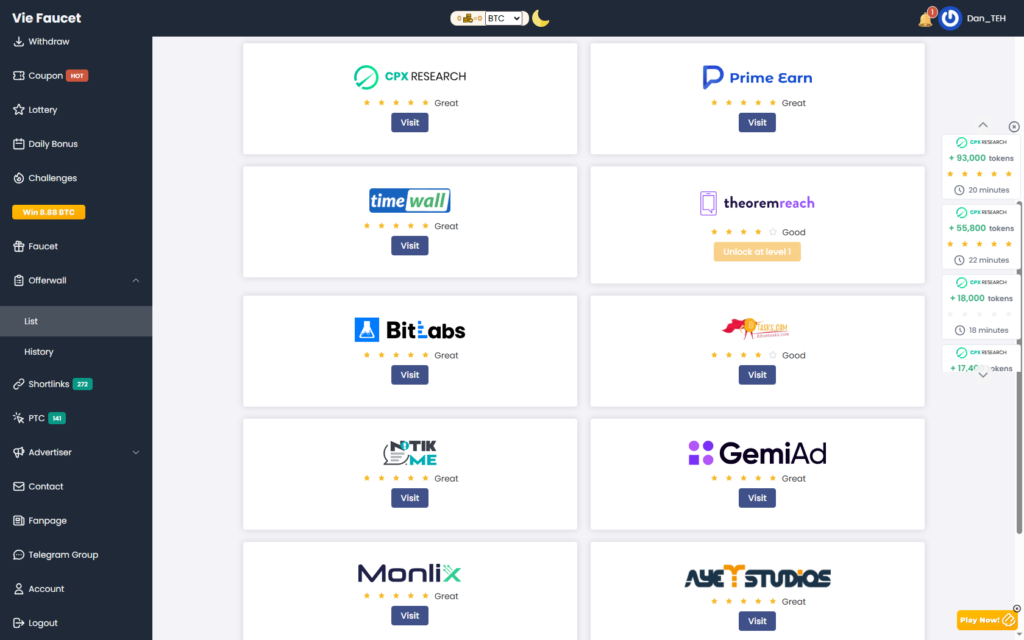
Vie Faucet integrates well-known offerwall providers including CPX Research, Timewall, BitLabs, Prime Earn, and AyeT Studios, which pay for completing surveys, mobile games, or app installs. Offerwall credits are not instant – the platform states pending offerwall rewards are credited within 12 hours, and some users report offerwall partners refusing payment with no explanation.
Shortlinks, Challenges, and Referrals
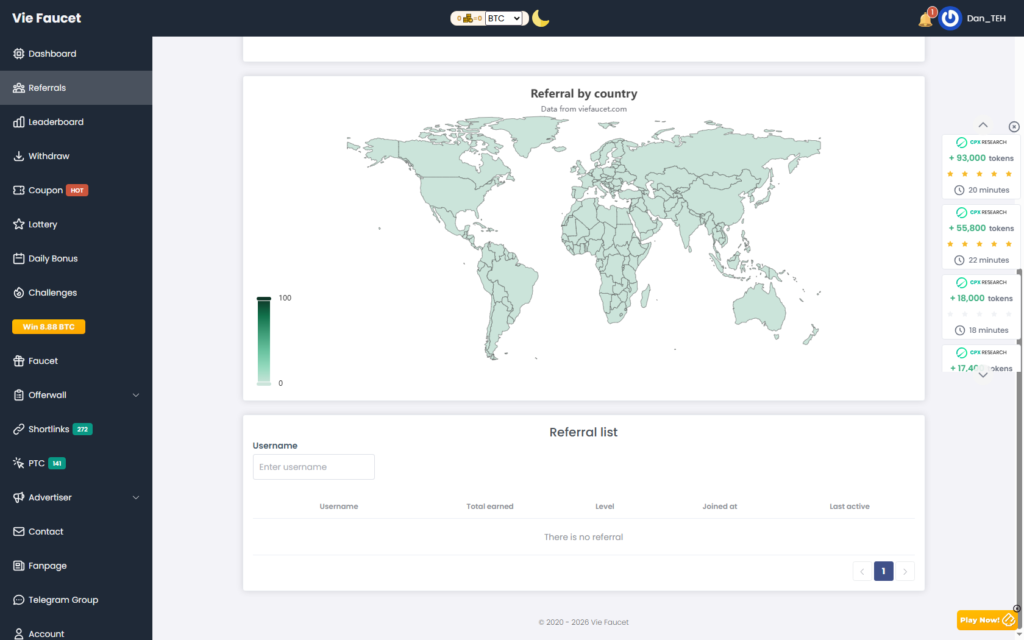
The shortlinks section listed 272 available links in one snapshot, each paying fractional tokens for a single ad view. A separate challenges tab rewards milestones like completing 50 faucet claims or inviting new users, and the referral program is advertised at 50% lifetime commission in third-party reviews, though the in-app dashboard itself displays a 10% commission rate – a discrepancy worth noting before relying on referral income.
People also read: Claim Coin Review: What This Web3 Faucet Actually Pays
Vie Faucet Payouts: What Users Actually Report Getting
Payout experiences on Vie Faucet are genuinely mixed, and that split shows up clearly across Trustpilot, Reddit, and independent review blogs. Many long-tenured users, some citing two or more years on the platform, describe fast, small, repeated withdrawals through FaucetPay with a minimum threshold cited around 10,000 satoshis, roughly $6. One frequently cited example on Trustpilot described a user who tracked $14.50 in total earnings over seven months, which lines up with how faucets are typically described: a slow trickle, not an income stream.
Against that, a distinct cluster of 2026 reviews describes withdrawals stuck in pending status for a month or longer, with support tickets and Telegram messages going unanswered. A handful of reviewers reported that direct-withdrawal balances in coins like DOGE, LTC, and BNB were removed from their transaction history without being paid. It is worth noting that the large majority of positive reviews on the platform’s Trustpilot page are extremely short, generic, and posted in clusters (“I love viefaucet,” “best faucet ever”), a pattern that review-integrity researchers commonly flag as consistent with incentivized or low-effort review campaigns rather than necessarily proving anything is wrong.
The Case for Vie Faucet: Real Advantages
- No KYC is required to start earning or to withdraw, which lowers the barrier for casual users.
- Withdrawals route through FaucetPay, an established micro-payment processor used across many faucets, rather than an unknown in-house wallet.
- The platform has no gambling mechanics of its own – no dice games, lottery-style betting, or wagering – unlike some faucet competitors.
- Multiple earning types (faucet, PTC, offerwall, shortlinks) let users stack small rewards instead of relying on one mechanic.
- The site has been operating since 2023 and, per ScamAdviser, holds a valid SSL certificate and reasonable traffic volume, both baseline signs of an active, maintained service.
The Case Against Vie Faucet: Complaints and Red Flags
- The domain owner is hidden through a WHOIS privacy service, which ScamAdviser notes reduces transparency about who actually runs the platform.
- ScamAdviser identifies the registrar as one that also hosts several low-scoring, spammer-linked sites, which does not confirm wrongdoing but does add uncertainty.
- Multiple 2026 reports describe withdrawals pending for a month or more with no functional support response across help desk and Telegram channels.
- The platform’s own PTC tab surfaces unvetted third-party offers making guaranteed-return claims, the exact language regulators warn against.
- The site displays its own on-platform warning that it “does not have any give away event” and to avoid downloading files promising free money – an indication that scammers have impersonated the brand to target its users.
Is Vie Faucet Legit? Weighing the Trust Signals
There is no single answer, and any honest review of a Web3 faucet has to hold two things at once. On one side, Vie Faucet clearly does process real payouts for a meaningful share of its user base, has operated for multiple years, and uses a recognized payment processor rather than an in-house wallet with no track record. On the other side, hidden ownership, a registrar associated with lower-trust sites, a wave of specific 2026 non-payment complaints, and a review profile dominated by short, generic five-star posts are all signals that deserve weight, not dismissal.
The most useful framing comes from the FTC’s guidance on cryptocurrency scams, which flags promises of guaranteed returns, pressure to act quickly, and vague or unverifiable operators as the core warning signs across the crypto space generally. Vie Faucet does not fit the profile of an outright advance-fee scam – it does not ask users to send funds in first – but the ownership opacity and the specific payout complaints mean it should be treated with the same caution the CFTC’s investor alerts recommend for any platform where the underlying operator cannot be verified: withdraw earnings often and in small amounts, and never treat a rising in-app balance as money you actually have until it lands in your own wallet.
Vie Faucet vs Other Web3 Faucets
Vie Faucet is one of many sites competing in the same space. The table below compares its core numbers against two frequently mentioned alternatives, AdBTC.top and FreeBitco.in, based on the same publicly available site information.
| Platform | Launched | Min. Withdrawal | Referral Rate | Gambling Features | KYC Required |
|---|---|---|---|---|---|
| Vie Faucet | 2023 | ~10,000 sats (~$6) | 10-50% (disputed) | None | No |
| AdBTC.top | 2019 | ~200 sats (FaucetPay) | 50% | None | No |
| FreeBitco.in | 2013 | ~30,000 sats | 50% | Lottery, interest account | No |
None of these platforms are audited by an independent financial regulator, so this table reflects self-reported and community-reported figures rather than verified guarantees from any of the three.
You may also like: FaucetGamers Review 2026: Is This Web3 Faucet Legit?
How to Use Any Web3 Faucet More Safely
- Withdraw small amounts frequently instead of letting a large balance sit unpaid on the platform.
- Use a disposable email address and a separate, low-value wallet for faucet activity rather than your primary crypto wallet.
- Never download an executable file, app, or “claim tool” that a faucet advertises as a way to unlock free money – legitimate faucets pay through their own dashboard, not a downloaded program.
- Search for recent payout proof and recent complaints before trusting a new site, since old positive reports do not confirm current reliability.
- Treat any in-app token balance as unrealized until it clears your wallet, and be skeptical of referral commission numbers that differ between the app and outside marketing.
These practices align with the FTC’s general guidance on cryptocurrency scams: scrutinize guaranteed-sounding claims, verify who actually operates a platform before committing time or funds, and remember that crypto payments carry none of the chargeback protections a credit card offers if something goes wrong. Applied to a Web3 faucet like Vie Faucet, that means treating it as a low-stakes side activity rather than a trusted income source.
Frequently Asked Questions
Vie Faucet shows both real long-term payouts and a recent cluster of unresolved withdrawal complaints, plus hidden domain ownership. It is not confirmed as a scam, but it carries enough unresolved red flags that it should only be used with small, frequently withdrawn amounts.
Reported earnings are small. One reviewer tracked about $14.50 across seven months of regular use. Faucets, PTC sites, and offerwalls are not designed to replace income; a good result is generally described as a few dollars a month.
Third-party reviews cite a minimum around 10,000 satoshis, roughly $6, processed mainly through FaucetPay, with CWallet available for meme coins like SHIB and PEPE.
No. Vie Faucet does not require identity verification to earn or withdraw, which is typical of faucet-style platforms but also means less accountability if a dispute arises.
A Web3 faucet pays small crypto rewards for simple tasks like ads, surveys, or timed claims, while an exchange is a regulated or semi-regulated platform for buying, selling, and holding larger amounts of cryptocurrency. Faucets carry far less oversight and far smaller sums.
