
A Web3 faucet is a website or app that pays out very small amounts of cryptocurrency, usually in exchange for solving a captcha, viewing an ad, or completing a short task. OnlyFaucet is one of the more actively promoted faucets in this category, offering instant claims across roughly 20 coins, a referral program, daily challenges, and a coupon system, all settled through the FaucetPay micro-wallet.
Key Takeaways
- OnlyFaucet is a Web3 faucet paying out roughly 20 different coins in tiny amounts through FaucetPay, with claims as small as 0.00000227 LTC per click.
- Independent trust scanners give this platform medium-to-low trust scores (35/100 to 60.8/100), citing hidden ownership data and a domain registered in 2023.
- Trustpilot reviews are mixed, with recurring complaints about shrinking claim limits, unresolved FaucetPay disputes, and unprofessional admin conduct toward at least one reviewer.
- The site’s own in-app warning admits its ad network can serve gambling and Ponzi-scheme advertisements, which is a rare and notable admission for a faucet to make.
- Like most Web3 faucets, this network’s realistic earning ceiling is a few cents to a few dollars per month, not a meaningful income source.
The faucet model exists inside a much larger crypto economy. Global cryptocurrency ownership reached 741 million people in 2025, a 12.4% increase from 2024, according to Crypto.com’s self-reported Market Sizing Report, and India ranked first worldwide for grassroots crypto adoption in the Chainalysis 2025 Global Crypto Adoption Index. Faucets like OnlyFaucet are often a new user’s first contact with that ecosystem, which is exactly why it matters whether the platform behind the free coins is trustworthy. This review works through how OnlyFaucet functions, what third-party scanners and real users say about it, and how it compares to the broader reality of Web3 faucets.
You may also like: Vie Faucet Review: Is This Web3 Faucet Worth Using in 2026?
What Is a Web3 Faucet, and Where Does OnlyFaucet Fit
The term Web3 faucet comes from the earliest Bitcoin faucets, which literally let value “drip” out a few satoshis at a time. Modern versions, including OnlyFaucet, still follow the same basic loop: the user proves they are human, clicks claim, and receives a fraction of a coin that is usually worth less than a cent. The website makes money from the ad impressions and click-through traffic surrounding that claim button, not from the faucet itself.
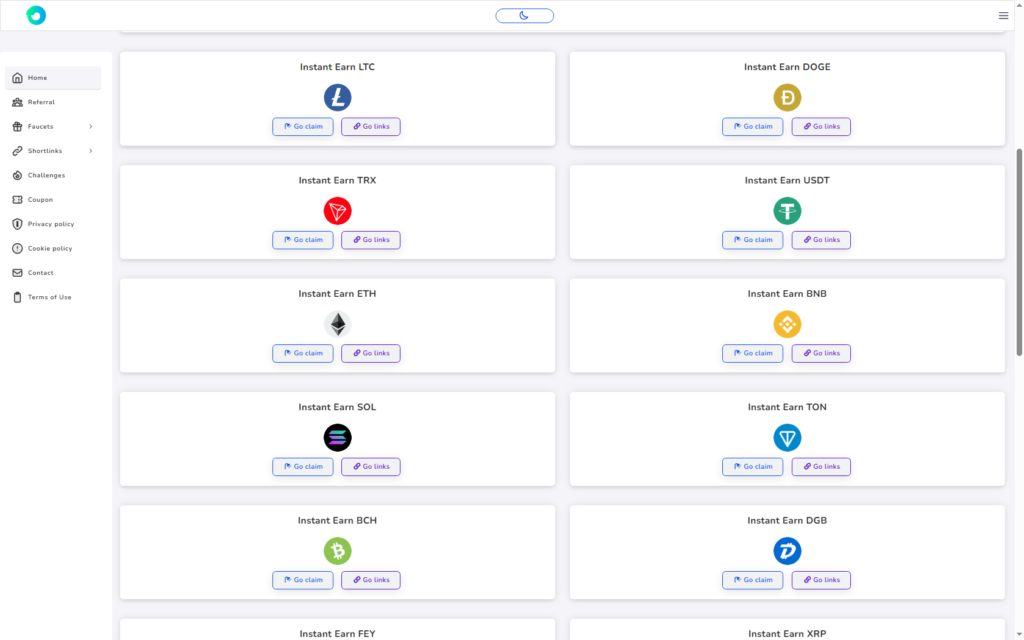
OnlyFaucet presents claim pages for coins including LTC, DOGE, TRX, USDT, ETH, BNB, SOL, TON, BCH, DGB, XRP, ADA, ZEC, XLM, USDC, XMR, PEPE, POL, and DASH, each on its own dedicated page under the site’s “Faucets” menu. Every coin has its own claim interval and reward size, and the LTC faucet, for example, pays 0.00000227 LTC every 10 seconds, a rate that translates to a fraction of a cent per hour of continuous claiming.
How OnlyFaucet Works
Claiming and Payout Mechanics
Each claim page requires the user to tick an “I am human” verification box, which sits directly beside display ads on the same page. The homepage also runs a live counter claiming figures such as 133,000+ happy users and 98,000+ payouts made today, though these are unverified, site-reported numbers rather than independently audited statistics, and they should be read as marketing rather than fact.
FaucetPay Integration
The network does not pay users directly. Claims are routed through FaucetPay, a micro-wallet launched in 2018 that exists specifically to aggregate tiny faucet payouts before a user withdraws them in one larger, fee-justified transaction. FaucetPay’s own materials describe support for 600-plus faucets and 300 million-plus rewards paid across its network, though these figures are self-reported by FaucetPay and not independently verified. This aggregation model is the reason nearly every small faucet, OnlyFaucet included, can afford to pay out amounts smaller than a single blockchain transaction fee.
Is OnlyFaucet Legit? What the Trust Scanners Found
Three independent website-trust services have scanned onlyfaucet.com, and none of them rate it as fully trustworthy. The results are summarized below.
| Scanner | Trust score | Key finding |
|---|---|---|
| Gridinsoft | 35/100 (“Suspicious Website”) | 1 blacklist/provider warning, 2.5-star average from 12 reviews, domain age of 2.9 years |
| ScamAdviser-style review | Flagged, no numeric score given | No visible license or regulation, WHOIS ownership hidden, domain hosted on an IP shared with previously flagged sites |
| Scam Detector | 60.8/100 (medium trust) | Low phishing (19/100) and malware (23/100) sub-scores, but oddly categorized under an unrelated industry tag |
None of these scores individually prove the platform is fraudulent, and low scores are common across the entire faucet category because faucets rely on anonymous ad networks and rarely publish corporate ownership details. But the combination of a recently registered domain (2023), hidden WHOIS data, and shared hosting infrastructure with sites already flagged elsewhere is exactly the pattern that trust-scanning services are designed to catch, and it means users should treat any balance held on the platform as disposable, not as savings.
What Actual Users Say About OnlyFaucet
Trustpilot reviews of onlyfaucet.com are mixed, and several recurring themes show up across multiple independent reviewers rather than a single complaint. Some users describe OnlyFaucet as “the best litecoin faucet” with fast support responses, while others say the payouts are too small to be worth the time, a common verdict across the faucet category generally.
More serious complaints describe a shift from instant FaucetPay withdrawal to an internal-coin system with unclear conversion rates, a drop to a 100-claims-per-day cap, and the invalidation of previously earned referral connections after a platform change, which several reviewers said happened without warning.
One reviewer also reported that tokens sent to their FaucetPay account never reflected in their balance, and that after they left a negative review, the site’s admin responded with hostile and unprofessional messages rather than resolving the dispute. That kind of admin conduct toward a paying, complaining user is a meaningful red flag independent of the trust-scanner data, since it suggests customer support is not a reliable path to resolving a payout problem.
OnlyFaucet Features Beyond the Basic Faucet
OnlyFaucet bundles several secondary earning mechanics around its core claim pages, all accessible from the same sidebar menu.
| Feature | What it does |
|---|---|
| Faucets | Per-coin claim pages, one for each of roughly 20 supported cryptocurrencies |
| Shortlinks | Ad-supported link-shortening tasks that pay a small reward per completed view |
| Challenges | A daily quota (for example, 60 faucet claims plus 3 shortlinks) that unlocks a bonus reward, resetting at 24:00 UTC |
| Coupon | A currency-selection tool for redeeming promotional codes into a chosen coin balance |
| Referral program | A 30% commission on referred users’ activity, tracked through a personal referral link |
The Ad Safety Warning: A Red Flag Worth Reading
OnlyFaucet displays a recurring in-app modal, reappearing roughly every 24 hours, titled “Important Ad Safety Warning.” The notice states plainly that the site’s own ad networks “may occasionally display gambling and Ponzi scheme advertisements” and instructs users never to click on or invest through those ads.
It is unusual for a faucet to formally warn its own users about its own advertising partners, and while the disclosure is honest, it also confirms that the ad inventory surrounding every claim button is not fully controlled or vetted, which matters because investment fraud remains the single largest category of financial loss reported by internet-crime victims, according to the FBI’s 2025 Internet Crime Report, which recorded 181,565 cryptocurrency-related complaints and more than $11.3 billion in reported crypto-scam losses in 2025 alone.
Referral Program and Daily Challenges
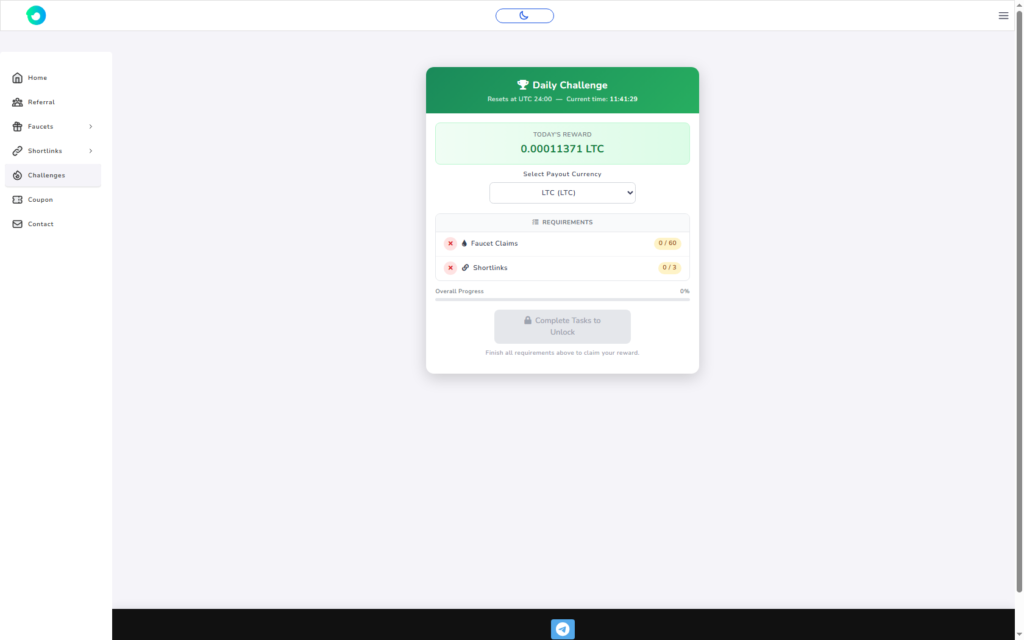
The referral system pays 30% commission on activity generated by referred users, tracked via a link in the format onlyfaucet.com/?r=[ID]. The Daily Challenge feature requires completing a set number of faucet claims and shortlinks before unlocking a bonus payout in a currency the user selects, which is a design pattern intended to increase time-on-site and ad impressions rather than to meaningfully boost a user’s earnings.
Why Web3 Faucets Rarely Pay What They Promise
Community discussion around faucet economics, including threads on Bitcointalk, is consistent on one point: display-ad income for faucet operators has collapsed over the past several years. Established ad networks used by faucet sites report payouts as low as $2.50 per month per publisher across thousands of participants, which is why so many faucets have shifted from ad revenue toward affiliate and referral commissions as their main income source, with users effectively becoming the product being marketed to each other. This is the same commercial logic behind OnlyFaucet’s own 30% referral program, and it helps explain why claim rewards across the entire Web3 faucets category have trended smaller over time rather than larger, even as the coins themselves have appreciated.
How to Use OnlyFaucet and Web3 Faucets Safely
- Treat any balance as disposable, not savings, given the site’s below-average trust scores.
- Never click on gambling, casino, or investment ads that appear next to the claim button, even though the faucet claim itself is free.
- Withdraw through FaucetPay once you hit the minimum threshold, rather than letting a balance accumulate on-site.
- Read recent reviews before assuming a payout dispute will be resolved quickly, since support quality is one of the most inconsistent parts of this category.
- Treat any daily claim total in the cents range as the realistic outcome, not the exception.
People also read: Aruble Faucet Review: Is This Web3 Faucet Legit in 2026?
Is OnlyFaucet Worth It in 2026
The platform functions as advertised at a technical level: it pays out through FaucetPay, supports a wide coin list, and layers in shortlinks, challenges, and a referral system that are common across the Web3 faucet category. What it does not offer is a strong trust profile. Third-party scanners rate it between suspicious and medium-risk, user reviews describe shrinking claim caps and at least one poorly handled dispute, and the site’s own ad-safety warning admits its advertising partners include gambling and Ponzi-scheme promotions.
For a beginner who wants a low-stakes, no-deposit introduction to how crypto claims and micro-wallets work, OnlyFaucet is usable if expectations stay realistic. For anyone hoping faucets will generate meaningful income, the math, the reviews, and the broader Web3 faucets landscape all point the same direction: they will not.
Frequently Asked Questions
OnlyFaucet is not a proven scam, but it is not fully trusted either. Independent scanners give it scores between 35/100 and 60.8/100, citing hidden ownership data and a young domain, and some users report unresolved payout disputes. Treat it as a low-trust, low-stakes faucet rather than a verified platform.
Based on the posted claim rates, such as 0.00000227 LTC every 10 seconds, continuous manual claiming across multiple coins realistically produces a few cents to a few dollars a month, not a meaningful income.
No. Claiming from OnlyFaucet does not require a deposit, and the site itself states it will never ask users to deposit or invest money. A FaucetPay account is required to receive payouts.
Faucets fund their payouts through ad revenue, and ad networks serving crypto-focused traffic frequently include gambling and high-yield investment advertisers. OnlyFaucet explicitly warns users about this in its own in-app safety notice.
FaucetPay is a widely used micro-wallet across the faucet industry and offers two-factor authentication, but it is not designed for storing large balances. It should be treated as a pass-through wallet, with funds withdrawn to a personal wallet once a meaningful balance accumulates.
