
Every few months, a new cryptocurrency project appears with a polished website, a detailed whitepaper, and promises of revolutionary utility. Most of them disappear just as fast. Some fail quietly. Others leave thousands of token holders with nothing. Square Token (SQUA) is one of the more instructive examples of a failed crypto project – not because it was unusually sophisticated, but because it followed a pattern that repeats itself constantly in the crypto space.
Key Takeaways
- Square Token (SQUA) was a BEP20 token launched by GoFintech Group – a direct rebrand of the collapsed GoArbit Ponzi scheme.
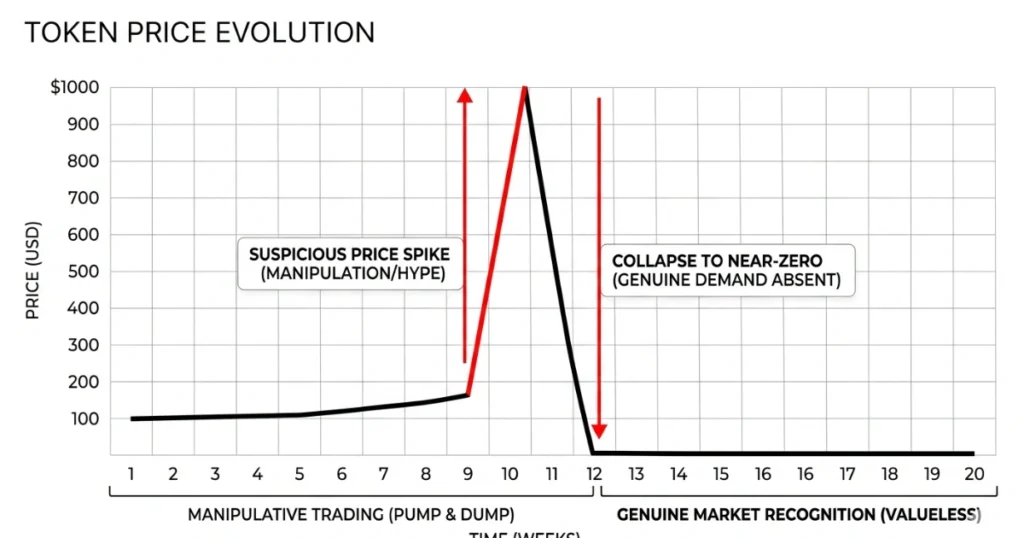
- Despite reaching a nominal all-time high of $18,071 per token, the price was driven by manipulated volume and thin liquidity, not real demand.
- The deflationary burn mechanism marketed as SQUA’s core value driver was never meaningfully activated – only 3 tokens were ever burned.
- All 66,830 SQUA holders are left with tokens of no practical value after the official website went offline on January 31, 2025.
- The project followed a classic rebrand-and-relaunch pattern that repeats constantly in crypto – recognizing it early is the only real protection.
Understanding what happened with SQUA means you will recognize the same warning signs the next time they appear under a different name. This article breaks down the broader pattern of why crypto projects collapse, then uses Square Token as a concrete case study – from its origins inside a documented Ponzi scheme to the on-chain data that tells the real story.
Why Do Crypto Projects Fail?
Before diving into Square Token specifically, it helps to understand the landscape. The vast majority of cryptocurrency projects fail within their first two years. The reasons are rarely mysterious, and they tend to cluster around the same structural weaknesses.
No real product behind the token
Many projects are built around a token that is supposed to power an ecosystem – but the ecosystem itself never materializes. The token exists before the utility does, and the utility never catches up. Investors buy into a promise, not a product.
Dependency on continuous inflow
When a project’s survival depends on attracting new investors rather than generating real revenue, it is structurally fragile. The moment growth slows, the entire model collapses. This is the defining characteristic of a Ponzi structure, but it also describes many projects that are not deliberately fraudulent.
Regulatory exposure and no licensing
Projects that operate without licensing in jurisdictions with active financial regulators are one fraud alert away from losing their entire audience. The combination of no regulatory standing and cross-border operations makes accountability almost impossible.
Rebranding as a recovery strategy
Some projects do not fail – they simply restart under a new name, with the same structure and the same people, targeting a new audience that has not yet heard the story. This pattern is more common than most participants realize, and Square Token is a direct example of it.
What Was Square Token?
Square Token (SQUA) was a BEP20 utility token built on BNB Smart Chain, developed by GoFintech Group. On paper, it was a deflationary payment token: every time SQUA was used to pay fees within the GoFintech ecosystem, a portion of tokens would be automatically burned, theoretically creating increasing scarcity over time.
The token launched via a Token Generation Event (TGE) on January 10, 2022, with a maximum supply hard-capped at 5,000,000 SQUA. It became tradable on PancakeSwap and was listed on CoinMarketCap, CoinGecko, and Yahoo Finance.
| Parameter | Value |
| Blockchain | BNB Smart Chain (BSC) |
| Token Standard | BEP20 |
| Max Supply | 5,000,000 SQUA |
| Token Holders | 66,830 wallets |
| All-Time High | $18,071 (January 18, 2022) |
| All-Time Low | $0.000000146 |
| Security Audit | None |
| Website Offline | January 31, 2025 |
| Buy/Sell Tax | 0% / 0% |
The Real Story Behind GoFintech Group
To understand Square Token, you need to understand where it came from. GoFintech Group was not a new company building a new product. It was a direct rebrand of GoArbit – a cryptocurrency investment platform that had operated since roughly 2020, promising daily returns of 0.5% to 1.5% through claimed arbitrage and mining operations. No verifiable documentation of any such operations was ever produced.
GoArbit was structurally a Ponzi scheme: early participants were paid using funds from new investors. When new investment inflows slowed in late 2021, the platform began blocking withdrawals. Around the same time, GoArbit’s founder relocated to Dubai – a jurisdiction with limited extradition agreements – and the company’s social media presence went silent.
GoFintech Group was registered in November 2021, almost immediately after GoArbit’s collapse. Square Token launched two months later. Argentina’s securities regulator (CNV) issued a formal fraud alert against GoArbit and its associated entities. The project had no licensing in any major financial jurisdiction.
The pattern here is textbook: collapse, rebrand, relaunch, find a new audience. The project’s primary audience was concentrated in Latin America – Colombia (30%), Venezuela (19%), and Peru (12%) based on peak traffic data. At its height in November 2022, the GoFintech ecosystem attracted over 4.5 million monthly website visits. By early 2023, that traffic had collapsed.
What the On-Chain Data Actually Shows
One of the underappreciated aspects of blockchain technology is that it preserves evidence. Even after a project dies, the smart contract remains permanently on-chain, and the data tells the real story.
The burn mechanism was never used
SQUA’s deflationary model – where tokens would be burned with every transaction – was the central value proposition marketed to investors. According to BscScan data, only approximately 3 tokens were ever burned out of a 5,000,000 supply. The mechanism existed in the contract but was never meaningfully activated.
Supply was concentrated from day one
Nearly the entire 5,000,000 token supply was minted directly to the owner’s wallet at deployment. This is a significant red flag that was visible on-chain from the moment the contract launched. It means the team controlled virtually all tokens and could exert enormous price pressure at will.
The all-time high was not real
A nominal price of $18,071 per SQUA sounds extraordinary. In practice, it was the result of extremely thin liquidity and likely manipulated trading volume on PancakeSwap. A residual AMM liquidity pool of approximately $497,000 still exists, but this is automated market maker remnant – not active project support. Any significant buy or sell order would move the price dramatically.
Warning Signs That Were Visible Before the Collapse
In hindsight, the red flags were present from the beginning. Identifying them earlier is the practical value of studying a case like this.
The parent company had a documented fraud history
GoArbit’s collapse and Ponzi structure were publicly documented by regulatory bodies and independent investigators before SQUA even launched. Anyone researching GoFintech Group would have found this within minutes. The new brand was designed to obscure a known bad actor, not to represent a genuinely new venture.
Supply control was total
When a team mints the entire token supply to a single wallet at launch, they can sell into any price rally at zero cost. This is not necessarily fraud on its own, but combined with the GoArbit history, it should have been immediately disqualifying.
No security audit
For a token marketed to tens of thousands of community members across Latin America, the complete absence of any smart contract audit was a significant warning. Legitimate projects seeking community trust invest in independent audits. SQUA never did.
The all-time high made no logical sense
A price of $18,071 for a token with thin liquidity and no verified utility is not a success story – it is a manipulation signal. Prices that reach extreme values on low volume with no corresponding product milestones almost always reflect artificial activity.
Founder relocated before the collapse
The Dubai relocation coinciding precisely with GoArbit’s withdrawal failures is not a coincidence. It is a pattern that appears repeatedly in crypto fraud cases – moving to a jurisdiction that makes accountability difficult before the collapse becomes public.
What to Take Away From This
Square Token is not an outlier. It is a representative example of how a significant portion of the crypto token economy actually operates. The branding changes, the blockchains change, the token names change – but the underlying structure is the same.
The questions worth asking before participating in any token project are straightforward: Does the product exist yet, or is the token being sold before anything is built? Who is accountable, and can they actually be held accountable? What does the on-chain data show about supply distribution? Has this team or these individuals operated under a different name before?
Most failed crypto projects fail predictably. Square Token was no exception – and the next one probably will not be either. The difference between losing money and not losing money is usually not technical knowledge. It is knowing what questions to ask before committing any funds.
FAQ
Square Token was a BEP20 utility token on BNB Smart Chain developed by GoFintech Group, which was itself a rebrand of the collapsed GoArbit investment platform. It launched in January 2022 and went offline in January 2025.
SQUA failed for multiple compounding reasons: its parent company had a documented Ponzi history, the deflationary burn mechanism it marketed was never activated, the entire token supply was controlled by the team, and the project never developed a real product or ecosystem.
Argentina’s securities regulator (CNV) issued a formal fraud alert against GoArbit and associated entities. GoArbit’s predecessor operation was identified by multiple independent investigators as a Ponzi structure. Whether SQUA itself constitutes fraud in a legal sense depends on jurisdiction – but the operational pattern is well documented.
66,830 wallets still hold SQUA tokens as of 2025. The tokens have no practical utility, no functioning ecosystem, and no active trading support. Holders are left with assets of no recoverable value.
Search the founders’ names and any associated company names before they appeared with the current project. Check whether the new brand was registered shortly after a previous project collapsed. Look for documented regulatory alerts or Ponzi investigations tied to the same individuals. On-chain data showing concentrated supply in a single wallet at launch is also a strong early warning signal.

Stefan is enthusiastic about the new technologies, including blockchain. He got to know cryptocurrencies more than 15 years ago, when he mined his first cryptocurrencies on graphics cards. His latest goal is to spread new ways to use cryptocurrencies in the real world.