
In the first four months of 2026, top crypto projects paid a combined $20.4 million in bug bounties. In this period, over 214 qualifying disclosures were discovered, and 31 critical vulnerabilities listed. Crypto bounties are a paid security research rather than a task you finish over a coffee break. One of the most used platforms in crypto bounty campaigns is HackenProof, a network where projects pay ethical hackers to find flaws before attackers do.
Key Takeaways
- HackenProof is a Web3-focused bug bounty platform operated by security firm Hacken, concentrating on exchanges, wallets, and smart contracts.
- The platform has introduced paid submissions, charging researchers to file a report as a spam filter, and the policy split the security community sharply.
- HackenProof deducts a triage fee of 5% to 10% of the reward on many contest programs, taken from the researcher side.
- Crypto thefts reached $3.4 billion in 2025, with a single Bybit breach accounting for $1.5 billion, which is the economics that funds bounty pools.
- This is not a beginner earning method: valid findings require working Solidity, Rust, or web application security skills plus a functioning proof of concept.
This review explains how the platform operates, unpacks the paid submission controversy, compares HackenProof against Immunefi and Sherlock, and closes with an honest verdict on who should realistically attempt it.
What the HackenProof Bug Bounty Model Actually Solves
A bug bounty is an offer where participants report a genuine security flaw through the proper channel and the project pays rather than letting a criminal find it first. Why are bounties important? As per Chainalysis data, crypto thefts exceeded $3.4 billion during 2025, with North Korean operations alone responsible for $2.02 billion and the February Bybit compromise accounting for roughly $1.5 billion on its own. When compared to such losses, a six-figure bounty pool is cheap insurance.
HackenProof positions itself specifically inside the Web3 segment of that market. Where general platforms cover corporate web applications, HackenProof programs skew heavily toward centralized exchanges, wallets, bridges, and on-chain protocols.
The scale of every bug bounty program is essentially reliant on the individual platform. For instance, KuCoin launched a $1 million bounty program on the platform, with critical findings tiered between $50,000 and the full seven-figure ceiling.
The important caveat is that a funded bounty program is a security signal, not a security guarantee. Plenty of projects with clean paperwork have failed anyway, and a passing audit score is not the same as a safe protocol. Bounties reduce risk at the margin. They do not eliminate it.
How the HackenProof Platform Works for Researchers
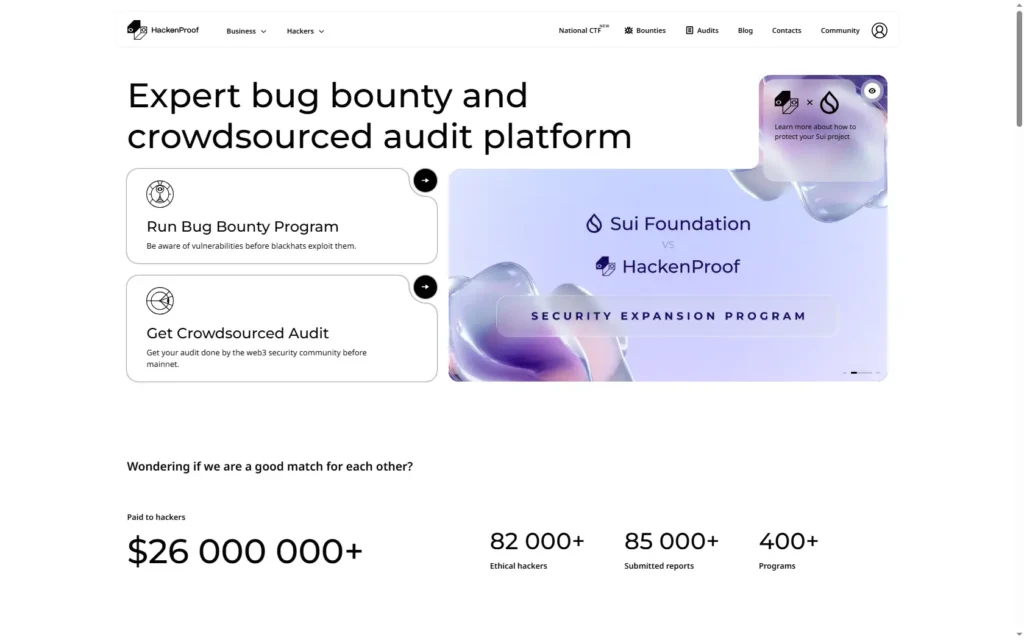
Programs come in two forms. Public programs run continuously and are open to any registered researcher. Private programs are invite-only, aimed at pre-release builds or sensitive infrastructure, and access depends on your reputation score on the platform. HackenProof states it works with over 400 projects and more than 82,000 verified researchers, though these are self-reported platform figures with no published methodology behind them.
Moreover, the rules of submission within hackenproof are way strict when likened to many other web2 platforms. In fact, program terms typically require a fully working proof of concept attached at the moment of submission, plus a suggested fix or mitigation. If a participant issues reports with missing a valid proof of concept, they get a reputation point penalty, which directly damages access to the better private programs later.
And, can you contact the clientele outside HackenProof? NO! Communication must stay on the platform; contacting a project team through Telegram or social channels can get you disqualified.
One detail worth knowing before you calculate expected earnings: on many contest-format programs, HackenProof is entitled to between 5% and 10% of the reward as its triage and services fee. That comes out of the researcher payout, not the project budget. Therefore, the amount advertised by the pool will not reach the researcher in full.
DualDefense Contests and How the Pool Gets Split
HackenProof runs time-boxed audit contests alongside standing bounties, and the reward mathematics here catches people out. Generally, the reward math depends on the rules for the specific HackenProof programs. The audit-contest rules say rewards are distributed across valid issues using severity, uniqueness, and contribution quality, and that duplicate reports of the same issue are shared by a formula rather than paid as separate full findings.
If three unique vulnerabilities surface, each one is allocated a third of the pool. If three researchers all independently found the same issue, they split that third between them, leaving each with a ninth of the original pool.
Possible Formula: 1×(0.9(N−1))/N1 \times (0.9^{(N-1)}) / N1×(0.9(N−1))/N
The practical consequence is that obvious bugs are worth very little in a contest format, because more researchers are likely to find them. The money sits with findings nobody else spotted, which is precisely the work that requires deep familiarity with the codebase and a real time investment before you know whether it will pay anything.
The Paid Submission Debate Splitting the Security Community
In its own platform page, HackenProof confirmed that some programs use paid submissions that create a financial barrier to spam, alongside a reputation system and an automated triage assistant that screens machine-generated reports. The argument is AI makes it easy to generate convincing vulnerability reports at scale, and triage capacity is the bottleneck the whole model depends on. That model has a clear upside for platform operators: it raises the cost of high-volume AI-generated spam and helps preserve reviewer capacity for substantive reports.
As expected, the reaction among active bug hunters has been considerably less enthusiastic. Their central objection is not necessarily the fee itself, but where the financial risk falls. A researcher who spends days uncovering a legitimate critical vulnerability is now also required to pay to report it, while the project incurs no additional cost. The argument is that the organization demanding security research should be the one with the budget. However, shifting even a small financial burden to researchers changes the relationship.
The strongest point of criticism is what happens when the process breaks down. If a project quietly patches a reported flaw and subsequently declines to issue a bounty, the researcher loses both the reward and the submission fee. And, this is a serious pain point especially for people who have been through it. As such, the community proposes a refundable submission model where the fees are collected and held, but once the report passes the preliminary validation, they are refunded. Only in cases of genuine spam should the fee be non-refundable.
Similar approaches already exist elsewhere. Sherlock operates a stake-to-submit system requiring $250 USDC per report, refunded when the finding is valid, which puts money at risk without penalising competent researchers. Immunefi likewise carries a paid submissions category on parts of its platform. The industry direction is fairly clear; the disagreement is about whether the fee should ever be non-refundable. These examples are not showing the industry standard; instead, it proves that bug bounty platforms are experimenting with different economic models to reduce spam while preserving incentives for high-quality research.
A more structural suggestion that surfaced repeatedly deserves mention: restrict scope to genuinely critical classes only, such as remote code execution, account takeover, or fund extraction, and require a planted flag as proof of exploitation. Under that design the acceptance criteria are deterministic, low-effort submissions fail automatically, and no researcher has to gamble a fee on a triager’s judgement. No major Web3 platform has adopted it yet.
People also read: Crypto Microtasks: Types, Best Platforms, and Realistic Earnings in 2026
How to Read a Program Page Before You Spend a Week on It
One of the most common warnings from experienced hunters is to avoid being persuaded by the mentioned bounty amounts and instead investigate the project’s track record. HackenProof’s program listings displays metrics like number of reports and total rewards paid. If a program is showing hundreds of submissions against $0 in rewards, investigate before you write a single line of code.
That signal however, does not place the project in the automatic red flag zone. A high-report, zero-payout program might mean the project rejects valid findings, which is the pessimistic reading. It might equally mean the program is drowning in automated low-quality submissions and has correctly rejected all of them. Both patterns produce identical numbers on the listing page.
Practical checks worth running before committing time:
- Ratio, not raw count: compare reports received against rewards paid, and treat a long-running program with zero payouts as a question to answer, not a coincidence.
- Last updated date: a program untouched for months usually means the security contact has moved on and your report will sit unread.
- Scope width: narrow scope with a high ceiling is generally healthier than sprawling scope with vague reward language.
- Project financial health: a protocol with a collapsing token and no revenue has no incentive to honour a large payout, and projects in decline fail their commitments in predictable ways.
One failure mode that program pages will never show you is the acknowledged but unrewarded finding: a report the project confirms is a real vulnerability, then declines to act on, then closes without further discussion. Researchers describe this as more demoralising than an outright rejection, because the finding was validated and simply never converted into either a fix or a payment.
HackenProof Compared to Immunefi, Sherlock, and the Web2 Platforms
HackenProof is not the default choice for Web3 security work, and experienced hunters are direct about that. The consensus positioning treats it as an accessible entry point with a smaller competitive field, while the largest payouts and the deepest scopes concentrate elsewhere. Immunefi advertises over $162 million in available bounties and is where the record payouts have historically landed, including $10 million to a single researcher for a Wormhole finding.
| Platform | Primary focus | Notable model detail | Best suited to |
|---|---|---|---|
| HackenProof | Exchanges, wallets, CeFi infrastructure, smart contracts | Paid submissions; 5-10% triage fee on contest rewards | Newer researchers, less crowded programs |
| Immunefi | DeFi protocols, bridges, layer-1 and layer-2 chains | Largest available pools in Web3; open submission on most programs | Experienced smart contract auditors |
| Sherlock | DeFi smart contracts and audit contests | Stake-to-submit at $250 USDC per report, refunded if valid | Confident researchers wanting faster triage |
| Code4rena | Time-boxed competitive smart contract audits | Contest format; rewards split across ranked findings | Auditors who prefer competition to standing programs |
| HackerOne, Bugcrowd | General web and mobile application security | Largest researcher pools; highest program pricing for clients | Web2 specialists, exchange front-end work |
The comparison looks different from the project side. Teams evaluating where to host a program report that HackenProof and similar Web3-native platforms charge materially less than HackerOne for comparable services including triage, which is exactly why smaller exchanges end up there. Cheaper hosting also tends to mean smaller bounty budgets, and that flows straight through to what researchers can expect to earn.
The Payout Risk That No Platform Fully Removes
The uncomfortable truth about every bug bounty platform, HackenProof included, is that the platform brokers the relationship but does not control the project’s wallet. Disputes over severity classification and payout size are the structural weak point of the entire model.
A widely discussed 2026 case illustrates the exposure. A researcher working through Immunefi, the largest platform in the sector, reported a critical Injective vulnerability that put more than $500 million at risk. Injective immediately pushed a mainnet upgrade to fix it within a day, suggesting it understood the severity perfectly well. The project then reportedly went silent for three months before offering $50,000 against a published critical maximum of $500,000. The researcher stated the reduced amount had still not been paid at the time of disclosure.
The lesson generalises beyond that one project. Responsible disclosure obliges you to stay quiet while the process runs, which means your only leverage during a dispute is reputational pressure after the fact. Choose programs partly on whether the project would care about that pressure at all.
It should go without saying, but the alternative is not an alternative. Frustration with unfair triage is legitimate and widely shared; acting on it by withholding or exploiting a vulnerability converts a payment dispute into a serious criminal offence in most jurisdictions. If a program treats you badly, the response is to stop working on that program and say so publicly once disclosure permits it. Recognising the wider landscape of crypto scams and bad-faith operators is part of choosing where to spend your time.
Is a HackenProof Bug Bounty Realistic if You Are Starting Out?
For beginners, the answer is NO, not immediately. Bug Bounty hunting requires honing skills like Solidity, Rust, or knowledge about Web and Blockchain apps over time. On top of it, you must know how to write a reproducible proof of concept and a clear report. Without those, submissions get closed and your reputation score drops before you have earned anything.
Understanding this distinction matters because bug bounties get listed alongside genuinely beginner-friendly methods in most “earn crypto” content. Yet, in practice, bug bounties are a lot more complex and have a substantially steeper learning curve.
If you are looking at the broader range of crypto tasks and activities, the realistic on-ramps look completely different: crypto faucets require no technical skill at all, testnet participation rewards patience and following instructions accurately, and airdrop farming sits somewhere between the two. Bug bounty hunting, by contrast, is a specialized security discipline rather than an entry-level earning opportunity.
If security work genuinely interests you, the most realistic path is to start building your skills. Begin by exposing yourself to intentionally vulnerable applications, capture-the-flag exercises, audit write-ups, and public vulnerability reports before progressing to smaller or less competitive public bounty programs. The first year is a training period that could occasionally pay. Do not fall for advertisements placing bug bounty hunting as quick beginner money. In fact, such framing shows up constantly on platforms that overstate what casual users can earn.
For readers who want technical crypto work with a shallower learning curve, structured microtask and testing programs offer far better hours-to-payment predictability, even though the ceiling is a fraction of a critical bounty.
You may also like: Fake Crypto Reward Platforms: How They Operate & How to Identify Them in 2026
Frequently Asked Questions
Yes. HackenProof is operated by Hacken, an established security firm, and hosts programs for recognisable exchanges and protocols. Legitimacy of the platform is a separate question from the quality of any individual program listed on it, and the second is where researchers actually run into problems.
HackenProof confirms it uses paid submissions as an anti-spam mechanism, though the fee structure varies and specific amounts are not consistently published. Check the terms of the individual program before submitting, and treat any program that charges a non-refundable fee with more scepticism than one that refunds valid reports.
The range is extreme. Critical findings on major protocols have paid seven figures, while the median outcome for a new researcher is zero across many attempts. Advertised maximums describe the ceiling for an exceptional finding on a well-funded project, not a typical result.
HackenProof generally has a thinner competitive field, which improves the odds of a first valid finding. Immunefi carries the larger pools and the more experienced researcher base. Starting on the less crowded platform and moving up as your reputation builds is the pattern most hunters describe.
On standing programs the first valid report is usually the only one paid, and later submissions are closed as duplicates. On contest-format programs the allocation for that issue is divided equally among everyone who found it, which can reduce an individual share substantially.
