
Fake crypto reward platforms are fraudulent websites and applications built to mimic legitimate cryptocurrency earning tools. They replicate the design language of real platforms – trading dashboards, reward counters, portfolio trackers, wallet integrations – while operating as a single-purpose fraud infrastructure whose only function is to extract money and personal data from users.
Key Takeaways
- Fake crypto reward platforms are designed to look exactly like legitimate earning and investment tools
- Every fake crypto reward platform follows the same lifecycle: show a growing balance, block withdrawal with a fee, collect the fee, disappear.
- The staged withdrawal is the most dangerous tactic
- A domain registered less than 6 months ago is a near-certain red flag
- Fake KYC is identity theft infrastructure
- Rebranding is standard practice.
Unlike other crypto scams that rely on a single deceptive message, fake reward platforms are persistent environments. Victims interact with them daily over days, weeks, or months. The longer a victim stays on the platform, the more invested they become – financially and psychologically – and the more difficult it becomes to accept that everything they have been looking at is fabricated.
This article covers how these platforms are built, the specific tactics they use at each stage of the scam, documented real-world cases, and a practical verification process you can run before trusting any platform with your time, identity, or money.
What Makes Fake Reward Platforms Look Legitimate
The investment that scammers put into their platforms has increased significantly. Early versions were crude websites with obvious design flaws. Modern fake platforms are indistinguishable from legitimate ones to an untrained eye. Understanding what goes into building them helps explain why even experienced users get caught.
Professional Interface Design
Fake crypto reward platforms are built using real web development frameworks. They feature live-updating charts, portfolio dashboards, transaction histories, and support chat interfaces – all of which are standard features on legitimate platforms. The charts show real market data pulled from public APIs, making them appear genuine even when viewed critically. The only thing that is fabricated is the user’s own balance and trading activity.

Fake Tax and Compliance Documents
More sophisticated fake crypto reward platforms generate PDF tax statements, account verification letters, and trading reports in the style of regulated financial institutions. These documents are sent to users who ask for proof of legitimacy, or presented proactively as evidence of the platform’s compliance. Community experience confirms this directly – one victim described receiving ‘detailed dashboards, tax statements, and staged transactions’ that made the platform feel completely legitimate.
Staged Withdrawal as Proof of Concept
The most effective credibility tool in a fake platform’s arsenal is the staged small withdrawal. Early in the relationship, before any large deposit is requested, the platform releases a small amount – typically $50 to $500 – to the user’s wallet. This proves the platform ‘works’. The user’s skepticism drops, they tell their friends, and they feel safe increasing their exposure.
This tactic is so effective that it has become standard across almost every documented fake crypto reward platform. A community member whose friend ‘made $20,000’ from a platform was in this exact position – their friend had received early payouts but had not yet tried to withdraw the full balance. The staged withdrawal was the investment that bought the scammer access to the entire social network.
Social Proof Through Referral Networks
Because early users receive real payouts, they become genuine advocates for the platform within their social circles. They post about their earnings, show their dashboard to friends, and actively recruit – not because they are part of the scam, but because they believe in it. Every person they recruit adds to the pool of funds that the scammers will eventually collect, while also deepening the social proof that protects the platform from skepticism.
The Full Lifecycle of a Fake Crypto Reward Platform
Every fake crypto reward platform follows the same operational pattern, regardless of what it claims to offer. Understanding each stage makes the scam identifiable at any point in the process.
| Stage | What the Platform Does | What the Victim Experiences |
| 1. Hook | Recruit via social media, friend referral, or unsolicited contact | Discovers an ‘exclusive’ earning or investment platform |
| 2. Setup | Provide fake dashboard with growing balance | Signs up, completes KYC, sees balance increase immediately |
| 3. Credibility | Allow small initial withdrawal to prove legitimacy | Withdraws $50-$200, convinced the platform is real |
| 4. Escalation | Encourage larger deposits with higher return promises | Deposits more, recruits friends, balance appears to grow |
| 5. Block | Freeze withdrawal with a fee or threshold requirement | Tries to withdraw large amount, told to pay tax or fee first |
| 6. Drain | Collect the fee payment, then demand more | Pays fee, withdrawal still blocked, new reason appears |
| 7. Disappear | Shut down domain, rebrand, move to next victims | Platform goes offline, balance is gone, no recourse |
Why the Fee Stage Is the Critical Moment
The withdrawal fee demand is the point where most victims first recognize something is wrong – but also the point where the psychological investment is at its maximum. By this stage, the user has spent weeks on the platform, has a large apparent balance, has told friends about it, and has received at least one real payout. The fee feels small relative to the balance being unlocked.
This is precisely why scammers structure the scam this way. A victim who has $15,000 on screen and is told to pay $500 to release it is in a completely different psychological position than someone being asked to send $500 cold. The sunk cost – of time, of social credibility, of previous deposits – makes the fee feel rational.
Community experience is unanimous: paying the fee does not unlock the funds. It triggers a new reason why withdrawal is still blocked – a second tax payment, an upgraded security verification, a higher minimum balance. Each payment follows the same pattern. The only exit is to stop paying.
Common Variants of Fake Crypto Reward Platforms
Fake crypto reward platforms adapt their surface presentation to match current trends in the crypto space. The underlying mechanics are identical, but the branding changes based on what type of platform seems most credible to their target audience at a given time.
Fake Crypto Investment Platforms
The most common variant presents itself as a private investment or trading platform offering higher-than-market returns. Users deposit crypto, which appears to generate consistent profits through ‘algorithmic trading’ or ‘exclusive market access’. The platform shows real-time P&L dashboards and trade histories.
Wealth Fims (wealthfrontes.com), later rebranded as ETRDStocks.net, operated exactly this model. It featured professional dashboards, tax statements, and even a simulated customer support system. A WHOIS check at the time of the fraud revealed wealthfrontes.com was 207 days old and etrdstocks.net was only 112 days old – both well within the danger zone for new fraud domains. The platform had already been rebranded once, a standard tactic after a domain accumulates enough negative search results.
Fake Staking and Yield Platforms
These platforms promise passive yield on deposited crypto – ‘stake your USDC and earn 12% monthly’ being a typical claim. They are particularly effective at targeting users who are already familiar with legitimate DeFi staking and understand that yield is a real concept.
The difference from legitimate staking: real platforms like Rocket Pool for ETH or Aave for USDC offer transparent on-chain staking where the user retains control of their funds and can verify their position on a blockchain explorer. On fake platforms, there is no on-chain record of the user’s position – because no real staking has taken place.
Fake Cashback and Shopping Reward Platforms
A growing variant mimics the model of legitimate crypto cashback platforms like Lolli or StormX. Users are told they earn Bitcoin or USDC back on everyday purchases by connecting their payment card or shopping through the platform’s portal.
The scam works through the same balance-then-fee mechanic. Users see cashback accumulating over weeks of normal spending. When they try to withdraw, a fee or minimum threshold appears. The platform may also harvest card details or personal financial data through the account setup process.
Fake Task and Notification Reward Apps
These present as simple earning apps where users click a button, watch an ad, or complete a small task to receive micro-payments in crypto. The ‘1-2% daily’ return from clicking notification buttons is the version documented in community reports from France.
What makes this variant particularly effective is its low barrier to entry. There is no investment required to start, so victims do not feel they are taking a financial risk. By the time the withdrawal fee is demanded, the user has invested significant time and has a balance that feels earned rather than deposited – making the fee feel even more justified.
Fake Crypto Credit Card Reward Platforms
As legitimate crypto credit card programs have grown – the crypto credit card market was valued at $2.10 billion in 2025 and is projected to reach $12.68 billion by 2035 – fake versions have emerged that mimic real card reward programs.
These platforms claim to offer crypto cashback on card spending but require a registration deposit, an ‘activation fee’, or a minimum balance before any rewards can be accessed. Unlike legitimate card programs from Crypto.com or the Chase/Coinbase partnership, these platforms have no underlying card infrastructure and no banking license.
How Fake KYC Becomes Identity Theft
Almost every fake reward platform at some point requests identity verification as a condition of reward access or withdrawal. This process is presented as regulatory compliance – the same KYC that legitimate exchanges require. The documents collected are not used for compliance. They are used to commit identity fraud.
What Is Collected and How It Is Used
The standard collection package: a government ID (front and back), a selfie holding the ID (used to defeat liveness detection on other platforms), and a screenshot of a bank account or crypto wallet. This combination is sufficient to: open bank accounts in the victim’s name, apply for credit cards, take out personal loans, and pass identity verification on other financial platforms.
The financial damage from identity theft frequently exceeds the direct loss from the platform scam itself. Credit lines opened in a victim’s name can result in debt collection, credit score damage, and years of remediation. A teenager whose parents attempted to open accounts in their name could have their credit history compromised before they have started their financial life.
Why This Is Different From Legitimate KYC
Legitimate exchanges require KYC to comply with anti-money-laundering regulations. The key difference: legitimate KYC is performed on the official platform of a regulated company, the data is protected under financial data regulations, and it is never used as a condition for withdrawing funds you have already earned. KYC on a legitimate platform happens once during registration.
On fake platforms, KYC requests appear specifically at the withdrawal stage – after the balance has grown and the user is emotionally invested. This timing is deliberate. A user who has been on the platform for weeks and has a large apparent balance is far more likely to hand over identity documents than a new user with nothing at stake.
How Fake Platforms Survive: The Rebranding Cycle
Fake reward platforms have a predictable lifespan. As victim reports accumulate on Reddit, Trustpilot, and Google, the platform’s domain begins to appear in scam-related search results. At that point, the operators shut down the domain and relaunch under a new name, often with identical underlying code and the same operational pattern.
The Rebranding Timeline
Wealth Fims illustrates this precisely. The platform launched as wealthfrontes.com, accumulated reports, then rebranded to ETRDStocks.net. A WHOIS check showed wealthfrontes.com was 207 days old and etrdstocks.net was only 112 days old at the time the victim filed reports – meaning the rebrand had already happened, and new victims were being onboarded to the fresh domain.
This is why domain age is such a reliable red flag. A fake platform operating for 6 months under one name will appear as a 112-day-old domain on its second iteration – regardless of how long the underlying criminal operation has been running.
Multi-Brand Operations
More sophisticated operations run multiple brands simultaneously targeting different demographics. The same backend infrastructure supports several front-facing platforms, each with different branding, reward mechanisms, and target markets. This spreads risk – if one domain is flagged, the others continue operating – and makes it harder for investigators to connect individual reports into a single case.
How to Verify Any Crypto Reward Platform Before Using It
Run through this checklist before signing up for any crypto reward platform, making any deposit, or providing any personal documents.
Step 1: Check the Domain Age
Go to whois.domaintools.com and enter the platform’s URL. Look at the domain creation date. Anything registered in the last 6 months should be treated as high risk. Anything under 12 months warrants significant caution. Established legitimate platforms like Coinbase, Binance, and Brave have domains that are years or decades old.
Step 2: Search for the Company Independently
Search the company name on Google without clicking any links the platform or the person who referred you has provided. Look for: regulatory registration (FinCEN in the US, FCA in the UK, BaFin in Germany), a physical address, a verifiable founding team, and press coverage from credible outlets. If the only information about the company comes from the platform itself or from referral-based reviews, treat it as unverified.
Step 3: Check Blockchain Explorer
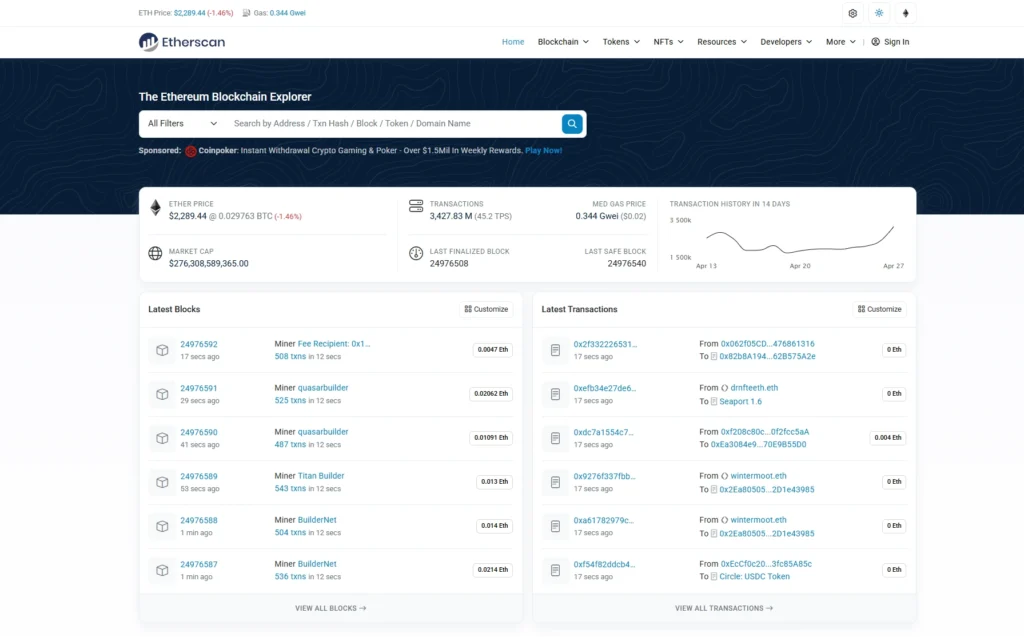
Any legitimate crypto balance can be verified on a blockchain explorer like Etherscan (etherscan.io) for Ethereum or Blockchain.com for Bitcoin. If the platform shows you a crypto balance but cannot provide a wallet address you can verify on-chain, the balance does not exist outside their own database.
Step 4: Test Withdrawal Immediately
Before depositing any funds or spending significant time on a platform, attempt to withdraw your full balance – even if it is only a small sign-up bonus. If you can withdraw freely with no conditions attached, the platform may be legitimate. If any condition appears – minimum balance, fee, threshold, verification requirement – stop immediately. Do not pay the fee. Do not try to meet the threshold.
Step 5: Search Reddit and Scam Databases
Search the platform name on Reddit and specifically in communities like r/Scams, r/CryptoScams, and r/personalfinance. Check Chainabuse.com for the platform’s wallet addresses. Check California’s DFPI Crypto Scam Tracker at dfpi.ca.gov. A platform with no community discussion at all is also a warning sign – legitimate platforms have active user communities.
Step 6: Verify How You Found It
Ask yourself: did I find this platform through my own independent research, or was I directed to it by someone else? Legitimate platforms are discoverable through search engines, app stores, and financial news. If the only path to the platform was through a referral from a specific person – online or offline – apply significantly more scrutiny before proceeding.
Documented Fake Reward Platforms From Community Reports
The following platforms have been documented in community discussions as confirmed or highly probable fake reward or investment platforms. This is not an exhaustive list – new platforms launch constantly under new names.
Wealth Fims / ETRDStocks
Operated as wealthfrontes.com, rebranded to etrdstocks.net. A retired federal employee lost $400,000 USDC between December 2024 and June 2025. The scammer made initial contact through financial content on Facebook – not through a direct cold message. Contact moved to WhatsApp, then to a ‘primary market’ trading group.
The platform featured professional dashboards, tax statements, and a staged initial withdrawal to establish credibility. Withdrawal of the full balance was blocked with sequential demands for ‘release fees’, ‘tax payments’, and ‘security deposits’. Wallet addresses used: 0x61876fa5cca2fa1a6b05764897f4aa77396c3ff7 and 0x6fca9545581b5b4d9383e71a2eafdbe987cfe86a (USDC / Ethereum network).
Domain registration check: wealthfrontes.com was 207 days old, etrdstocks.net was 112 days old at time of reporting. The platform had already been rebranded once before the victim filed reports.
BonChat-Associated Platforms
BonChat itself is a messaging app, not an investment platform. However, it has been repeatedly flagged as the communication layer used in fake reward and investment platform scams. Scammers prefer it for its end-to-end encryption and lower public awareness compared to WhatsApp or Telegram.
The pattern: initial contact through social media or a mutual connection, conversation moved to BonChat, introduction to an investment or reward platform. The platform itself is a separate website but the entire relationship is managed through BonChat. Any investment opportunity introduced through BonChat should be treated as highly suspicious.
Notification System Apps – Unnamed Variants
Multiple community reports describe essentially identical unnamed apps using a ‘notification system’ mechanic: click a confirmation button at intervals, earn 1-2% in crypto per action. These apps circulate through Facebook and Zalo in Southeast Asian and Eastern European communities, through WhatsApp in North American immigrant communities, and through Telegram groups globally.
These apps all share: KYC requirements that collect ID and selfie data, minimum withdrawal thresholds that keep moving upward, and a referral mechanic that spreads them through trusted social networks. The specific app names change frequently as domains are shut down and rebranded.
Frequently Asked Questions
No. Paying the next fee will not release your funds. Once the first fee is paid, a second reason will appear. Then a third. Each payment is simply additional revenue for the scammers. The only way to stop losing money is to stop paying. Document everything, report to the FBI IC3, and accept that the original balance shown on the platform was never real crypto – it was a number in their database.
Not necessarily. Staged small withdrawals are the single most effective tool fake platforms use to establish credibility. The $200 you withdrew was the scammer’s investment in your continued participation. It was released specifically to eliminate your skepticism before you deposited or ‘earned’ a larger amount. The relevant test is whether you can withdraw your full current balance right now without any conditions.
They pull real market data from public APIs – CoinGecko, CoinMarketCap, or direct exchange feeds – and display it in a trading interface. The charts are genuine market data. The only fabrication is the line showing your portfolio performance and your account balance, both of which are numbers stored in the platform’s own database with no connection to any real blockchain transaction.
Act immediately. In the US: place a fraud alert with Equifax, Experian, and TransUnion, and consider a full credit freeze. Monitor all existing accounts for unauthorized activity. Report identity theft to the FTC at identitytheft.gov. Outside the US, contact your national consumer protection or identity fraud authority. The combination of ID plus selfie holding ID is specifically designed to defeat liveness detection – meaning it can be used to pass identity verification on financial platforms that use this method.
Yes, and it is worth doing even if personal recovery is unlikely. Report to: FBI IC3 (ic3.gov), FTC (reportfraud.ftc.gov), your country’s financial regulator, and Chainabuse.com with the wallet addresses used. Report the domain to Google’s Safe Browsing tool and to the hosting provider. These reports contribute to the databases that flag the domain in browsers and search results, protecting future victims. They also contribute to law enforcement investigations that occasionally result in seizures.
Multiple victims from the same platform can file coordinated reports, which strengthens the investigation and increases the chance of law enforcement action. File individual reports with IC3, then contact your local FBI field office and mention that you have a group of connected victims. The FBI’s Operation Level Up was specifically designed to identify and notify victims of cryptocurrency investment fraud – the more connected reports exist, the more likely investigators can map the operation.
