
Move to earn crypto is one of the more unusual ideas to emerge from the Web3 space: the promise that walking, running, or cycling can generate real cryptocurrency rewards. The concept gained serious momentum in 2022, driven by STEPN’s explosive growth and a broader wave of health-meets-blockchain apps. Since then, the sector has matured, contracted, and settled into something more honest – smaller rewards, stronger communities, and a clearer picture of what these platforms can and cannot deliver.
Key Takeaways
- Move to earn crypto rewards users with tokens for physical activity like walking, running, and cycling through GPS-tracked mobile apps.
- Most platforms use a dual-token system – one utility token for in-app use and one governance token
- The biggest recurring criticism from users is inflationary tokenomics: unlimited token supply and rewards paid from new user investment rather than genuine outside revenue.
- Entry costs vary significantly – STEPN requires purchasing NFT sneakers to start earning, while Sweatcoin lets users start for free.
- The most realistic value proposition is fitness motivation, not income
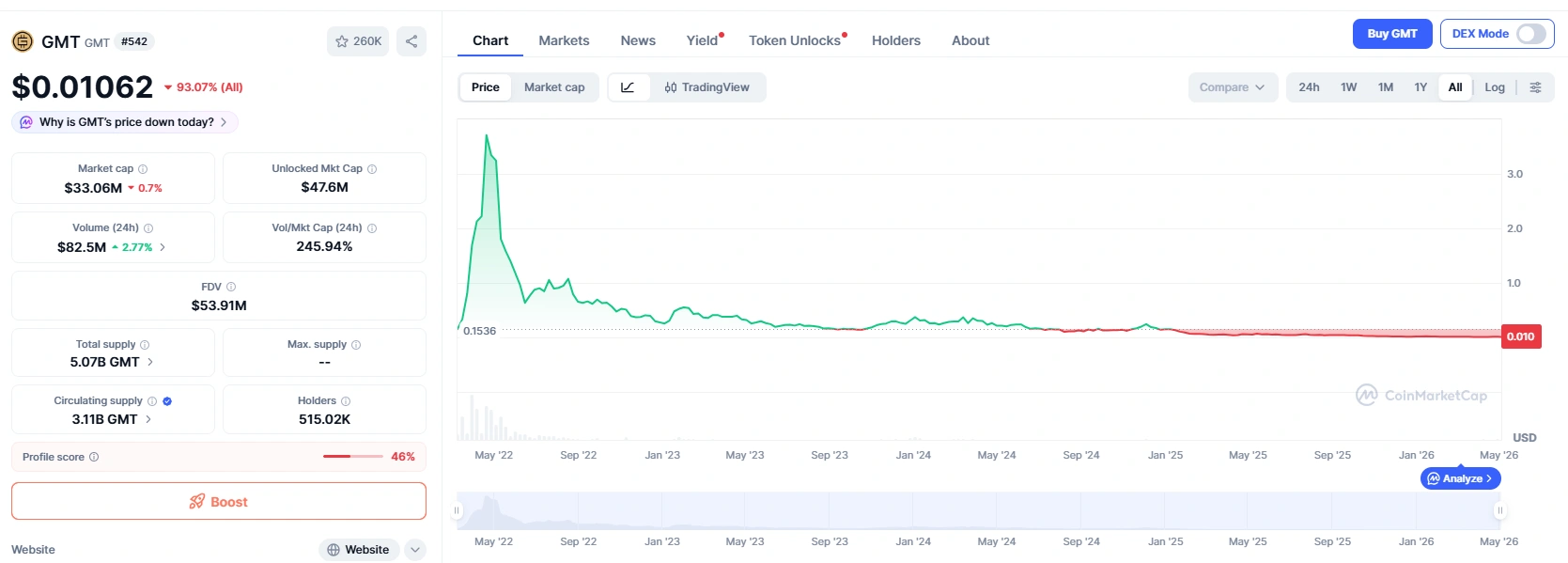
The combined market cap of move-to-earn tokens tracked by CoinGecko sits at approximately $70 million as of early 2025, down sharply from the 2022 peak but still representing a sector with active development and real user bases. STEPN’s governance token GMT reached an all-time high of $4.11 in April 2022 before falling more than 99% to around $0.011 in 2025 – a price history that tells most of the story about M2E market cycles. The fitness app market within which these projects operate is projected to reach $2.3 billion by 2033 according to IMARC Group, suggesting the underlying opportunity remains significant even if early token economics proved unsustainable.
This guide covers how move to earn crypto actually works, the technology behind it, how earnings are calculated, and what real users have found after months of daily use. It also takes an honest look at the most common criticisms – including the ponzi debate that has followed this sector since its earliest days.
What Move to Earn Crypto Actually Means
Move to earn is a blockchain-based model where physical activity generates cryptocurrency rewards. Users download an app, connect or create a crypto wallet, and then earn tokens as they walk, run, cycle, or exercise. The more they move, within the rules of the specific platform, the more they earn.
The concept sits within the broader GameFi category, which combines gaming mechanics with decentralized finance. Unlike play-to-earn platforms where users earn by completing in-game tasks, move-to-earn platforms require real physical movement verified by GPS tracking, motion sensors, or pedometer data from the user’s smartphone or wearable device.
The appeal is straightforward: most people already walk. Most people own a smartphone. If that movement can generate even a small amount of cryptocurrency on top of the health benefit, that is a net positive – provided the entry costs, token volatility, and privacy trade-offs are understood going in.
How the Technology Behind Move to Earn Works
Move to earn crypto platforms combine several technologies to verify movement, calculate rewards, and distribute tokens. Understanding each layer helps users evaluate whether a specific platform is technically sound.
GPS and Motion Tracking
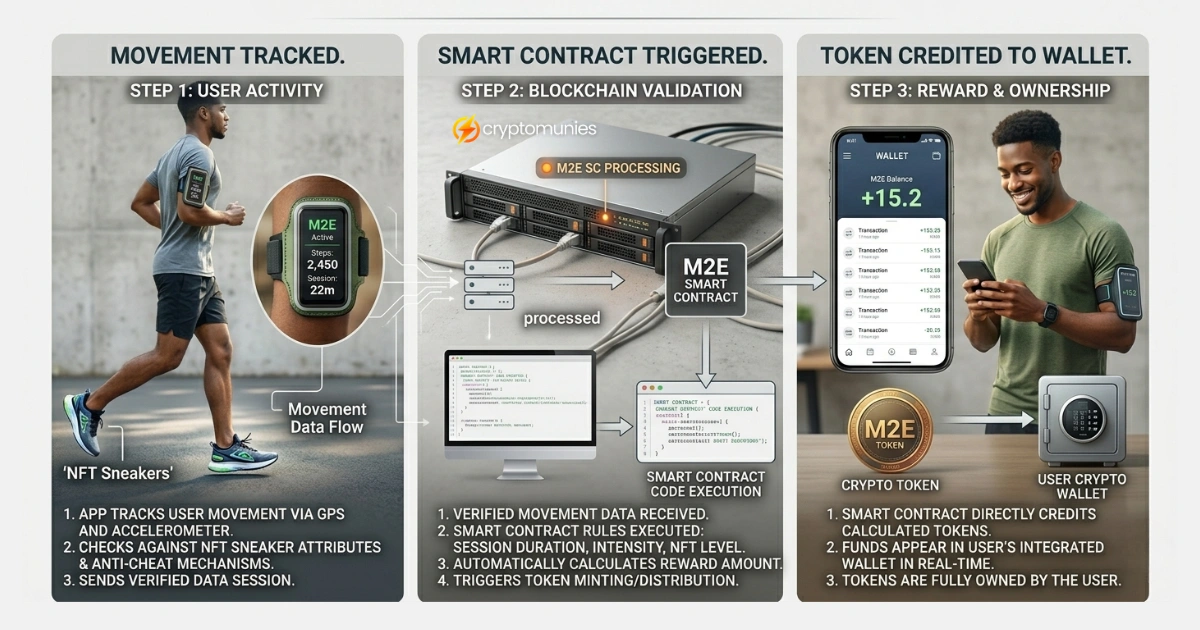
The most fundamental layer is activity verification. Most M2E apps use the GPS chip and accelerometer built into modern smartphones to track distance, pace, and movement patterns. This data is used to confirm that real physical activity took place and to calculate how many tokens to distribute.
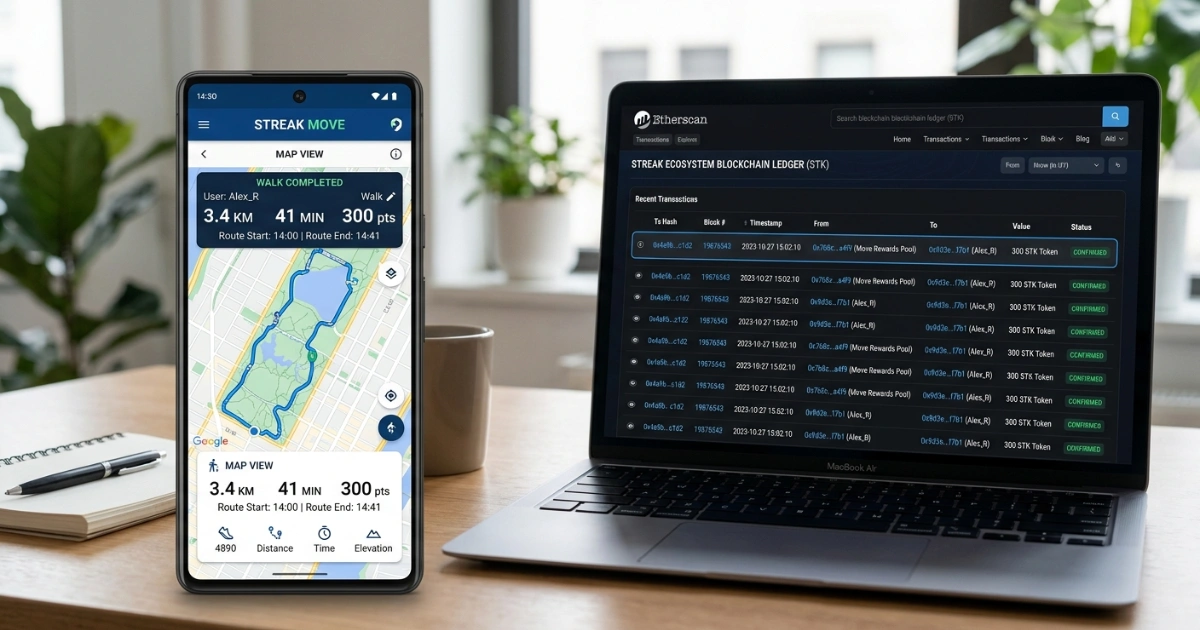
The weakness in this system is that GPS and step data can be spoofed. Reddit users have pointed out this vulnerability directly – one noted the possibility of using specialized software to simulate steps, which would mean the fitness purpose is entirely bypassed. Platforms attempt to counter this through anomaly detection algorithms and behavioral analysis, but no system is fully cheat-proof.
Blockchain and Smart Contracts
All transactions and reward distributions are recorded on a public blockchain – in STEPN’s case, Solana; in Sweat Economy’s case, the NEAR protocol. This provides transparency and immutability: every token earned and every in-app transaction is on-chain and verifiable.
Reward distribution is automated through smart contracts – self-executing code that releases tokens once predefined conditions are met. When a user completes a qualifying activity, the smart contract automatically credits their wallet without requiring manual processing.
The Dual-Token System
Most established M2E platforms use a dual-token model with two distinct tokens serving different purposes within the ecosystem.
| Token Type | Purpose | Platform Examples |
|---|---|---|
| Utility Token | In-app currency for upgrades, repairs, minting, and in-game purchases | GST (STEPN), SWEAT (Sweat Economy), FITFI (Step App) |
| Governance Token | Voting rights on protocol decisions; often unlocks premium features or staking | GMT (STEPN), GENE (Genopets), GRND (SuperWalk) |
The utility token is typically what users earn from movement, and it often has unlimited supply – meaning more tokens are minted as more users earn. This creates the inflation risk that critics frequently raise. The governance token usually has a fixed or capped supply and is more commonly used to access higher-tier features.
How Earnings Are Calculated in Move to Earn Crypto Apps
Earnings in M2E platforms are not simply proportional to distance covered. Most of move to earn apps use multi-variable formulas that factor in the NFT assets held, their quality and level, and the user’s available energy.
The Energy System
The most common mechanic is an energy cap. In STEPN, for example, one unit of energy corresponds to five minutes of earning activity. A user starts with limited energy and must either wait for it to replenish or own more NFT sneakers to increase their daily earning window. This was explicitly designed to limit unlimited earning and encourage moderation, but it also means users who want to earn more must invest more.
NFT Quality and Rarity
In platforms that require NFT assets – STEPN being the primary example – the type, rarity, and level of the NFT directly determines earning rate. A common-tier sneaker earns significantly less per energy unit than an uncommon or rare one. One Reddit user noted earning roughly $0.60 per day from their NFT, while another reported $16 per day – the difference being entirely the NFT quality.
Real Earnings: What Users Actually Report
Community feedback paints a consistent picture. Most active users earn small amounts in the range of a few cents to a few dollars per day, with higher earners relying on significant initial NFT investment. Here are representative figures pulled from user experiences:
| Platform | Entry Cost | Reported Daily Range | Free to Start? |
|---|---|---|---|
| STEPN | NFT sneaker required ($30+ at lower end in 2025) | $0.50 – $18 depending on sneaker quality and token price | No |
| Sweat Economy | None required | $0.00 – $0.02 per day at current SWEAT price | Yes |
| Walken | None for basic play | Small WLKN amounts; one user reported $30 over time without investment | Yes (limited) |
| Genopets | Free starter pet; habitat NFT needed for full earning | Varies; reported low for free users | Partially |
One Reddit user who walks 14-16 km per day for work reported earning the equivalent of $3.17 USD over nine months on Sweat Economy. Another STEPN user who bought near the all-time high noted earning a profit of $1 over six months before closing their account. These are not outliers – they represent the median experience for users without significant NFT investment.
The Ponzi Debate: Is Move to Earn Crypto Sustainable?
No honest assessment of move to earn crypto can avoid this question. The community has debated it extensively, and the concern has structural validity.
The Core Criticism
The fundamental issue is where the money comes from. In a functioning economic model, value is created through a product or service that generates external revenue. In most M2E platforms at launch, the primary revenue source was NFT sales – meaning new users buying in funded the rewards paid to existing users. As one Reddit commenter put it: the payouts are being generated out of thin air, with no sustainable mechanism to continue.
This is the classic definition of a ponzi structure: new entrant capital funds existing participant returns. STEPN’s token GST has no supply cap, meaning more users minting and earning tokens continuously increases supply without proportional demand increases. The GST price history confirms this: it fell dramatically from highs above $8 in early 2022 to fractions of a cent by 2025.
The Counter-Arguments
Those who defend the model or have found it valuable raise several reasonable points.
First, data monetization provides real revenue. M2E apps collect detailed GPS and movement data from millions of users – data that is genuinely valuable to insurers, healthcare companies, advertisers, and urban planners. Sweat Economy explicitly offers users the option to sell their movement data to healthcare companies. Several community members noted that Google, Meta, and Apple already harvest this data for free, so receiving even a fraction back in tokens is an improvement.
Second, some platforms are developing legitimate advertising and partnership revenue. Sweatcoin generates revenue through in-app advertising and brand partnerships, including a partnership with the NHS in the UK. If ad revenue and brand deals can fund a meaningful portion of user rewards, the model becomes less dependent on new user NFT purchases.
Third, community members who have been honest with themselves acknowledge a simpler version of the value: the motivation to exercise is the product. One long-time STEPN user wrote that the app changed their life by getting them walking every day and they are now preparing for a marathon – something they attributed directly to the financial incentive. Another noted they would have never had the motivation without the app. The fitness value is real even when the financial return is minimal.
The Honest Middle Ground
The most accurate framing is that M2E platforms sit on a spectrum. Platforms with capped token supply, genuine external revenue, and realistic reward rates have a viable long-term model. Platforms that rely entirely on new user NFT purchases to fund existing user rewards are structurally fragile and will face collapse when user growth slows. Most current platforms sit somewhere between these poles, and their longevity depends on how effectively they develop non-user-investment revenue streams.
Privacy and Data: What You Are Actually Giving Up
One of the most consistent themes in community discussion is concern about GPS data collection. Multiple Reddit users described these apps as primarily data harvesting tools that pay users pennies for information worth significantly more.
The concern is not unfounded. M2E apps collect highly granular location data – not just aggregate step counts but timestamped GPS coordinates that reveal home addresses, work locations, daily routines, and movement patterns. This data has substantial commercial value.
What users should look for before joining any platform:
- Does the privacy policy clearly state what movement data is collected and how it is used or shared?
- Is location data anonymized before any third-party sharing?
- Can users opt out of data sharing while retaining earning functionality?
- Does the platform sell data without user consent or only offer voluntary data selling with compensation?
Sweat Economy scores reasonably here – it states data is anonymized and explicitly never sold without user consent. Users can opt into data selling for additional rewards. Other platforms are less transparent, and the absence of clear policy language is a legitimate warning sign.
The Step-by-Step Process to Start Earning
The onboarding experience varies by platform, but the general process follows a consistent pattern.
Step 1: Download and account setup
Download the app from your platform’s official website or app store. Create an account with your email address or social login. Most platforms will automatically generate a crypto wallet on setup, meaning you do not need prior blockchain experience to get started.
Step 2: Fund your wallet (if required)
For platforms requiring NFT purchases (primarily STEPN), you will need to transfer cryptocurrency – typically SOL for STEPN – to your in-app wallet before buying a sneaker NFT from the marketplace. Free-to-start platforms like Sweat Economy skip this step entirely.
Step 3: Acquire your NFT asset (if required)
In STEPN, you must purchase at least one sneaker NFT. Sneakers range in quality from Common to Epic, with higher rarity sneakers earning more per energy unit. Entry-level common sneakers have fluctuated significantly in price depending on token market conditions.
Step 4: Move and earn
Begin your physical activity with the app active. GPS and motion sensors track your movement in real time. Earnings accumulate based on your energy allocation, movement type, and NFT quality. Most platforms show real-time earnings during activity.
Step 5: Manage your tokens
Once earned, tokens can be used for in-app upgrades, staked for additional yield, or sold on supported exchanges. Many users recommend converting earned tokens to more stable assets promptly rather than holding platform-native tokens long-term.
Common Ways to Earn Beyond Walking
While walking and running are the primary earning activities, most established platforms offer multiple ways to grow returns within their ecosystem.
NFT Staking and Lending
Some platforms allow users to stake their NFT assets for additional passive rewards, or to rent out their NFTs to users who cannot afford the initial investment. The renter earns from physical activity and splits a portion with the NFT owner. This lowers the barrier to entry while giving NFT holders an additional yield source.
Token Staking
Governance tokens on most M2E platforms can be staked for yield. Sweat Economy offers Growth Jars, where users lock SWEAT tokens for a set period and receive additional tokens in return. This creates a reason to hold the token beyond speculation.
In-App Events and Competitions
Many platforms run challenge events, leaderboards, and seasonal competitions with boosted rewards. Sweat Economy has run giveaways where winners have received $20 worth of tokens without any investment. Step App runs fitness missions with token bounties. These events can meaningfully increase returns for active participants.
NFT Minting and Trading
In STEPN, users at sufficient level can mint new sneaker NFTs by combining two existing ones, then sell them on the marketplace. When NFT prices are healthy, this minting strategy can generate significant returns – though it also requires burning GST and GMT crypto in the process, and profits depend entirely on market demand for new sneakers.
Move to Earn Crypto vs. Traditional Fitness Apps
Understanding the trade-offs helps set realistic expectations before investing time or money.
| Feature | Move to Earn Crypto Apps | Traditional Fitness Apps |
|---|---|---|
| Financial reward | Yes – token earnings (small to moderate) | None directly (some offer cashback via StepBet) |
| Entry cost | Free (Sweat) to hundreds of dollars (STEPN NFTs) | Free to $10/month subscription |
| Privacy risk | Higher – GPS data used for tokenization | Medium – data sold to third parties |
| Motivation impact | High for financially motivated users | High for socially motivated users (streaks, friends) |
| Token volatility risk | Significant – earnings value tied to token price | None |
| Long-term sustainability | Uncertain – depends on tokenomics and revenue model | High – established business models |
Red Flags to Watch For in Move to Earn Projects
The M2E space has attracted scam projects alongside legitimate ones. Several warning signs consistently appear before a project fails.
Unlimited token supply with no burn mechanism
If the platform’s utility token has no supply cap and no mechanism to remove tokens from circulation, inflation is guaranteed. Earnings denominated in that token will progressively lose purchasing value as more tokens are minted.
No revenue source outside of new user investment
Ask directly: how does this platform make money? If the only answer is NFT sales and minting fees paid by users, the platform requires continuous user growth to sustain payouts. The moment growth slows, rewards dry up.
Banning or censoring criticism
Several Reddit users flagged that asking legitimate questions in STEPN’s Discord or subreddit resulted in instant bans. Suppressing community discussion about tokenomics or sustainability is a significant red flag. Legitimate projects welcome scrutiny.
Promised returns that require significant ongoing investment
If earning meaningful rewards requires continuously buying higher-tier NFTs or upgrading assets, the project is closer to a freemium game with crypto branding than a sustainable earning model.
Constantly changing reward rules
One Reddit user described STEPN changing the rules repeatedly in ways that disadvantaged smaller holders. Frequent mid-game changes to earning rates or NFT mechanics signal that the platform is struggling to balance its token economy.
What the Future of Move to Earn Crypto Might Look Like
Despite the problems of the first generation of M2E platforms, the underlying concept has real potential – particularly if the revenue model evolves beyond NFT sales. Several directions are plausible for the sector.
Health insurance integration is the most frequently cited opportunity. Some European insurers already reward policyholders for meeting activity targets. A move to earn platform integrated into insurance infrastructure could receive direct institutional funding to support rewards, creating a genuinely sustainable model with verified external revenue. The NHS partnership with Sweatcoin is a small-scale example of this direction.
DePIN (Decentralized Physical Infrastructure Networks) framing offers another path. Rather than rewarding movement purely for health reasons, platforms could reward users for collecting specific data – air quality readings, traffic flow, geographic coverage – that has verified commercial value. Hivemapper, which rewards drivers for recording road footage, demonstrates this model for driving. A similar approach to walking would give M2E tokens real utility backed by tangible data demand.
Better tokenomics design is already emerging in newer projects. Deflationary burn mechanisms, harder supply caps, and more transparent revenue models address the core structural weakness that caused early M2E tokens to collapse. The fitness app market is projected to grow substantially through 2033, and projects that solve the economic sustainability problem while retaining the fitness incentive mechanic could capture meaningful market share.
Frequently Asked Questions
For most users, the honest answer is no as a primary income source – but potentially yes as a secondary motivation with minor token upside. Free-to-start platforms like Sweatcoin generate fractions of a cent per day for the average user. Investment-backed platforms like STEPN can generate more, but only if you buy quality NFTs and token prices remain favorable. Most experienced users treat any earnings as a bonus rather than a reason to join.
Not always. STEPN requires purchasing a sneaker NFT to start earning, which represents the biggest barrier to entry in the sector. Sweat Economy, Walken (at basic tier), and some newer platforms allow free participation, though earnings without investment are minimal.
STEPN generates revenue primarily through marketplace transaction fees – a 6% fee on every sneaker sale (2% trading fee and 4% royalty fee). During peak activity in 2022, this reportedly generated millions of dollars per day. GST and GMT burned in-app for upgrades and minting also remove tokens from circulation, partially counteracting inflation.
Yes, and several have. GST (STEPN’s utility token) fell from over $8 in April 2022 to fractions of a cent by 2025. SWEAT’s all-time high was above $0.09 and it now trades at fractions of a cent. Governance tokens like GMT have fared better due to supply caps, but have still lost more than 99% from their peaks. Token price risk is one of the most significant risks in this sector.
The primary safety concerns are privacy risk from GPS data collection and financial risk from token volatility and NFT price fluctuations. Most established platforms (STEPN, Sweat Economy, Walken) are not scams in the traditional sense – they deliver on their core promise of tokens for movement. The risk is that the tokens earned may have little or no monetary value, and that your location data is being collected and potentially monetized.
For beginners who want to explore the concept with zero financial risk, Sweat Economy (Sweatcoin) is the most accessible entry point – it requires no investment, no NFT purchase, and runs in the background automatically. The rewards are very small at current token prices, but it is a genuine zero-cost introduction to the move to earn model. Users with a higher risk tolerance and a fitness motivation may find STEPN more engaging, but should treat the NFT purchase as an expense rather than an investment.
Platforms attempt to prevent cheating through behavioral analysis, GPS pattern detection, and speed limits that flag non-human movement. STEPN, for example, only rewards movement within jogging-speed ranges. However, GPS spoofing and step-faking scripts are documented in the community, and no current platform has fully solved this problem. Widespread cheating dilutes rewards for legitimate users and is one of the factors that contributed to token inflation in the 2022-2023 period.

Stefan is enthusiastic about the new technologies, including blockchain. He got to know cryptocurrencies more than 15 years ago, when he mined his first cryptocurrencies on graphics cards. His latest goal is to spread new ways to use cryptocurrencies in the real world.