
The Code4rena competitive audits platform stood among the nearly 10 projects offering this class of crypto bounties. However, only recently, in May 2026, the platform behind this network announced closure. Understanding what the model did well matters more now than it did while it was running, because the format survives on other platforms and the archive it leaves behind is the best free security curriculum in Web3.
Key Takeaways
- Code4rena announced its wind down on 13 May 2026, with active competitions and bounties seen through to completion rather than abandoned.
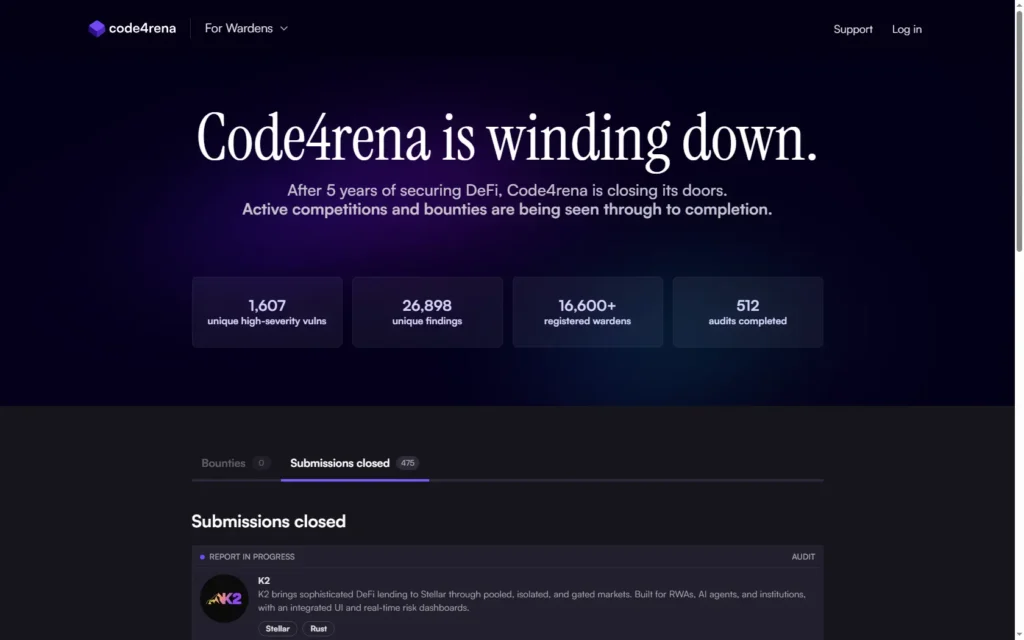
- The platform completed 512 audits and surfaced 26,898 unique findings, including 1,607 unique high-severity vulnerabilities, across a pool of more than 16,600 registered wardens.
- It paid over $20 million to security researchers and estimates it prevented around $12 billion in potential exploits.
- The public report archive is the most valuable thing it leaves behind, and its long-term availability is not guaranteed.
- The competitive format continues on Sherlock, Cantina, and CodeHawks, so the model outlived the company that invented it.
This guide explains how the model worked, what the closure means, why the report archive deserves your attention this week rather than eventually, what wardens actually earned, where the format continues, and how to learn the skill it rewarded.
What the Code4rena Competitive Audit Model Actually Was
Smart contract audits in the older days meant hiring a firm to explore the code, and later receiving a report/ However, Code4rena pioneered an entirely different concept where the code was opened up to everyone for a fixed window, a prize pool is funded, and payments done for results rather than hours. The platform organised the model around three roles. Wardens were the security researchers who reviewed the code. Sponsors were the projects funding the prize pool. Judges decided the severity, validity, and quality of every finding, and rated warden performance.
These competitions ran for a defined period, typically between three days and two weeks, with pools that commonly sat between $50,000 and $500,000.The security researchers submitted findings, judges classified them, and the pool was distributed by an awarding algorithm weighted toward unique valid findings and severity.
Two procedural details mattered to participants: there was a 48-hour post-judging QA window in which sponsors and wardens could comment before the judge finalised decisions, though audits covering live code did not get that window by default, and awards were distributed in two batches so winners had time to satisfy payout requirements.
The scope was broader than most people assume. Alongside EVM chains, competitions covered Solana in Rust, Starknet in Cairo, Cosmos, and Stellar in Soroban, which is part of why the warden community became a genuine cross-ecosystem talent pool rather than a Solidity club.
The Closure, and the Economics Behind It
On May 13, 2026, the team at Code4rena announced that they will be winding down operations after 5 years of offering security services to DeFi protocols. Reporting at the time confirmed the platform would complete all active contests before shuttering in late Q2, with the team stating that every active competition and bounty would be seen through to a full and proper close. Nothing was abandoned mid-contest, which in this market is worth noting rather than assuming.
The part played by Code4rena in the crypto markets should never be understated. The network estimated it had prevented roughly $12 billion in potential exploits across protocols including OpenSea, ENS, and zkSync. That figure is a platform estimate rather than an audited number, but the underlying counts are concrete: 512 completed audits, 26,898 unique findings, 1,607 unique high-severity vulnerabilities.
The commercial trajectory is instructive for anyone assessing where to spend their time in this sector. Code4rena was acquired by security firm Zellic in August 2024, and from June 2025 it ran competitive contests at a 0% platform fee. That is excellent for sponsors and wardens and difficult as a business model. Combined with a broader consolidation across blockchain security, where competing platforms and mid-sized DeFi services have been closing through 2026, the closure reads less like a failure of the format than a squeeze on the companies operating it.
For the reader the practical lesson generalises well beyond one platform: the platform you rely on for income can disappear, and the pattern of infrastructure winding down while the underlying activity continues is one that crypto projects repeat in predictable ways. Reputation that lives only inside one platform’s leaderboard is fragile. Published findings, write-ups, and a portfolio you control are not.
You may also like: Crypto Airdrops: The Smart Way to Find Legit and Profitable Airdrops in 2026
The Archive Is the Real Legacy, and It Deserves Your Attention Now
Ask experienced smart contract auditors how to learn the craft and the same answer recurs with striking consistency: read old Code4rena audit reports. Before taking courses or watching tutorials, study real vulnerabilities found in production code along with the judges’ explanations. Auditing is mainly about reading code and spotting problems, and these reports provide thousands of real examples for free, covering the types of bugs that have caused protocols to lose millions.
What makes these reports better teaching material than most paid courses is the adversarial framing. They also show the severity rating, the project’s response, and sometimes debates over how serious the issue really is. You learn not only what the bug was but how experienced people argue about whether it matters, which is the part beginners consistently get wrong.
One thing to keep in mind is that the Code4rena report archive is still available at the time of writing, but there is no guarantee it will remain online forever. If you plan to use these reports as a learning resource, it’s wise to download the ones you want now instead of assuming they’ll always be available. Findings from these contests are also indexed in third-party vulnerability databases, which provides some redundancy, though not the full report context.
A practical way to work through the archive:
- Pick one protocol type and read every report on it. Lending, AMMs, and staking each have recurring failure patterns that only become visible across multiple reports.
- Read the high-severity findings first, then the disputed mediums. The disputed ones teach severity judgement, which is where most submissions fail.
- Reproduce a finding before moving on. Fork the affected contract locally and write the test that proves it. Reading is recognition; reproducing is skill.
- Keep your own notes as a searchable index. If the source disappears, your notes are what remain.
What Wardens Actually Earned
The headline figures are real but they do not tell the full story. Across its lifetime the platform paid more than $20 million to wardens, with $4.82 million in 2023 alone, and a warden known as cmichel became the first to cross $1 million in lifetime C4 earnings back in May 2022.
The distribution underneath is steeply skewed. Industry data suggests active wardens typically made between $1,000 and $20,000 per contest, depending on how many valid findings they submitted and how severe those issues were. Top auditors occasionally earned more than $100,000 from a single contest, but they were already highly skilled and consistently finding valid vulnerabilities.
The mechanic that decided your share is worth understanding because it applies identically on every surviving contest platform. Pools split across unique valid findings, so if several wardens independently reported the same issue they divided that issue’s allocation between them. A bug that is obvious to everyone pays close to nothing. The money concentrated in finding nobody else spotted, which is precisely the work requiring days of investment before you know whether it pays at all.
Because of this, experienced auditors often gave newcomers a simple piece of advice: keep a day job in a related field until this genuinely takes off. Contest results are valuable because they provide a public record of your abilities, making them a strong portfolio for future auditing opportunities. The prize money is a bonus, not something you should expect to live on.
Where the Competitive Audit Format Continues
The model outlived its inventor, which is the most important thing for anyone who was planning to compete. Three platforms now carry it, and they are not interchangeable.
| Platform | Position | Best suited to |
|---|---|---|
| Cantina | Largest pools in the category, exceeding $2 million on major protocols; grew out of Spearbit | Experienced auditors chasing the biggest prize pools |
| Sherlock | Contests plus insurance-backed bounties; stake-to-submit model with refunds on valid findings | Confident researchers who want faster triage |
| CodeHawks | Run by Cyfrin; First Flights beginner challenges on real contracts, linked to a vulnerability database | Newcomers with no contest history |
| Immunefi, HackenProof | Standing bug bounties on live code rather than time-boxed contests | Researchers who prefer per-vulnerability rewards |
If you have no contest history, CodeHawks First Flights is the only genuine beginner tier in the category, running accessible challenges on real smart contracts. The progression auditors describe is First Flights first, then the larger contest platforms once your hit rate justifies competing against people doing this full time.
What a Competitive Audit Does Not Guarantee
The most important thing to understand about any audit, whether it is a contest or a traditional review, is that it improves code coverage but does not guarantee security. Code4rena consistently found more high-severity issues than single-firm reviews, and that is a real advantage. However, finding more bugs does not mean a protocol is completely safe.
A 2026 incident involving the Venus Protocol shows why. This protocol suffered roughly $2 million in bad debt on one market, and the underlying donation vulnerability had already been flagged during Venus’s Code4rena contest. The problem was identified, but it was never fully addressed before attackers exploited it. Audit contests can uncover vulnerabilities, but they cannot force projects to fix them. The biggest risk often comes from the delay between discovering a bug and actually resolving it.
This is the same reasoning that makes audit badges a weak signal for users choosing where to put funds. The economics justify the spend, given that crypto thefts exceeded $3.4 billion in 2025, but a completed review tells you a project paid for scrutiny, not that the scrutiny caught everything or that anything was fixed. As the Piacoin case shows, a clean audit score is not the same as a secure protocol.
Why Small Projects Never Fit the Contest Model
One common complaint from developers highlights a limitation of audit contests. Many builders with small or simple smart contracts found that competitive audit platforms charged minimum fees of around $20,000. For hobby projects or early-stage protocols with only a few hundred lines of code, that price was simply too high.
The reason is straightforward. Audit contests need a large enough prize pool to attract experienced auditors for one or two weeks. If the rewards are too small, few people participate. A contest with only a handful of auditors provides limited code coverage, making the results far less valuable.
The practical alternatives builders reported using were independent auditors and small security firms, with day rates around $1,000 producing a review in the $5,000 to $10,000 range for a simple contract. The recurring caution was to check that whoever you hire actually has security expertise rather than development experience alone, and to look up the specific individuals who will do the work rather than relying on a firm’s brand. That advice sits alongside the wider need to evaluate crypto service providers sceptically, since the audit market has no shortage of confident marketing.
How to Learn the Skill the Format Rewarded
The learning path the community converges on is remarkably consistent and almost entirely free. Cyfrin Updraft comes up more than any other resource for blockchain fundamentals, Solidity development, and smart contract auditing as a structured sequence. CryptoZombies remains the standard hands-on introduction to Solidity, OpenZeppelin’s contracts and documentation are the reference for security patterns, and the OWASP Smart Contract Top 10 gives you the vulnerability taxonomy to work against.
Tooling matters as much as theory, and here the practical technique is the same one attackers use. You fork mainnet state locally with Anvil or Hardhat and interact with the real contracts at zero cost, systematically, until something breaks. Contract bytecode is retrievable on-chain whether or not the source is verified, so unverified code is an obstacle rather than a wall. Foundry is the current standard for writing the tests and fuzzing harnesses that turn a suspicion into a demonstrated finding, and a finding you cannot demonstrate is not reportable anywhere.
Where AI Helps and Where It Does Not
This divides the security community sharply, and the practitioners with the strongest track records tend to land in the same place. Language models are genuinely useful for catching common patterns such as reentrancy, access control gaps, and arithmetic issues, and for scaffolding a test environment quickly.
The failure modes are specific and worth internalising. Models miss vulnerabilities that depend on economic incentives, human error, or multi-contract interaction effects, which is where most serious modern exploits live. Their training data lags on newer standards, so freshly published ERCs get analysed against outdated assumptions. And they are agreeable to a fault: auditors describe knowing a hole existed, failing to get a model to find it despite detailed prompting, and then receiving immediate enthusiastic agreement the moment they pointed at the exact issue. Agreement after the fact is not detection.
The line the community draws is blunt and correct: internal review is not an audit. Running static analysis and a model over your own code is a reasonable way to clear low-hanging problems so that a real review is not wasted on them. It is not a substitute for adversarial human scrutiny, and shipping to mainnet on that basis is how projects end up as case studies.
If this all sounds like a larger commitment than you were expecting, that is an accurate reading rather than a discouraging one. Competitive auditing sits at the far end of the range of crypto tasks and activities, well beyond crypto faucets, testnet participation, airdrop farming, or structured microtask programs. It pays far more and asks for a year of unpaid learning first.
People also like: Crypto Faucets: Are They Worth It and How to Earn Safely
Frequently Asked Questions
No. Code4rena announced its wind down on 13 May 2026 and confirmed it would complete all active contests before shuttering in late Q2 2026. Existing competitions and bounties were seen through to completion rather than cancelled. Check the site directly for the current state of the report archive.
A warden was a security researcher competing in Code4rena audits. Anyone could register, with no gatekeeping on entry, and wardens advanced up a leaderboard as they landed valid findings. Judges classified severity and validity, and the awarding algorithm distributed the prize pool accordingly.
Cantina runs the largest pools, Sherlock combines contests with insurance-backed bounties, and CodeHawks offers First Flights, the only genuine beginner tier in the category. For standing bounties on live code rather than time-boxed contests, Immunefi and HackenProof are the main options.
They are among the best free auditing material that exists, because each report pairs a real finding against production code with the judge’s severity reasoning and the sponsor’s response. Save what you want locally, since no commitment has been made about how long the archive stays online.
The platform paid over $20 million across its lifetime, but the distribution was steeply skewed. Most active wardens earned roughly $1,000 to $20,000 per contest, top performers occasionally cleared $100,000 from one competition, and newcomers frequently earned nothing while learning.
