
The green satoshi token (GST) is one half of STEPN’s dual-token economy – the half that most users interact with first, and the half that has generated the most debate. While GST crypto captures the daily grind of move-to-earn economics, the other half – GMT crypto (Green Metaverse Token) – was designed as the project’s scarcer, governance-layer asset. Both tokens launched with enormous hype in early 2022, both collapsed by the end of that year, and both are still traded today under very different conditions.
Key Takeaways
- GST crypto is an unlimited-supply utility token earned through movement and burned through in-app actions – its price is directly tied to STEPN’s active user count.
- GMT (Green Metaverse Token) has a hard cap of 6 billion tokens and is only earnable at level 30, making it structurally scarcer than GST.
- The core tension in GST’s economics is unlimited supply vs. burn mechanics – when active users decline, issuance outpaces burning and price falls.
- GMT Pay, launched in April 2025, lets users spend GMT earnings via a virtual Mastercard
- Both tokens have fallen over 99% from their 2022 all-time highs
This article does not cover the basics of the STEPN crypto app itself – it focuses exclusively on what each token does, how each token’s supply and burning mechanics actually work, and what has changed for both assets since the 2022 crash.
Understanding the tokenomics of GST and GMT matters because they behave in fundamentally different ways. GST has no supply cap and its price is almost entirely a function of how many people are actively using the app. GMT has a fixed supply of 6 billion tokens, a halving mechanism borrowed from Bitcoin’s playbook, and an expanding set of real-world use cases through GMT Pay.
What the Green Satoshi Token Actually Is
Green Satoshi Token (GST) is the in-game currency of STEPN. When users walk, jog, or run outdoors with NFT Sneakers equipped, they earn GST. The token replaces the experience point system familiar from traditional gaming but adds a twist: GST can be withdrawn and traded on exchanges. According to STEPN’s official documentation, GST is required for sneaker repair, leveling up, minting new sneakers, gem upgrades, socket unlocking, and attribute resets – essentially every action that consumes in-game resources costs GST.

Unlike most utility tokens, Green Satoshi Token has no defined maximum supply. Every session of active movement mints new tokens. The circulating supply as tracked by CoinMarketCap has grown to approximately 4.7 billion GST tokens as of 2025 – up from just 3.6 million in April 2022. That expansion of roughly 1,300x in circulating supply over three years tells you everything about why the price collapsed from its all-time high of $8.51 in April 2022 to fractions of a cent today.
Green Satoshi Token also runs on multiple chains. The Solana version (GST-SOL) and the BNB Chain version (GST-BSC) are tracked separately by data providers and have historically carried different prices due to differences in user activity across chains. Most data and discussion in this article refers to the Solana version, which is the original and most actively traded.
Check out also: Best Move to Earn Apps in 2026: Honest Reviews
How Users Earn GST
To earn Green Satoshi Token a user needs at least one NFT Sneaker and sufficient Energy. Energy replenishes at a rate of 25% every six hours and the total cap scales with how many sneakers a user holds. Each Energy unit represents five minutes of movement. Users in Solo mode earn GST while GPS-tracked outdoors. Background mode pulls step counts from the phone’s fitness tracker and can generate GST passively. How much GST a session generates depends primarily on the sneaker’s Efficiency attribute and the user’s movement speed matching the sneaker type (Walker, Jogger, Runner, or Trainer).
The amount earned is not fixed. A poorly optimized common sneaker might yield 15-20 GST per four-energy session at low GST prices, while a high-efficiency sneaker leveled to 19 with optimized gem sockets can push significantly higher. Reddit users in STEPN communities have reported real session earnings as context – one user noted getting around 19 GST after repairs with a level 9 common sneaker with efficiency above 44, which at $0.005 per GST amounts to less than $0.10 per session. At GST’s 2022 peak above $8, the same session would have returned over $150. That gap explains almost everything about STEPN’s user retention problem.
The GST Burn Mechanisms
The theory behind GST’s tokenomics is straightforward: if the ecosystem is healthy, GST burned through gameplay should roughly offset or exceed GST minted through movement, creating a supply equilibrium. According to STEPN’s official documentation, GST is automatically burned (destroyed) when users perform the following in-app actions:
- Shoe-minting (combining two sneakers to create a new one)
- Repairing sneaker HP (health points)
- Leveling up NFT Sneakers
- Adding gems and upgrading gems in sneaker sockets
- Unlocking new gem sockets
- Resetting Sneaker attributes
- Carbon Removal Credit purchases (GST donated to environmental initiatives)
STEPN also introduced a Schadenfreude Pool mechanic in its whitepaper: users who burn GMT to subscribe to these pools can earn Green Satoshi Token returns from other players’ failures (lower-than-expected shoebox openings, unsuccessful gem upgrades). This creates a small additional burn sink for GMT while recycling GST within the system.
The problem, as multiple Reddit users identified during the 2022 collapse and as subsequent data confirms, is that burn mechanics only work as intended when there is sustained demand for minting and upgrading. When new user growth stalls, minting activity drops, fewer GST tokens are burned, but the movement rewards keep issuing new tokens regardless. One Reddit commenter summarized the dynamic bluntly: “Smaller MarketCap / More GST = Value going to zero.” This is mathematically accurate for an unlimited supply token when demand weakens.
GST 2.0 and Recent Updates
In September 2025, STEPN launched GST 2.0, a protocol upgrade aimed at enhancing purchasing power and revising tokenomics incentives. The announcement came via the STEPN official account but specific technical details about the exact changes to emission rates or burn mechanics were not publicly disclosed in detail at launch. The upgrade was framed around attracting broader investment and increasing GST utility within the ecosystem.
In the same period, Bitget delisted the GST/USDT trading pair in August 2025 citing low liquidity and network stability concerns. This is a meaningful signal: when exchanges delist a token for liquidity reasons rather than regulatory ones, it typically reflects sustained low trading volume. The delisting reduced accessible trading venues for GST, which adds fragmentation risk to an already low-cap token.
STEPN also partnered with Pantone in July 2025 for limited co-branded sneaker NFTs requiring GST for raffle entries. The collaboration added a small demand driver, though the 149-sneaker batch was too limited in scale to move GST’s overall supply dynamics meaningfully.
What GMT Crypto Is and How It Differs from GST
GMT – the Green Metaverse Token – was designed to operate on a completely different layer of the STEPN economy. Where GST is the day-to-day currency, GMT is the governance and premium layer. The most structurally important difference is supply: GMT has a hard cap of 6 billion tokens, all of which were minted at the Token Generation Event on March 9, 2022. No new GMT can ever be created beyond this fixed amount, which gives it a fundamentally different inflation profile than GST.
GMT is earned through physical movement on STEPN, but only through two specific conditions. Users need either a Rainbow sneaker or a level 30 Classic sneaker to earn GMT – a high barrier that was deliberately set to make GMT issuance scarcer than GST. The amount of GMT earned scales with the sneaker’s Comfort attribute, which is a separate stat from Efficiency (which drives GST earning). The GMT earning system also follows an exponential decay (halving) schedule: the total daily GMT available to earn halves every three years, mimicking Bitcoin’s halving mechanics. On January 1, 2026, GMT rewards were reduced by 50% under this schedule.
GMT Token Allocation and Vesting
According to STEPN’s official whitepaper and data from Tokenomist, the 6 billion GMT were allocated as follows at launch:
| Allocation Category | Percentage | Token Amount |
|---|---|---|
| Ecosystem / Treasury | 30% | 1.8 billion GMT |
| Move & Earn / Governance | 30% | 1.8 billion GMT |
| Private Sale | 16.3% | 978 million GMT |
| Team | 14.2% | 852 million GMT |
| Binance Launchpad Sale | 7% | 420 million GMT |
| Advisors | 2.5% | 150 million GMT |
The vesting schedule extends into 2040. As of 2025, approximately 51.86% of total GMT supply (around 3.1 billion tokens) has been unlocked and is in circulation, according to Tokenomist. GMT uses linear vesting for ecosystem and treasury allocations, releasing tokens gradually to reduce supply shocks. The Ecosystem fund unlocks 0.3% of total supply (18 million GMT) monthly to support STEPN’s global growth, with unspent amounts held in treasury.
The Binance Launchpad IEO in March 2022 sold GMT at $0.01 per token and raised $4.2 million. At GMT’s all-time high of $4.11 (April 28, 2022), Binance Launchpad participants saw a theoretical 411x return in roughly six weeks. As of May 2026, GMT trades at approximately $0.01-0.02, bringing it back near IEO price after one of the fastest bull-and-crash cycles in GameFi history.
What GMT Is Used For Inside the Ecosystem
GMT’s in-app utility is concentrated in higher-level actions. According to STEPN’s official documentation, GMT is burned when users:
- Mint Rare, Epic, or Legendary sneaker qualities (higher-tier minting requires GMT, not just GST)
- Upgrade Level 4 and above Gems
- Level sneakers beyond the lower tiers
- Redistribute Sneaker attribute points
- Participate in Fusion (combining sneakers at higher grades)
- Vote in governance through GMT DAO on treasury allocations and protocol proposals
- Buy items from the STEPN Marketplace and participate in MOOAR NFT auctions
- Purchase raffle tickets for branded NFT drops (e.g., Adidas, Snoop Dogg, Argentina Football Association collaborations)
STEPN also operates a quarterly buyback and burn mechanism for GMT. A portion of platform revenues from marketplace fees and in-app purchases is used to buy GMT from the open market and burn it, reducing circulating supply over time. This mirrors the token burn programs used by Binance’s BNB and other exchange tokens, and is explicitly designed to create deflationary pressure on GMT over the long term.
The GST vs GMT Comparison: Side by Side
The two tokens are not interchangeable and should not be evaluated on the same criteria. The table below captures the key structural differences:
| Feature | GST (Green Satoshi Token) | GMT (Green Metaverse Token) |
|---|---|---|
| Supply Type | Unlimited (inflationary) | Capped at 6 billion |
| Who Can Earn It | Any sneaker owner (Solo/Background mode) | Level 30 Classic or Rainbow sneaker only |
| Earning Attribute | Efficiency | Comfort |
| Halving Mechanic | None | Every 3 years |
| Primary Role | In-game currency / repair & upgrade fuel | Governance + premium tier access |
| All-Time High | $8.51 (April 2022) | $4.11 (April 2022) |
| Current Price (May 2026) | ~$0.001-0.002 | ~$0.01-0.02 |
| Circulating Supply (2025) | ~4.7 billion | ~3.1 billion |
| Burn Mechanics | Minting, repair, upgrades, gems, sockets | High-tier minting, gem upgrades, governance, Fusion |
| Real-World Use | Limited | GMT Pay (Mastercard), Apple/Google Pay |
The Inflation Problem: Why GST Crypto Struggles to Hold Value
The most persistent criticism of GST’s tokenomics – echoed consistently in Reddit communities and by on-chain analysts – is that an unlimited supply token tied to user activity creates a structural one-way pressure toward zero when the user base stops growing. This is not FUD. It is a mathematical property of the model.
The core formula is simple: token value = market cap / circulating supply. If market cap stays flat or shrinks while circulating supply keeps expanding (as happens whenever any user moves and earns GST), price falls. For GST’s price to increase, demand from new buyers or from in-app burns must outpace new token issuance. During STEPN’s 2022 bull run, this demand was met by the “mint farm” phenomenon: large operations would buy Green Satoshi Token to mint new sneakers, creating massive buy pressure. Once those operations became unprofitable, the demand disappeared but the emissions did not.
The circulating supply growth is stark. According to CoinMarketCap data, GST’s circulating supply has grown from roughly 3.6 million tokens in April 2022 to approximately 4.7 billion by 2025 – an increase of over 1,300x. Over the same period, the price fell from $8.51 to under $0.002. The two trends are directly related.
One Reddit commenter who had analyzed STEPN’s economics noted that the situation resembled other inflationary game economies: “If GST is at $1, that means you get $30 per day [from a basic setup] and your ROI is less than 20 days. If this is true, everyone will make money like hell. Where would the money come from?” This correctly identifies the economic impossibility of sustained high GST prices without either massive sneaker price inflation (which requires a bull market for SOL) or a radical reduction in GST emission rates.
STEPN has introduced several measures to address inflation, including the HP (Health Point) system added in July 2022, which gives sneakers a limited lifespan. Without HP, sneakers had infinite use and would never wear out – the team’s own words described this as “a recipe for inflation and eventual price drop.” The HP system requires repair costs in GST, creating a recurring burn demand even from passive holders. However, at current GST prices, repair costs are so small in dollar terms that they do not meaningfully slow token accumulation for active users.
GMT Crypto and the Shift Toward Real-World Utility
While Green Satoshi Token’s story in 2025 is largely about managing inflation and liquidity erosion, GMT’s story has pivoted toward real-world payment infrastructure. The most significant development for GMT in recent years is GMT Pay, announced in January 2025 and publicly launched in April 2025 by FSL (the studio behind STEPN).
GMT Pay allows users who earn GMT through STEPN and other FSL products to load their earnings onto a virtual Mastercard available in $25, $50, $100, $200, and $300 denominations. The card works at any Mastercard-accepting merchant worldwide – online (Amazon, Spotify) and offline (retail, cafes) – and is compatible with Apple Pay and Google Pay. In July 2025, GMT Pay received a major upgrade adding multi-chain support (Solana, BNB Chain, Ethereum, Polygon), support for the FSL ecosystem’s native stablecoin GGUSD, and lower-denomination $25 cards. In April 2026, STEPN launched a “Learn & Earn” campaign in Japan via OKCoin Japan, where users completing quizzes earn GMT directly – expanding the token’s user acquisition pipeline.
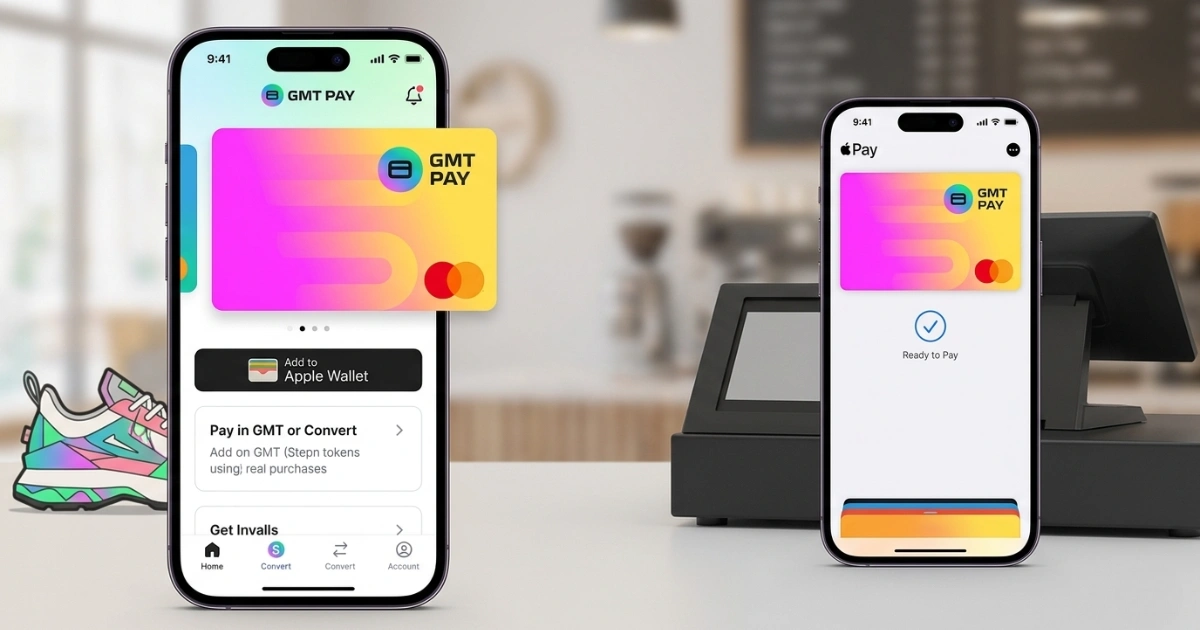
FSL co-founder Yawn Rong described the GMT Pay launch as bridging digital and physical worlds. From a tokenomics perspective, GMT Pay creates a new demand vector: users need to hold or acquire GMT to fund their cards. Every card purchase effectively converts GMT into fiat spending power, representing a soft burn of token value from the ecosystem into the real economy.
GMT’s Partnership-Driven Burn Events
A meaningful portion of GMT’s utility since 2022 has come from branded partnership raffles, which require users to lock or burn GMT to participate. These events have included:
- Adidas x STEPN GO (2024): Genesis NFT sneakers with physical Ultraboosts. Over 300 million GMT locked across raffles.
- Snoop Dogg x STEPN (2024): 800 exclusive Genesis sneakers. Approximately 161 million GMT locked for raffle entry.
- G-SHOCK x STEPN GO (2024): Around $20 million worth of GMT staked.
- Argentina Football Association x STEPN (May 2025): 400 exclusive sneakers, raffle tickets priced at 19,000 GMT each (refundable if not selected).
- Pantone x STEPN (July 2025): Co-branded color-themed sneaker NFTs.
These events temporarily remove significant amounts of GMT from liquid circulation while raffles run, which can create short-term price support. However, the refundable nature of most raffle deposits (GMT is returned to unsuccessful entrants) means the burns are often temporary locks rather than permanent supply reductions. The non-refundable burns happen primarily through in-app actions like high-tier minting and gem upgrades – activities that require sustained user engagement.
Price History: How Both Tokens Have Performed
Any honest assessment of GST and GMT must include their price histories, which are among the most dramatic in GameFi history – in both directions.
Green Satoshi Token Price History
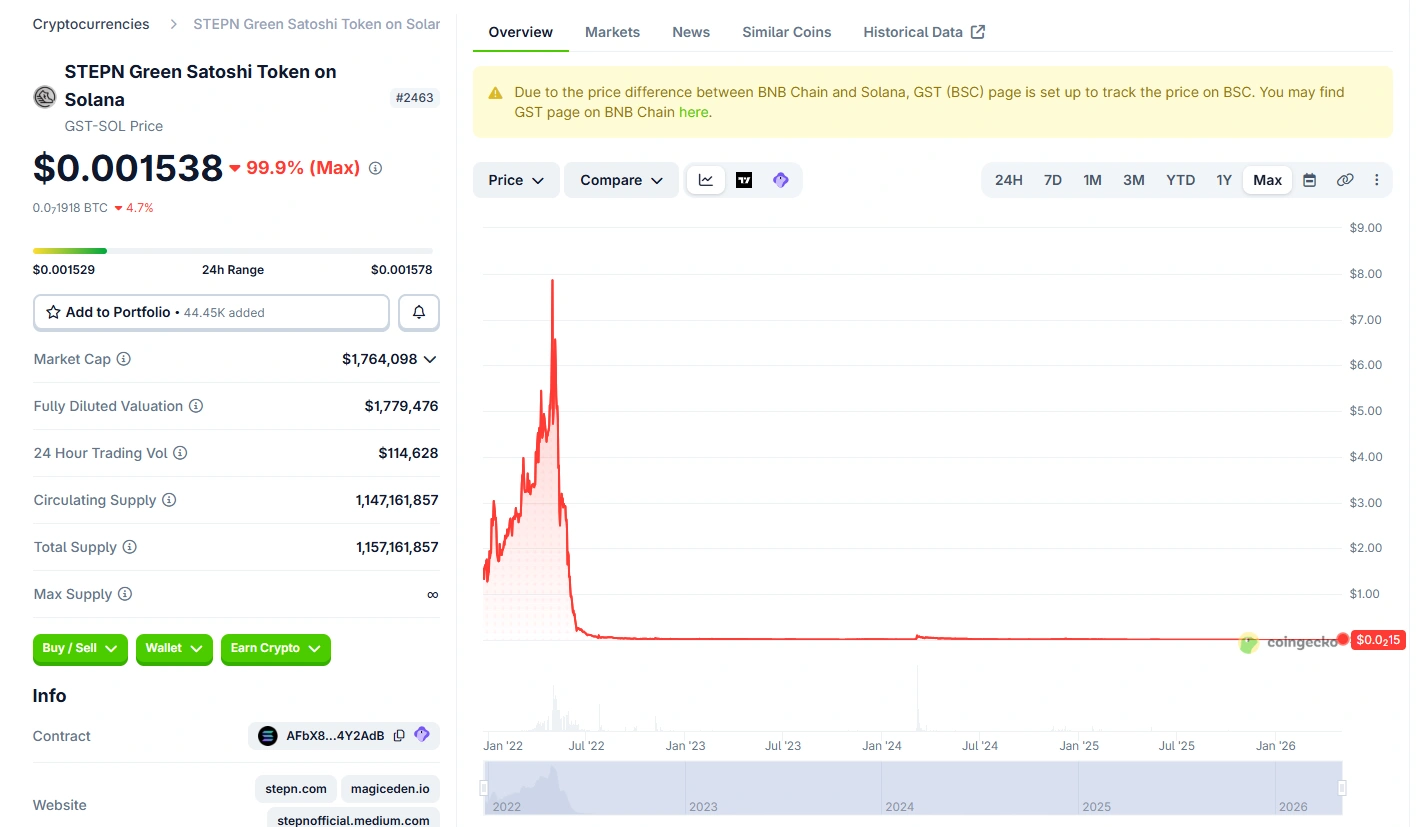
Green Satoshi Token (GST) first appeared on major data aggregators in December 2021 at approximately $1.55. It reached its first notable high of $3.04 in January 2022, climbed to $5.45 on April 8, and peaked at an all-time high of $8.51 in late April 2022. The collapse was rapid and severe. By June 2022, GST had fallen to $0.20. By September 2022, it had hit an all-time low near $0.02 – a decline of over 99.7% from peak in roughly five months. From 2023 through early 2025, GST consolidated below $0.01 with occasional spikes tied to broader crypto market movements. As of 2025, the token trades in the $0.001-0.007 range, representing a decline of approximately 99.9% from its all-time high.
GMT Price History
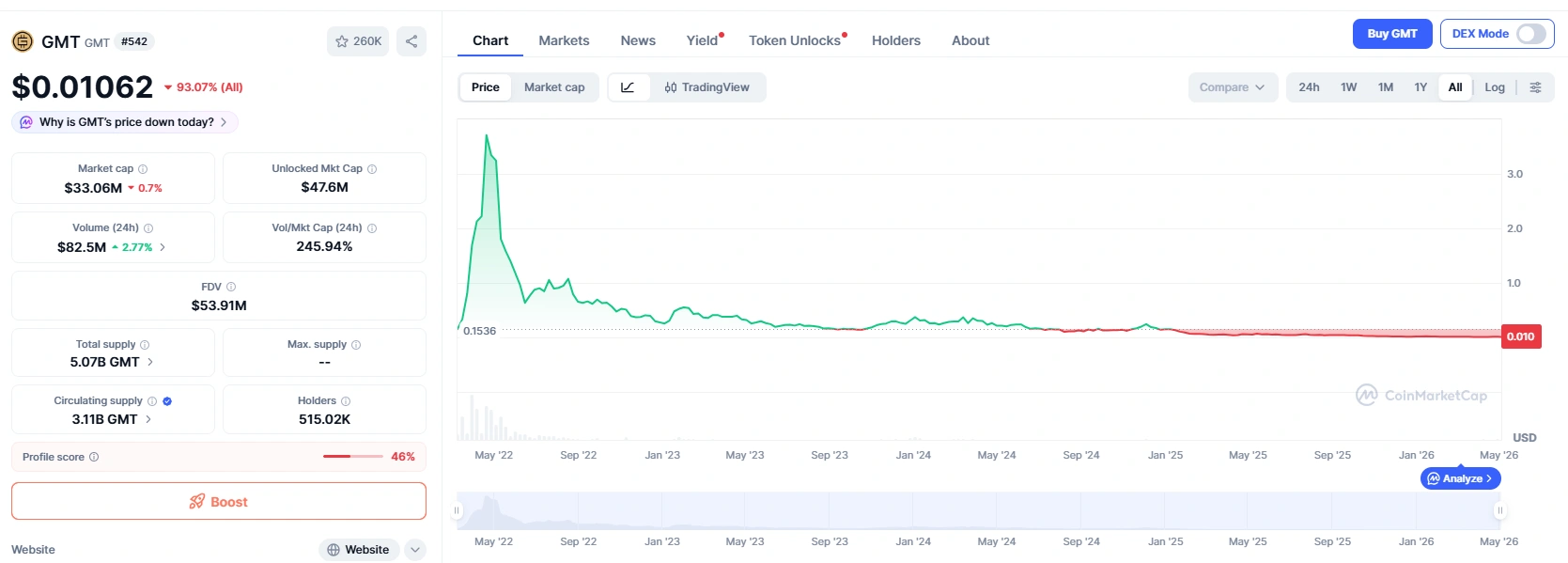
GMT launched at $0.01 per token at the Binance Launchpad IEO in March 2022. Within six weeks it had reached its all-time high of $4.11 on April 28, 2022 – a 41,100% gain from IEO price. Like GST, GMT’s collapse was swift. By 2023 it had stabilized in the $0.15-$0.45 range. The best year for GMT per CoinLore data was 2023, when it moved from $0.42 to $0.68. By 2025, GMT had fallen from a year-opening price of around $0.15 to lows below $0.01 – its worst annual performance on record. The token touched its all-time low of approximately $0.009 in late March 2026, down roughly 99.8% from its peak. As of May 2026, GMT trades around $0.01-0.02 per the current data across Coinbase, CoinGecko, and other data providers.
The Reddit community has been clear-eyed about this trajectory. A commenter who said “I personally don’t see it getting over $1 again. It’s an in game token with limitless supply” was speaking specifically about Green Satoshi Token, and that assessment has been validated by the data. For GMT, the counterargument has always been the fixed supply and governance utility – but GMT’s performance in 2025 demonstrated that fixed supply alone does not protect a token when overall ecosystem activity declines.
What Would It Take for Either Token to Recover?
This is the question most people ask, and the honest answer involves separate conditions for each token because their economics are genuinely different.
Recovery Conditions for GST Crypto
For GST to sustain higher prices, the key variable is not price – it is burn rate vs. emission rate. Without a structural change in how much GST is burned relative to how much is minted, rising prices will always attract more selling from holders who have accumulated at lower cost. The conditions that could genuinely support GST include:
- Massive new user onboarding driving minting demand – the scenario that created 2022’s bull run. This would require a return of “mint farm” economics or a viral fitness-crypto trend.
- New GST burn mechanics tied to features users actually want to use repeatedly – not just low-frequency events like minting but regular spending on meaningful upgrades.
- Fitness brand integrations that create external demand for GST outside the STEPN ecosystem – for example, third-party apps accepting GST for health-related purchases or rewards.
- GST 2.0 delivering on its stated goals of enhanced purchasing power and revised tokenomics incentives (specifics remain undisclosed as of late 2025).
Several Reddit community members pointed out that the fitness-tracking angle remains genuinely compelling. As one commenter noted: “If they would focus on fitness and accessibility, this app would be a game changer for incentivizing people to workout. It keeps me motivated to walk 6 miles everyday.” The problem is that GST’s value must grow to make the financial incentive meaningful, which requires the user growth to come first – a classic chicken-and-egg problem.
Recovery Conditions for GMT Crypto
GMT’s path to recovery is structurally more interesting because it involves tangible non-speculative catalysts. The most meaningful are:
- GMT Pay adoption growing beyond STEPN’s existing user base. If GMT Pay’s Mastercard functionality gains traction as a genuine crypto spending tool, demand for GMT could be driven by people who have never played STEPN.
- The halving effect on GMT emissions reducing new supply entering the market. The January 2026 50% cut in GMT rewards lowers daily issuance, which improves the supply dynamic even if demand stays flat.
- Partnership events requiring GMT locks at scale – the Adidas collaboration locking 300 million GMT demonstrates the potential of this mechanism, though refundable deposits limit permanent supply reduction.
- MOOAR marketplace and broader FSL ecosystem growth driving governance participation and burning activity across more products than just STEPN.
Honest Risk Assessment for Both Tokens
Neither GST nor GMT should be approached without understanding their specific risk profiles, which differ significantly.
GST Risk Factors
- Unlimited supply creates permanent inflation pressure. Any price recovery that is not accompanied by accelerating burn activity will attract sell pressure from holders and reduce gains.
- Exchange delistings reduce liquidity. Bitget’s August 2025 delisting of GST/USDT for “low liquidity and network stability concerns” is a warning sign about the token’s exchange support declining over time.
- Demand dependency on STEPN’s user count means GST’s fortunes are almost entirely tied to one app. If STEPN user activity declines, there is no secondary demand source for GST.
- Price prediction sites for GST are almost entirely speculative and should not be used as investment research. Sites projecting 57,000%+ gains by year-end are not providing verified analysis.
GMT Risk Factors
- Continued vesting unlocks through 2040 mean supply will keep increasing for many years. The 51.86% of supply unlocked by 2025 still leaves significant remaining supply to enter circulation.
- Team allocation (14.2%) and Private Sale allocation (16.3%) represent significant potential sell pressure if long-term holders choose to liquidate.
- GMT Pay’s actual utility and adoption rate remains unverified. The product exists and was launched publicly but independent data on card issuance volumes or merchant transaction counts is not available.
- Both tokens are deeply correlated to broader crypto market cycles, and GMT has demonstrated it can reach its IEO launch price even after years of product development.
The Dual-Token Design: Was It the Right Model?
The dual-token model STEPN adopted was controversial from launch. The theoretical logic was sound: separate the inflationary utility layer (GST) needed for day-to-day gameplay from the deflationary governance layer (GMT) needed for high-value actions and protocol direction. This mirrors real economies that have both operational currencies and store-of-value assets.
In practice, the model created a dynamic that Reddit’s STEPN communities diagnosed early: new users and casual earners interacted almost entirely with GST, concentrating speculative demand for GMT among a smaller group of committed players who reached level 30. During a bull market, this meant GMT’s narrative of scarcity and premium access attracted capital. During a bear market, it meant GMT had fewer natural buyers from within the app.
One clear strategic choice embedded in the model is that GMT is designed to eventually displace GST as the primary earning token for advanced players. The whitepaper’s level 30 requirement, combined with the Comfort attribute system and the halving mechanics, points toward a long-term STEPN economy where GST becomes less relevant and GMT becomes the primary incentive for sustained participation. Whether this transition actually happens depends on whether STEPN retains and grows a user base willing to invest the time and resources to reach level 30 – a significant ask in a market full of competing move-to-earn and GameFi alternatives.
Where GST and GMT Sit in the Broader Move-to-Earn Market
STEPN was the first major move-to-earn application and its success in 2022 spawned dozens of competitors including FITFI, MOOV, and others. None has replicated STEPN’s peak user numbers or market cap. According to STEPN’s official communications, the platform had 5.7 million registered users (self-reported by FSL). This figure is self-reported and does not reflect active daily users, which are significantly lower.
The CoinGecko data shows GST-SOL with a market cap around $1.96 million as of mid-2026 and GMT with a market cap of approximately $33 million. By comparison, both tokens peaked at market caps in the billions in 2022. Both are now small-cap assets with all the liquidity and volatility risks that classification implies.
The broader move-to-earn sector has not recovered to 2022 levels. Competing tokens have not achieved mainstream adoption, and the narrative around fitness-and-crypto has cooled considerably. FSL has responded by broadening the product suite (STEPN GO, MOOAR, DOOAR, Gas Hero) and by focusing GMT on real-world payment utility rather than relying solely on the move-to-earn thesis.
Check out our guide on: Crypto Rewards: All Types of Earnings Explained (2026)
Conclusion
The green satoshi token and GMT represent two distinctly different bets on the STEPN ecosystem. GST is the operational currency – its value lives and dies with daily active users and the balance between movement rewards and in-game burns. GMT is the governance and premium-access layer – it carries a fixed supply, a halving emission schedule, and an expanding set of real-world utilities that extend beyond the app itself.
Neither token is currently in a position that makes straightforward investment analysis easy. GST’s unlimited supply means that sustained price recovery requires a structural shift in user activity that simply has not materialized since 2022. GMT’s fixed supply and real-world utility through GMT Pay represent genuine differentiation, but the token has still fallen 99.8% from its all-time high and trades near its original IEO price.
For anyone researching GST crypto or GMT crypto as a potential position, the most important question is not price predictions – it is whether you believe STEPN’s user base will grow significantly, and whether GMT Pay will reach a scale of adoption that creates genuine independent demand for the governance token. Both outcomes are possible. Neither is probable based on current data. As always in crypto, do your own research, understand the tokenomics you are buying into, and never invest more than you can afford to lose.
FAQ
GST (Green Satoshi Token) is STEPN’s unlimited-supply utility token earned through movement and spent on everyday in-app actions like repairs and upgrades. GMT (Green Metaverse Token) is the governance token with a fixed supply of 6 billion and is only earnable by users with level 30 or Rainbow sneakers. GST is inflationary by design; GMT is deflationary over time through burns and a halving schedule.
The primary cause was the mismatch between token issuance and burning. During STEPN’s 2022 peak, “mint farm” operations created massive buy pressure for GST to produce new sneakers. Once minting became unprofitable, that demand disappeared while the app continued issuing new GST tokens to all active users. The circulating supply grew from millions to billions while market cap shrank, driving the price from over $8 to fractions of a cent.
GMT has deflationary mechanisms but is not fully deflationary yet. Its fixed 6-billion supply cap prevents new issuance beyond the original mint, and quarterly buyback-and-burn programs using platform revenues reduce circulating supply. The halving of GMT rewards every three years (the first since-confirmed reduction took effect January 2026) also slows issuance. However, continued vesting unlocks through 2040 mean additional supply continues to enter circulation for many years.
GMT Pay is a payment service launched by FSL in 2025 that lets users convert their GMT and GGT earnings into a virtual Mastercard for real-world spending. The card is available in $25-$300 denominations, works at any Mastercard merchant globally, and supports Apple Pay and Google Pay. From a tokenomics perspective, GMT Pay creates demand for GMT outside the STEPN app and creates a pathway for token value to flow into real-world purchases, adding a non-speculative utility layer.
At current circulating supply levels (approximately 4.7 billion tokens), a $1 GST price would require a market cap of roughly $4.7 billion. For context, GST’s peak market cap in 2022 was reached when circulating supply was a tiny fraction of its current level. Most experienced community members and on-chain analysts consider $1 GST extremely unlikely without a dramatic reduction in circulating supply (through accelerated burns) combined with massive new user growth. This is not financial advice – it is a reflection of the mathematical relationship between supply and market cap.
GST is available on Coinbase, MEXC, Raydium (DEX on Solana), and other exchanges, though the number of listing venues has declined after Bitget delisted GST/USDT in August 2025. GMT is listed on major exchanges including Binance, OKX, Bybit, and Coinbase. Always verify current availability on the exchange’s official site before trading, as listings change.
GST exists on both Solana and BNB Chain, with the Solana version being the original and more widely traded. GMT was originally on Solana but has been expanded to Ethereum, BNB Chain, and Polygon to support GMT Pay’s multi-chain functionality. Each chain version has its own contract address and can carry slightly different prices depending on liquidity.

Stefan is enthusiastic about the new technologies, including blockchain. He got to know cryptocurrencies more than 15 years ago, when he mined his first cryptocurrencies on graphics cards. His latest goal is to spread new ways to use cryptocurrencies in the real world.