
StepN crypto had one of the most explosive rises – and steepest falls – in recent blockchain history. At its peak in mid-2022, the app had over 700,000 monthly active users, and early players reported crypto earning $50 to $200 per day simply by going for a run. If you are researching StepN in 2025 or 2026, the landscape looks very different.
Key Takeaways
- StepN crypto is a Web3 move-to-earn app built on Solana that rewards users with GST and GMT tokens for walking, jogging, or running outdoors.
- Users must purchase NFT sneakers to start earning
- At its peak in May 2022 the app had over 700,000 monthly active users and early players reported $50-$200 per day in earnings.
- The earning model depends on new users buying NFT sneakers to sustain token value.
- FSL is rebuilding with StepN Go, GMT Pay, and token burn initiatives – but whether the model can sustain itself long-term remains genuinely unproven.
The app’s governance token GMT is down more than 99% from its all-time high, and its utility token GST has fared even worse. The move-to-earn fitness app market is projected to grow from $608.2 million in 2024 to over $2.3 billion by 2033 according to IMAARC Group, but the path forward for StepN itself is far less certain.
This article covers how StepN crypto actually works, what the NFT sneaker system means in practice, the honest economics of earning in 2026, why things went wrong, and what FSL – the company behind StepN – is attempting to do to keep the project alive.
What Is StepN Crypto and How Does It Work
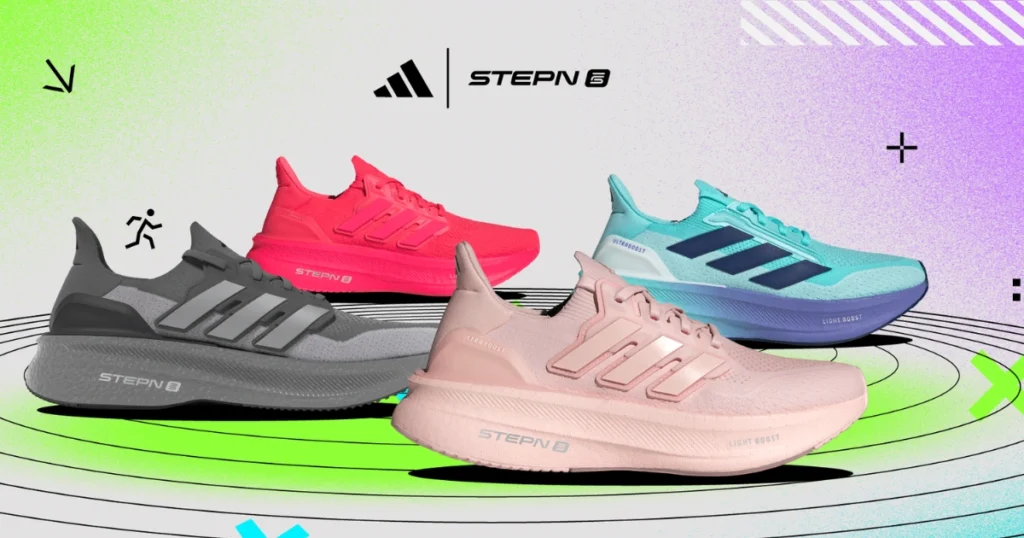
StepN is a Web3 lifestyle app created by Find Satoshi Lab (FSL), a studio founded by Yawn Rong and Jerry Huang in Adelaide, Australia. The app launched in public beta on the Solana blockchain in December 2021 and popularised the concept of move-to-earn (M2E) – earning cryptocurrency rewards for physical activity.
The mechanic is straightforward in concept. You download the app, purchase an NFT sneaker from the StepN marketplace, take it outside, and start walking or running. The app tracks your movement via GPS and converts your activity into token earnings. You are not getting paid by a company for exercising. You are earning newly minted tokens whose value is set entirely by market demand.
StepN is available on Solana, Ethereum, and BNB Chain. Solana remains the most widely used network within the app due to significantly lower transaction fees. Each chain operates as a separate realm with its own sneaker marketplace and token prices.
Check out our detailed breakdown of how GST and GMT function inside the StepN – their supply mechanics, burn rates, vesting schedules, and tokenomics.
The Two Tokens: A Brief Overview
StepN runs on two tokens. GST (Green Satoshi Token) is the everyday in-app currency – earned by walking and spent on repairs, upgrades, and minting. GMT (Green Metaverse Token) is the governance token, earnable only once a sneaker reaches level 30, with a fixed supply of 6 billion. Both tokens launched with enormous hype in 2022 and both collapsed by year end. Their current prices reflect that history: GST trades near $0.002 and GMT near $0.01 as of May 2026.
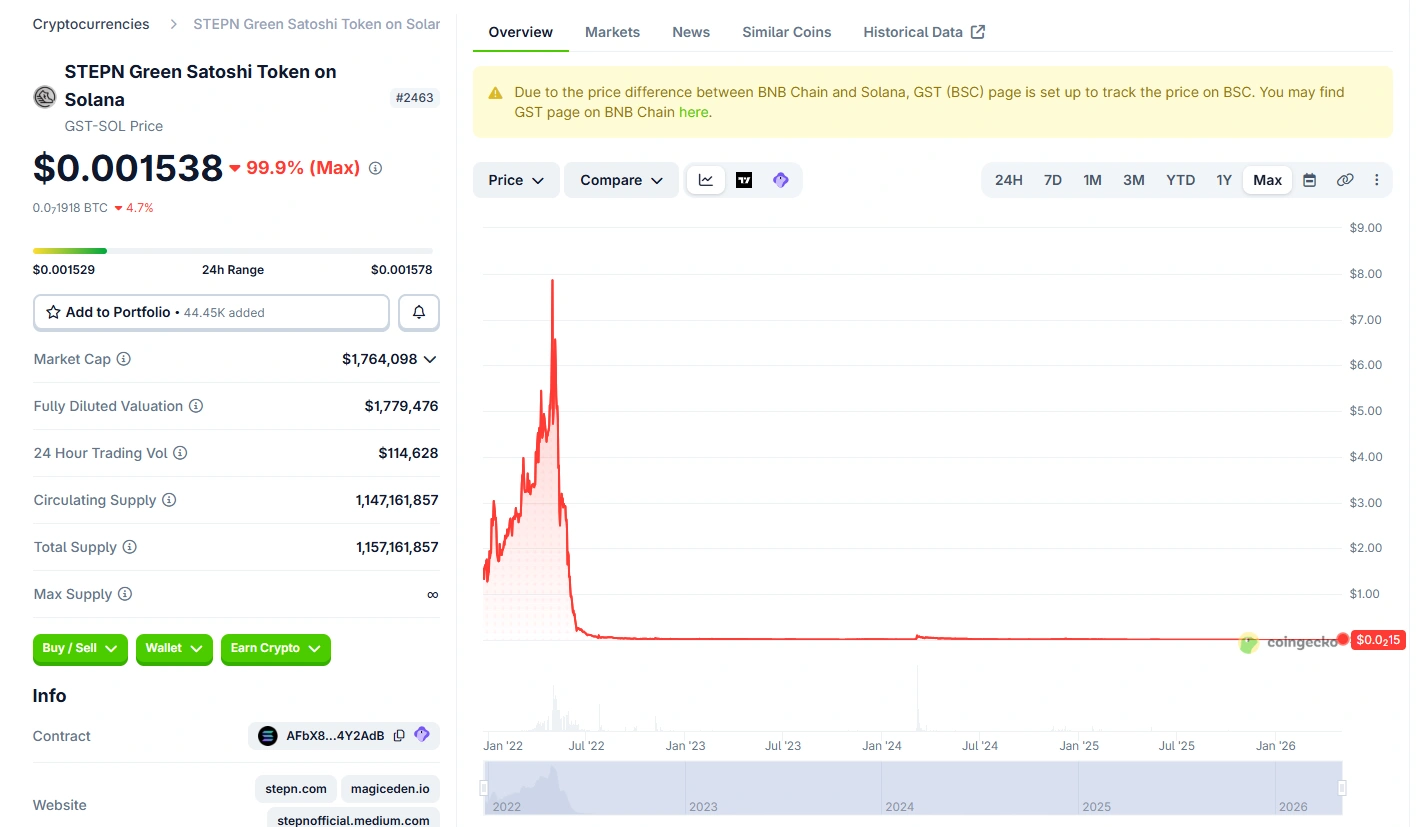
For a full breakdown of how each token’s supply, burn mechanics, vesting schedule, and earning attributes work, see the companion article: Green Satoshi Token and GMT – A Deep Dive into StepN’s Dual-Token Economics.
NFT Sneakers: The Entry Point and the Main Cost
To earn anything on StepN, you must own at least one NFT sneaker. At the height of demand in early 2022, the floor price for a single sneaker reached around $800 to $1,200 worth of SOL. Reddit users at the time were direct about this barrier: “$1,000 to buy an NFT shoe. And then you gotta pay to repair it too. No thanks,” wrote one commenter.
Sneakers come in four quality tiers – Common, Uncommon, Rare, and Epic – each offering different earning rates and energy allocations. Each sneaker is matched to a movement speed range: Walker (1-6 km/h), Jogger (4-10 km/h), Runner (8-20 km/h), and Trainer (1-20 km/h). Moving outside your sneaker’s optimal speed range reduces earnings.
Each sneaker has four attributes that affect earnings and durability:
- Efficiency – determines how much GST you earn per minute of movement.
- Luck – affects the chance of receiving Mystery Boxes.
- Comfort – influences GMT earnings and reduces HP decay rate.
- Resilience – slows how fast your sneaker’s durability drops.
Durability (HP) degrades with use and must be repaired using GST. A sneaker with 0% HP cannot be used to earn. This built-in repair mechanic was designed as a token burn mechanism to help control GST supply – but it also means the cost of playing never fully stops.
The Energy System and Daily Earning Caps
A detail that surprises many new users is the energy system. Each user starts with 2/2 energy, which translates to roughly 10 minutes of earning time per day. Energy replenishes over time, and you can increase your maximum by owning more sneakers.
| Sneakers Owned | Daily Energy (approx. minutes) | Daily GST Cap |
|---|---|---|
| 1 | 10 min | 5 GST |
| 3 | 20 min | 10 GST |
| 9 | 45 min | 45 GST |
| 30+ | ~100 min | Up to 300 GST |
As one Reddit reviewer noted after buying in: “Today I had my full energy, but this lasted only about 10 minutes. No one told me to stop the app after the energy had burned – at that point, I would be degrading my shoes with no payoff.” The daily energy cap is one of the most common surprises for new users who expect StepN to function like a full fitness tracker.
How Much Can You Actually Earn with StepN Crypto in 2026
This is the most important question – and the most honest answer is: considerably less than during 2022, for most users.
At StepN’s peak, a single Common sneaker could theoretically generate $50-60 in GST for 10 minutes of walking when GST was trading near $6. With GST now trading at roughly $0.002, the same 10 minutes produces a fraction of a cent in real-world value. The tokens are still being minted and earned – the purchasing power behind them has largely evaporated.
The Real Return-on-Investment Calculation
Any honest assessment of StepN earnings must start from the cost of entry. If you spend $50 on a sneaker and earn 6 GST per day at $0.002, that is $0.012 per day – a return on investment measured in years, not months. Profitability improves if token prices recover, if you own higher-tier sneakers with optimised gem setups, or if you are earning GMT at level 30.
Active community members recommend building a portfolio of sneakers optimised with yellow gems (Efficiency) in their sockets to maximise GST output. One user from the community explained: “A sneaker without yellow gems earns close to nothing.” Even with optimal gem setups, profitability is directly tied to token prices that have historically been extremely volatile.
For early users during the 2022 bull run, returns were genuinely significant. One Reddit user wrote at the time: “I paid about $1,200 per NFT shoe pair at 3 pairs. I net 30 GST a day after repairs for a 20 minute run. I’ve already almost made my initial investment back.” That window closed rapidly when token prices collapsed. The same setup today would generate less than $0.10 per session at current GST prices.
GMT Earnings: The Higher-Tier Option
Earning GMT requires a sneaker levelled to level 30 – a significant investment of GST upgrades over time. GMT’s fixed supply of 6 billion tokens gives it different price dynamics compared to GST, and it has historically commanded a higher price. The tradeoff is the substantial time and resource commitment required to reach the level 30 threshold. For a detailed comparison of GST vs GMT earning mechanics and token economics, see the companion article on StepN’s dual-token economy.
The Ponzi Question: Is StepN Crypto a Scam
The question of whether StepN is a Ponzi scheme dominated early Reddit discussions and continues to surface. The answer is nuanced, but the structural concern is legitimate and worth explaining clearly.
The Core Structural Problem
The most accurate summary of the critique comes from one of the community’s most-upvoted comments: “Newbies have to buy shoes with tokens that people who joined earlier earned by walking. So early users sell the earned tokens to new users. When there are no new users anymore, nobody will buy the token and it will become worthless.”
This describes an economic model where the primary source of value flowing into the system is new user investment in NFT sneakers – not external revenue from goods, services, or advertising. The 6% royalty FSL takes on every sneaker sale and the transaction fees are real revenue, but they are still dependent on users buying sneakers from other users. If new entrants stop buying, token demand collapses.
This is structurally different from a classic fraud, but it creates what crypto communities call “ponzinomics” – a system where existing holders can only realise gains by selling to newer participants. One Reddit commenter identified the problem precisely: “If the only way I pay off my buy-in is to get more users to buy in, it is a pyramid scheme.” Whether that constitutes a scam depends largely on how informed buyers are at the time of purchase.
The GPS Spoofing Problem
One vulnerability the community identified early was GPS spoofing and accelerometer manipulation. Since the app pays based on movement data from a phone, technically-inclined users can simulate runs without physically moving. StepN has anti-cheat mechanisms in place, but the existence of this vulnerability puts upward pressure on token minting without a corresponding real-world activity base. StepN Go introduced a dedicated anti-cheat system called the Schadenfreude Pool specifically to address this – earnings from flagged cheating accounts are frozen and redistributed to honest users.
What FSL Says – and What the Data Shows
Find Satoshi Lab has consistently maintained that StepN has real utility beyond token speculation – pointing to its health incentive mission, real-world brand partnerships, and the introduction of GMT Pay. They are not wrong that the original concept has genuine merit. An estimated 30% of StepN’s 2022 user base had never used a blockchain service before, making it one of the more effective Web3 on-ramps of that period.
What the data also shows is that monthly active users fell from a peak of 700,000 in May 2022 to under 100,000 by September of the same year – a collapse driven almost entirely by declining token prices. The app’s user base did not stay for the health benefits once the financial rewards evaporated. That is a meaningful signal about the actual motivation of most participants.
StepN Token Price History: The Rise and the Crash
The price histories of GST and GMT are among the most dramatic in GameFi history. The table below covers the key moments. For a full analysis of price mechanics, circulating supply growth, and what would need to happen for a recovery, see the companion tokenomics article.
| Period | GMT / GST | What Happened |
|---|---|---|
| March 2022 | GMT $0.01 / GST ~$1.32 | IDO launch; app enters public beta and gains rapid traction |
| April 28, 2022 | GMT $4.11 ATH / GST $8.51 ATH | Peak hype; 700,000+ monthly active users; early players earning $50-$200/day |
| May-June 2022 | Both down 80-97% | Broader crypto crash; China user ban; minting demand collapses |
| Late 2022 onward | Continued decline | User base stabilised at a fraction of peak; FSL began rebuilding with new products |
| May 2026 | GMT ~$0.01 / GST ~$0.002 | Both tokens down 99%+ from ATH; GMT market cap ~$34M |
The 2022 collapse was accelerated by two compounding events: the broader crypto market downturn and StepN’s decision to ban mainland China users in May 2022, which removed a significant share of the active user base almost overnight.
What Is StepN Go and How Does It Differ from StepN
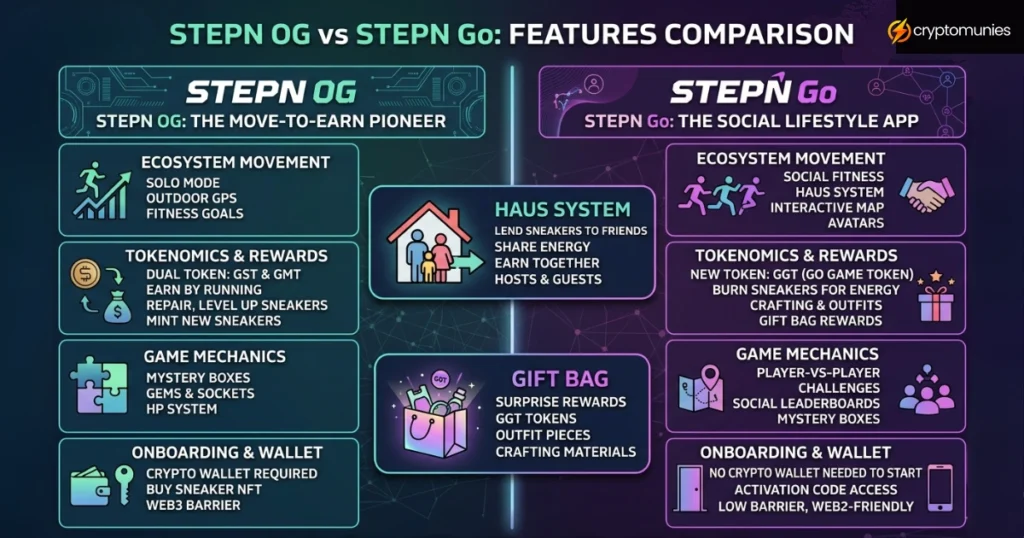
In May 2024, FSL officially launched StepN Go – a parallel app designed to address two of the original StepN’s biggest weaknesses: high entry costs and social isolation.
Key Differences Between StepN and StepN Go
| Feature | StepN (OG) | StepN Go |
|---|---|---|
| Primary Token | GST (utility) + GMT (governance) | GGT (Go Game Token) + GMT |
| Entry Method | Must buy NFT sneaker directly | Gift Bag trial sneaker available – no upfront purchase needed to try |
| Social Features | Minimal – primarily solo activity | Avatars, messaging, friend system, interactive map, PvP mode |
| Sneaker Lending | Limited | Haus System – NFT owners lend sneakers and split earnings with borrowers |
| Anti-Cheat | Standard GPS and motion checks | Schadenfreude Pool redistributes earnings from flagged cheat accounts |
| Brand Partnerships | ASICS, Adidas (historical) | Adidas Ultraboost 5, Snoop Dogg, G-SHOCK, Argentina Football Association |
The Gift Bag System
One of StepN Go’s most significant changes for new users is the Gift Bag feature – a trial sneaker that lets people earn GGT without purchasing an NFT upfront. Based on community testing, a Gift Bag generates approximately 22 GGT before its energy expires. To continue earning after that, users need to purchase a permanent sneaker – Common or Uncommon – via the marketplace before the trial’s QR code expires.
The Haus System: Sneaker Lending
The Haus System is StepN Go’s answer to one of the original app’s biggest complaints – the high barrier to entry. NFT sneaker owners can lend their sneakers to other users and split the GGT earnings. The owner takes the majority share and retains the risk of HP degradation, while the borrower can participate without owning an NFT. This mirrors the scholarship model that briefly made Axie Infinity accessible to lower-income players in developing countries, though StepN Go’s version includes more structured ownership protections.
GMT Pay: From In-App Tokens to Real-World Spending
In April 2025, FSL launched GMT Pay – a Web3 payment product featuring a virtual Mastercard compatible with Apple Pay and Google Pay. Users can convert their in-app earnings (GMT, GGT, and other FSL ecosystem tokens) into spendable funds at any Mastercard merchant worldwide. The card is available in $25, $50, $100, $200, and $300 denominations.
GMT Pay represents the most concrete attempt FSL has made to bridge the gap between crypto earnings and real-world value. Rather than requiring users to manually sell tokens on an exchange, it provides a familiar payment experience that removes a major friction point for non-crypto-native users.
FSL’s 2025 Efforts to Rebuild StepN Crypto
FSL has made several structural changes since the 2022 crash aimed at improving long-term sustainability. The most significant token-side move is a 600 million GMT buyback and burn – the company repurchased these tokens from early investors and advisors, removing them from circulation. For users of the app, the more visible developments have been on the product and partnership side.
- GMT DAO Launch – giving token holders a formal on-chain governance mechanism to vote on treasury allocations and protocol proposals.
- Trailblazer Airdrop (July 2025) – distributing GMT and FSL Points to active users based on activity, badge achievements, and leaderboard rankings.
- Argentina Football Association partnership (May 2025) – a two-year collaboration featuring limited-edition Genesis Sneakers inspired by Argentina’s football heritage.
- Guinness World Records partnership – a community milestone event used to drive engagement around organised fitness challenges.
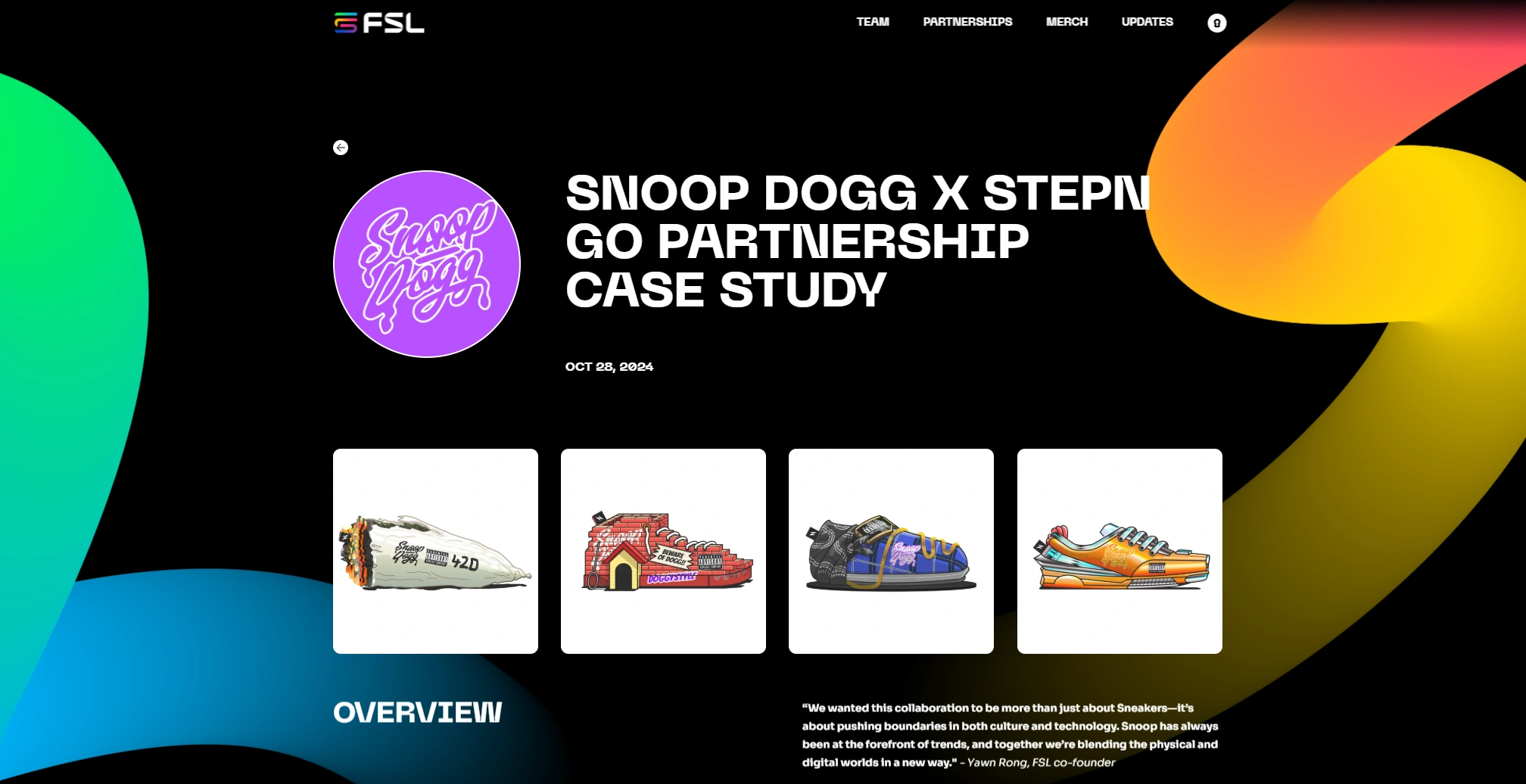
- Snoop Dogg and G-SHOCK collaborations (2024) – cultural marketing partnerships targeting audiences beyond the existing crypto fitness community.
- Learn and Earn campaign in Japan (April 2026) – users on OKCoin Japan completing educational quizzes earn GMT directly, expanding the token’s user acquisition pipeline.
These moves show a team actively working to extend the project’s life through diversification. Whether they are sufficient to rebuild sustainable token economics is a separate question – and one the data does not yet answer clearly.
StepN vs Other Move-to-Earn Crypto Apps in 2026
StepN is not the only move-to-earn option available in 2026. The broader M2E sector has a combined market cap of approximately $69.7 million as of May 2026 according to CoinGecko – a fraction of its 2022 peak. Several projects operate with meaningfully different models worth comparing.
| App | Chain | Entry Cost | Reward Token | Key Difference |
|---|---|---|---|---|
| StepN OG | Solana / ETH / BNB | NFT sneaker required | GST + GMT | Pioneer; deepest ecosystem; most brand partnerships |
| StepN Go | Solana | Gift Bag trial available | GGT + GMT | Social features, PvP, Haus lending system |
| Sweatcoin | NEAR | Free to start | SWEAT | No upfront NFT purchase required |
| Genopets | Solana | NFT pet required | GENE | Tamagotchi-style gameplay layer |
| DEFIT | Polygon | Free to start | DEFIT | Supports cycling and swimming as well as running |
For users who want to explore move-to-earn without the upfront NFT investment, Sweatcoin and DEFIT both offer free-to-start models. These platforms carry different – and arguably lower – token sustainability risks since they are not funded primarily by NFT sneaker sales.
How to Get Started on StepN Crypto in 2026
If you are considering entering StepN today, the steps below reflect the current process. The key warning before anything else: read the StepN whitepaper at whitepaper.stepn.com before spending any money. Many early frustrations in the community came from investing without understanding how the energy system and sneaker attributes actually work.
Step 1 – Download the App and Choose a Blockchain
The StepN app is free to download on iOS and Android. On first launch, you select which blockchain realm to operate in: Solana, Ethereum, or BNB Chain. Solana is the original home of StepN and offers the lowest transaction fees. You then fund a wallet within the app with the relevant cryptocurrency.
Step 2 – Acquire a Sneaker NFT
Browse the in-app marketplace and select a sneaker that matches your usual movement speed. Check the sneaker’s Efficiency attribute and available gem sockets carefully – these are the two factors most directly tied to GST earnings. Community tools like stepn-market.guide and the optimiser at stepn.guide can help you compare options and estimate earnings before buying.
A key tip shared consistently by experienced community members: never buy a sneaker already levelled above 24 unless it is a GMT earner, because levelling a sneaker to 25 provides a one-time free HP restoration. Buying one already past that level means paying for the levelling cost without receiving that benefit.
Step 3 – Optimise Your Gems Before Running
Install Level 3 or 4 yellow gems (Efficiency) in your sneaker sockets. Community analysis consistently shows gems below level 3 offer poor return on investment, while gems above level 5 have extremely long payback periods at current token prices. Keep the sneaker’s Comfort attribute at approximately 30-35 or above to reduce HP decay and repair costs.
Step 4 – Walk at Optimal Speed and Stop When Energy Runs Out
Move at the speed that matches your sneaker type. The app stops minting tokens if you move too fast or too slow. Critically: stop the app when your energy runs out. Continuing to move after energy is depleted degrades your sneaker’s HP with no corresponding earnings. Track your daily output and use community calculators to estimate your real ROI at current token prices before committing to additional purchases.
FAQ
Yes. StepN OG and StepN Go both remain operational. FSL is actively developing the ecosystem, including GMT Pay, DAO governance, and ongoing brand partnerships. Token prices remain far below their 2022 highs and daily active users are a fraction of the peak, but the app continues to function as designed. The question is not whether it works – it is whether the financial returns justify the entry cost at current prices.
In purely financial terms, profitability at current token prices is extremely difficult for most users. A Common sneaker earning 6 GST per day at $0.002 generates roughly $0.012 daily. Recouping a $50 sneaker entry cost at that rate would take years. Profitability improves if GMT or GST prices recover meaningfully, if you own higher-tier sneakers with optimised gem setups, or if you reach level 30 and begin earning GMT. For most new entrants at current prices, the health benefit is the more reliable return.
The crash had several causes. The broader May 2022 crypto market collapse was the primary trigger, compounded by StepN banning mainland China users and removing a significant share of the active user base. The underlying structural issue was that GST has unlimited supply – every active user mints new tokens every time they walk. As more users earned and sold GST, supply increased faster than demand, driving prices down. Lower prices reduced the incentive to participate, further reducing demand – a self-reinforcing downward cycle. For the full tokenomics analysis of this dynamic, see the companion article on StepN’s dual-token economy.
Calling it a classic Ponzi scheme is technically inaccurate – FSL collects real fees from sneaker sales and does not promise fixed returns. The more accurate characterisation is “ponzinomics” – a model where token value depends on continued new-user inflows. One widely-upvoted Reddit comment summarised it as: “If the only way I pay off my buy-in is to get more users to buy in, it is a pyramid scheme.” That structural dynamic is real, regardless of FSL’s intent.
StepN OG rewards users with GST and GMT for walking or running with NFT sneakers in a primarily solo format. StepN Go is a more social version with avatars, messaging, PvP competition, and a new token called GGT. StepN Go also introduced the Gift Bag feature allowing trial access without buying a sneaker upfront, and the Haus System for sneaker lending. Both apps continue to operate simultaneously and share the GMT governance token.
For detailed analysis of how each token’s supply, burn mechanics, vesting schedule, halving program, and earning attributes work – including what would need to happen for either token to recover – see the companion article: Green Satoshi Token and GMT: A Deep Dive into STEPN Dual-Token Economics

Stefan is enthusiastic about the new technologies, including blockchain. He got to know cryptocurrencies more than 15 years ago, when he mined his first cryptocurrencies on graphics cards. His latest goal is to spread new ways to use cryptocurrencies in the real world.