
Mobile crypto mining is one of the most searched – and most misunderstood – topics in the crypto space. The promise is seductive: download an app, tap a button, and earn cryptocurrency passively from the phone already in your pocket. But the reality is far less glamorous.
Key Takeaways
- True mobile crypto mining of major coins like Bitcoin is technically possible but practically worthless
- The majority of apps labelled as mobile mining apps are either scams, gamified simulations, or data-harvesting tools
- Both Google and Apple ban on-device mining apps from their official stores
- Projects like Pi Network redefine ‘mobile mining’ as a social validation mechanism – they do not mine cryptocurrency in any traditional sense.
- If you want to earn crypto with your phone, safer alternatives exist – but expect very small rewards
According to the Chainalysis 2025 Crypto Crime Report, crypto scams and fraud took in at least $14 billion on-chain in 2025 – up from $12 billion the previous year – and fake mining apps represent a significant slice of that fraud landscape.
This pillar guide cuts through the hype. It explains what mobile crypto mining actually is at a technical level, why your smartphone is fundamentally ill-suited for real mining, what different types of ‘mobile mining apps’ are really doing behind the scenes, and how to tell a legitimate product from a scam. Specific app reviews and rankings are covered in dedicated sub-articles; the purpose here is to give you the foundational knowledge to evaluate any mobile mining claim you encounter.
What Is Mobile Crypto Mining?
At its core, cryptocurrency mining is the process by which new transactions are verified and added to a blockchain. Miners compete to solve complex cryptographic puzzles – known as Proof of Work (PoW) – and the first machine to find the correct solution earns the block reward. The speed at which a device can attempt these calculations is measured in hashes per second (H/s).
Mobile crypto mining refers to using a smartphone – its CPU, and in some cases GPU – to perform these calculations. In theory, any device with a processor can attempt to mine. In practice, the gap between what a smartphone can do and what modern mining hardware can do is enormous, and the gap keeps widening.
The Hardware Gap: Phones vs. ASICs
Today’s Bitcoin network is secured by Application-Specific Integrated Circuits (ASICs) – machines designed for one purpose only: to compute SHA-256 hashes as fast and efficiently as possible. The leading 2025 models, such as the Bitmain Antminer S21 XP, produce around 270 terahashes per second (TH/s). A high-end smartphone CPU, by contrast, operates in the range of roughly 1-2 megahashes per second (MH/s) – a gap of approximately 100 million to one.
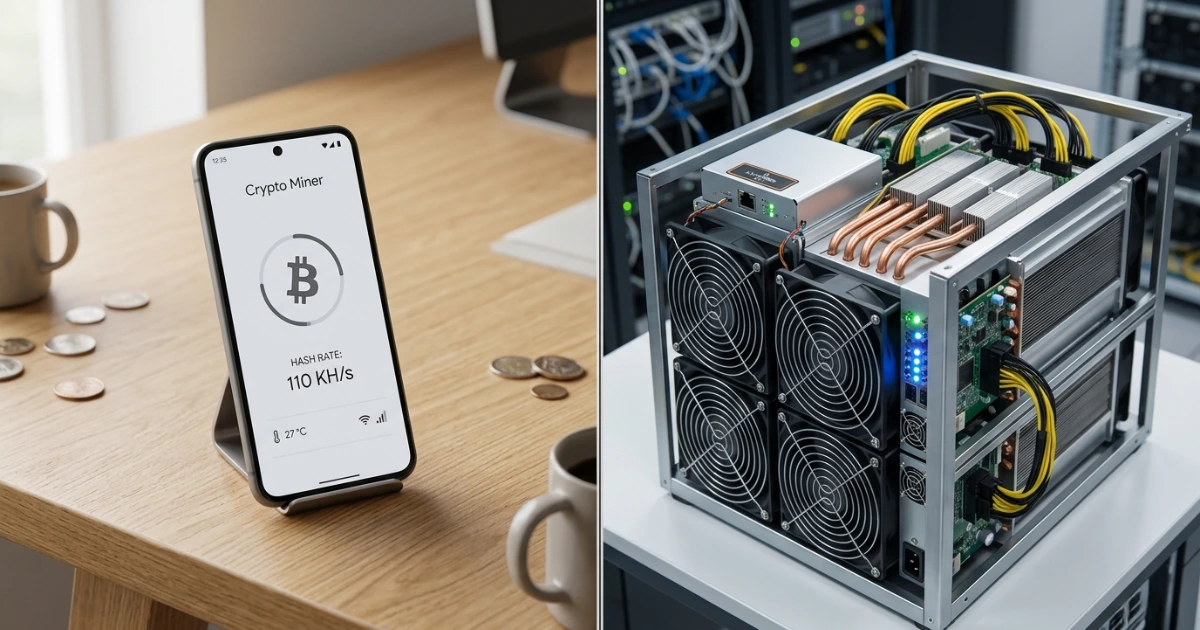
In practical terms, a single top-tier ASIC earns its owner around $11-12 per day at 2025 Bitcoin prices with electricity at $0.10/kWh. A smartphone running at its absolute limit would earn a fraction of a cent per day – while consuming its battery and degrading its hardware at a rate that makes the entire exercise a net financial loss.
| Device Type | Typical Hashrate | Daily BTC Earnings (est.) | Realistic for Mining? |
|---|---|---|---|
| Top ASIC (Antminer S21 XP) | 270 TH/s | ~$11-12/day gross | Yes, with cheap electricity |
| GPU Rig (4x RTX 4090) | ~1.2 GH/s (ETH alts) | ~$3.89/day (varies by coin) | Marginal, 5+ yr payback |
| High-End Smartphone (2025) | ~1-2 MH/s | < $0.01/day | No – net loss |
| Budget Android Phone | < 0.5 MH/s | Negligible | No – device damage risk |
Why Smartphones Are Fundamentally Unsuited for Mobile Crypto Mining
Processing Power
The Bitcoin network’s total hash rate in 2025 sits in the hundreds of exahashes per second (EH/s). A smartphone contributes so little to that total that its probability of ever solving a block solo is statistically indistinguishable from zero. Even pooling with other phone miners does not change the fundamental economics – there simply is not enough raw compute.
Thermal Management
Professional mining rigs use industrial cooling – fans, liquid cooling, purpose-built ventilation systems. Smartphones have none of this. Sustained CPU load at 100% causes rapid overheating, which triggers thermal throttling (the phone slows itself down to avoid damage), reduces processing speed further, and over time causes permanent degradation to the battery and processor. Security researchers and consumer advocacy groups have repeatedly flagged that mining apps cause battery damage, overheating, and shortened device lifespan.
Battery and Electricity Costs
Mining is an energy-intensive process by design. Running your smartphone CPU at maximum load will drain even a large battery (4,000+ mAh) in a matter of hours. If you charge continuously to keep mining, you are consuming electricity at a cost that far exceeds any micro-earnings from the mining activity itself. The math does not work in the miner’s favour.
App Store Bans
Both Google and Apple have formally banned on-device cryptocurrency mining apps from their official stores. Google Play’s policy states explicitly: “We don’t allow apps that mine cryptocurrency on devices.” Apple’s guidelines similarly prohibit apps that mine crypto unless the processing is performed off-device (i.e. cloud-based). These bans exist because of the documented harm to user hardware and the prevalence of deceptive app descriptions. Any app you find in the official stores that claims to mine crypto on your device is either misrepresenting what it does or has slipped through moderation.
What Mobile Mining Apps Are Actually Doing
The term ‘mobile mining app’ covers a wide range of products, most of which have nothing to do with real mining. Understanding the different categories is essential before you download anything.
1. Gamified Simulation Apps (Fake Mining)
These apps display a mining dashboard with rising numbers, hash rate counters, and rewards accumulating in your ‘wallet.’ Behind the scenes, no actual cryptographic computation is taking place. The counter is a timer function – a piece of code that simply increments a number on your screen. Security researchers at Trend Micro, who analysed multiple apps removed from Google Play, found that the ‘mining activity on the app’s user interface is carried out via a local mining simulation module that includes a counter and some random functions.’ The coins you ‘earn’ are either worthless proprietary tokens or, in scam cases, balances you can never actually withdraw.
A simple way to test a suspicious app: restart your phone while it is ‘mining.’ If the coin counter resets to zero, the app is a simulation, not a real miner.
2. Cloud Mining Interfaces
Legitimate cloud mining involves renting hash power from a remote data centre that operates real mining hardware. Your phone acts as a dashboard and management interface – it is not doing the mining itself. In this model, the actual computation happens at the data centre, and your earnings reflect your share of that rented hash power.
The problem is that the cloud mining sector is rife with fraud. According to industry data cited by BingX, cloud mining-style scams alone defrauded investors of more than $500 million in 2024. Many platforms claim to own data centres but show fabricated dashboards, paying early users from new investor deposits in a classic Ponzi structure. The SEC brought charges against the founders of a fake crypto mining pyramid scheme called HyperFund in 2024, which it claimed defrauded victims of $1.7 billion.
Even legitimate cloud mining contracts carry significant risk – profitability depends on Bitcoin’s price, network difficulty, and platform fees, all of which can move against you. Free withdrawal is a red flag: real crypto transfers require on-chain fees.
3. Social Consensus / Validation Apps
These are projects like Pi Network that use the word ‘mining’ to describe a social participation mechanism. Users are not solving cryptographic puzzles – they are pressing a button to confirm they are active in the network, which is then used in a trust-based consensus algorithm. This is categorically different from Proof of Work mining.
4. Crypto Faucets and Task-Reward Apps
Crypto reward apps that pay you small amounts of crypto for watching ads, completing surveys, or playing games are not mining apps at all – they are reward platforms funded by advertising revenue. The earnings are real but extremely small, and the model is transparent. They are not deceptive in the same way as fake miners, but they are often marketed alongside mining apps in a way that blurs the distinction.
5. Cryptojacking Malware
This is the hostile version of mobile mining: malware that secretly uses your device’s resources to mine for the attacker’s benefit, without your knowledge or consent. Cryptojacking apps have been found disguised as games, utilities, and even VPNs. The tell-tale signs are rapid battery drain, device overheating, and unexplained slowdowns.
Pi Network: A Case Study in ‘Mobile Mining’ Redefined
Pi Network is arguably the most high-profile mobile mining project in the world, with a claimed user base of over 60 million globally as of 2025. It is worth examining closely because it represents a model that is neither a straightforward scam nor traditional mining – and that ambiguity is exactly what makes it controversial.
How Pi ‘Mining’ Actually Works
Pi Network runs on a modified version of the Stellar Consensus Protocol (SCP), which does not use Proof of Work at all. When users press the ‘mine’ button daily, they are not solving cryptographic puzzles. They are confirming their active participation in a trust network. Analysts and critics – including a detailed review by Coin Bureau – note that it would be more accurate to call Pi’s ‘miners’ validators or participants, and the process ‘validation,’ not mining.
The app is free and does not drain the battery or damage the device during the button-press activity, which is genuinely different from the hardware-damaging fake mining apps. However, every button-press surfaces an advertisement – a pattern that has led critics to argue that Pi’s primary business model may be advertising revenue and user data collection rather than building a functional cryptocurrency.
Key Criticisms of Pi Network (2025)
The following concerns have been raised by multiple independent analysts, including Coin Bureau and CCN, as of 2025:
- Centralized control: Reports from January 2025 indicate that all mainnet nodes are operated by the Pi Network core team, not by community members.
- No open market trading: Pi Coin is not listed on major exchanges, making its stated value speculative. Without open markets, price discovery is impossible.
- Opaque tokenomics: The circulating supply, total supply cap, and long-term inflation rate have not been transparently disclosed.
- KYC data concerns: Mandatory identity verification data is reportedly stored on centralized servers, raising data privacy questions.
- MLM-like growth mechanics: The referral-based system, where inviting others increases your mining rate, resembles a multi-level marketing structure.
Pi launched its Open Mainnet in February 2025 and has announced partnerships including a $100 million ecosystem fund and integration with Chainlink. Whether these developments translate into a genuinely functional cryptocurrency with real-world liquidity remains to be seen. For now, Pi Coin’s value is largely theoretical.
How to Spot a Mobile Crypto Mining Scam
The crypto fraud landscape is large and growing. The FBI reported that US citizens lost $9.3 billion to crypto scams in 2024 – a 66% increase year-over-year. Fake mining apps are a consistent component of that total. The following red flags apply to any mobile mining app or cloud mining platform.
| Red Flag | What It Usually Means |
|---|---|
| Guaranteed daily profits | Real mining is never guaranteed – it is probabilistic by design. |
| No company information or registered address | Legitimate cloud mining companies have identifiable legal entities. |
| Upfront payment to ‘start mining’ or ‘upgrade’ | Classic fake mining app model – you pay; the app simulates activity. |
| Free withdrawals with no transaction fees | Crypto transfers always require on-chain fees. Fee-free withdrawals = no real crypto. |
| Counter resets to zero after app restart | The ‘mining’ is a JavaScript counter, not real computation. |
| App only available outside official stores | Legitimate apps that are removed from official stores for policy violations are often re-distributed as APKs. |
| Referral-heavy incentives to recruit others | Common in Ponzi and pyramid schemes that depend on new user capital. |
Does Mobile Mining Damage Your Phone?
For apps that actually attempt on-device computation (as opposed to simulations or cloud interfaces), the answer is yes. Sustained high CPU load causes:
- Battery degradation: Lithium batteries degrade faster under repeated deep discharge cycles caused by sustained high load. Each charge cycle at high draw accelerates capacity loss.
- Thermal damage: Overheating can permanently damage the SoC (System on Chip), the battery, and other internal components. In extreme cases, devices have failed entirely.
- Performance throttling: Modern smartphones automatically reduce CPU speed when a temperature threshold is reached – meaning your ‘miner’ progressively slows down, earning even less while still consuming power.
- Shortened device lifespan: Even if no acute damage occurs, sustained high-temperature operation accelerates the wear of all components.
For fake simulation apps, the device impact is minimal – the app is not actually doing heavy computation. The damage in that case is financial rather than physical.
Legitimate Ways to Earn Crypto With Your Smartphone
If you want to participate in the crypto ecosystem from your phone without falling for scams or damaging your device, the following models have genuine (if modest) earning potential.
- Crypto faucets and reward apps: Platforms that pay small amounts of crypto for completing tasks, watching ads, or learning about crypto. Crypto earnings are very low but the model is transparent and the risk is limited.
- Staking via a mobile wallet or exchange app: Holding Proof of Stake cryptocurrencies in a wallet and earning staking rewards is a legitimate passive income mechanism. The phone is used as an interface, not a miner.
- Crypto learning rewards: Some major exchanges offer small amounts of crypto for completing educational modules. This is a legitimate, low-risk way to accumulate small holdings.
- Monitored cloud mining (high risk): If you are considering a cloud mining contract, use only platforms with verifiable legal registration, transparent audit data, and a track record. Never deposit money you cannot afford to lose completely. Conduct independent research beyond the platform’s own marketing materials.
None of these alternatives will make you rich. Anyone promising significant passive income from a smartphone with no capital outlay is almost certainly misrepresenting reality.
Frequently Asked Questions
Technically yes, practically no. Your phone’s CPU has nowhere near the processing power needed to compete with modern ASIC miners on the Bitcoin network. The tiny amount you might earn would not cover your electricity costs, and you would degrade your phone hardware in the process. Legitimate Bitcoin mining in 2025 requires dedicated ASIC hardware.
Apps that manage cloud mining contracts from your phone are legitimate in structure, though the underlying cloud mining industry has a high fraud rate. Apps that claim to mine directly on your device are either banned by app stores or are simulations. Always verify a platform independently before depositing funds, and treat any guaranteed profit claim as a red flag.
Pi Network is not a straightforward scam in the sense of disappearing with users’ money – it is a real project backed by Stanford graduates that launched its Open Mainnet in 2025. However, it is also controversial: it uses the word ‘mining’ for a process that is not mining, its token has no reliable market value or exchange listing, its infrastructure is currently centralized, and its business model appears to be heavily advertising-driven. Whether it ultimately delivers value to its users is still an open question.
This is unlikely for major Proof of Work coins like Bitcoin. As phone hardware improves, ASIC hardware improves faster – the gap does not close. For alternative coins designed specifically for CPU mining (such as Monero), phone mining is more feasible but still marginal given electricity costs and device wear. The more realistic future for ‘mobile’ crypto participation is staking, governance, and DeFi interfaces – not mining.
Uninstall it immediately. Run a mobile antivirus scan (reputable options include Bitdefender Mobile Security and Malwarebytes). Change the passwords for any accounts you accessed while the app was installed, especially if those accounts are linked to real crypto wallets or exchanges. Report the app to the relevant app store.
Yes, if the app is performing real computation. Sustained CPU load at high temperature degrades lithium battery capacity faster than normal use. Fake simulation apps do not cause this problem – but they do not actually mine anything either.

Stefan is enthusiastic about the new technologies, including blockchain. He got to know cryptocurrencies more than 15 years ago, when he mined his first cryptocurrencies on graphics cards. His latest goal is to spread new ways to use cryptocurrencies in the real world.