
According to a Nielsen’s 2021 Global Trust in Advertising study which surveyed 40,000 people across 56 countries, 88% of consumers globally trust recommendations from people they know more than any paid ad format. It is based on this trust that referral programs, including Bybit’s own program, were born.
Key Takeaways
- Bybit offers two separate tracks – a flat signup reward for the referee and an ongoing trading-fee commission for the referrer
- Headline numbers like “up to $30,000” or a $200,000 prize pool describe the total pool split across every participant, not what one referrer typically walks away with.
- Account bans and revoked reward reports form a recurring pattern in user complaints, usually traced back to Bybit’s automated risk review system rather than a named rule violation.
- Referral rewards are taxable as ordinary income in most jurisdictions the moment they land in your account, separate from any capital gain or loss when you later sell the coins.
- Bybit still does not operate in the United States
Headquartered in Dubai, Bybit is a cryptocurrency exchange network founded in 2018, offering a wide range of services like spot trading, derivatives, copy trading, staking style earn products, and a Web3 wallet. This article walks through what Bybit referral program is, detailing critical nuts and bolts of the platform.
Bybit’s Referral Program
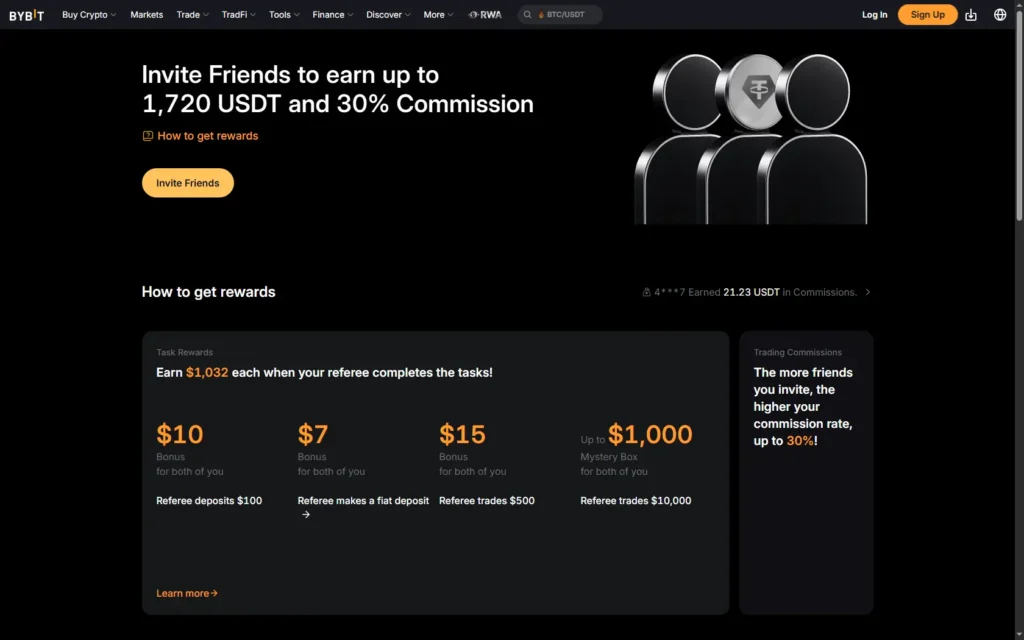
Bybit referral bonus is a simple trade where you share a link, a friend signs up and deposits, and Bybit pays both of you. This program includes a one-time signup reward, a recurring trading-fee commission, seasonal campaigns tied to gold-backed tokens, and a separate high-volume affiliate track.
When you sign up, Bybit generates a unique referral link and a short alphanumeric code tied to your account. Anyone who registers through that link, or types your code into the referral field during signup, is permanently attached to you as an attributed referral. This attribution is set once, at registration, and generally cannot be changed afterward.
From that point, two independent reward tracks can activate:
- A one-time deposit or task bonus for the new user (the referee), typically triggered by a deposit of $100 or more within seven days of signup. This is sometimes combined with a small trading-volume requirement.
- An ongoing trading-fee commission for the person who shared the link (the referrer). This is calculated as a percentage of the fees their referral pays on every trade, for as long as that referred account keeps trading.
It is from the second track that you notice the separation between a referral bonus from a plain signup bonus. The former doesn’t stop after the first deposit.
Read also: Crypto Cashback: Earn Money Back on Everyday Spending
How to Participate: A Step-by-Step Walkthrough
The mechanics are the same across most of Bybit’s referral campaigns, whether you’re chasing a flat $10-$30 bonus or a seasonal prize pool. Here’s the sequence:
- Create an account on Bybit and locate your unique referral link or code in the Rewards Hub or Affiliate section.
- Share the link or code before the person you’re referring registers. It must be entered during signup; it generally cannot be added to an account that already exists.
- The referred user completes identity verification (KYC), which is a prerequisite for almost every reward tier, including the base signup bonus.
- The referred user deposits the minimums required from an eligible source like fiat, crypto, One-Click Buy, or P2P. Internal transfers between Bybit accounts, coupon-funded deposits, and bonus balances typically don’t count.
- Some campaigns also require a minimum trading volume, often as low as $10-$500 depending on the tier, within a set window (commonly seven days).
- Points or rewards are credited after Bybit’s risk review confirms the referral was legitimate, which the company’s own campaign terms describe as taking up to three days for points and up to ten days for final payouts.
That risk-review step is the part most complaints center on. Community threads on the r/Bybit subreddit include cases where a referral was marked “Referral Failed” after the referred user signed up on the same Wi-Fi network as the referrer, with Bybit support attributing the failure to risk flagging tied to shared network or device fingerprints rather than any deliberate rule-breaking by either party.
Where Bybit Referral Bonuses Go Wrong: Account Bans
Account bans tied to referral activity are one of the most consistently repeated complaints across Reddit threads spanning 2021 through 2026. After completing KYC, and referring a friend, users have complained of their accounts being restricted. All this happens with little to no specific explanation from support beyond a generic reference to “risk flagging” or “terms violation.”
So, what often triggers the flags?
- Shared IP address or Wi-Fi network between the referrer and the referee, even when both are real people.
- Low trading volume from the referred account relative to what the campaign expected, which can read as an attempt to farm the signup bonus without genuine trading activity.
- Device fingerprint overlap, where two accounts show enough similarity in browser or app signals to be flagged as a single person operating multiple accounts.
- Bot-like registration timing, such as several referred accounts created in rapid succession.
Bybit notes that it has the right to withhold rewards for activity it deems inappropriate, dishonest, or abusive, without a firm obligation to specify which condition applied. And this is a primary reason for the many complaints, with many saying that even legitimate users get caught in the same net with no accessible appeal path beyond opening a general support ticket.
Noteworthy is the idea that the exchange has been forced to rebuild trust after the $1.5 billion hack it suffered on February 21, 2025. Bybit filed a civil suit against North Korea and the Lazarus Group and said customer funds were unaffected. Yet, the incident is part of why the exchange’s compliance and risk-review systems have tightened since.
When the Bybit Referral Code Doesn’t Work
Referral codes fail for reasons that are almost always mundane rather than malicious. If your code isn’t applying, or a friend’s signup didn’t credit you, check these first:
- The account already exists.
- Typo in the code.
- Campaign expired or is region-locked.
- Auto-attribution from another link.
- Deposit source not eligible.
- Failed or incomplete KYC.
If none of these explain it, Bybit’s own support team has stated in community threads that the fastest path is contacting support directly from the registered email address. The company will not discuss account-specific referral details with anyone other than the account holder. There is no self-service appeal beyond that support channel.
The Bybit Referral League: The XAUT Prize Pool Campaign
Bybit’s Referral League campaign is structured around XAUT (Tether Gold), a token backed 1:1 by physical gold. Individual referrals contribute points toward a shared prize pool that can grow to a stated maximum of $200,000 in XAUT. The final tier is determined by the total number of confirmed referral points the whole community generates by the campaign deadline, not by any single person’s activity.
To qualify for a personal payout, Bybit’s terms require a minimum of two successful referrals. A successful referral means a new user registers through your link or code and deposits at least $100 within seven days of signing up, using an eligible funding source. Points credit within roughly three days of a qualifying deposit. Bybit says final rewards are distributed within about ten days of the campaign ending, subject to risk review.
The Referral League is one of several XAUT-linked promotions Bybit has run through mid-2026. A separate “Squad Gold Rush” team campaign, running through August 18, 2026, offered a squad prize pool of up to 100,000 USDT split by team performance, plus lucky-draw entries with a displayed prize value of up to $10,000 in XAUT for top contributors.
Both campaigns explicitly exclude users residing in the European Economic Area.
The Bybit Card and Bybit in the United States
Bybit Card cashback and its own referral layer
The Bybit Card is a crypto-linked debit card that auto-converts crypto balances to fiat at checkout. Base cashback runs around 2% in USDT, with promotional tiers offering higher rates of up to 12.5% for a limited window on some categories. There is also a widely advertised 100% cashback on select subscriptions such as Netflix or Spotify during a user’s first month. The above is subject to a monthly spending threshold and a points cap that typically drops the rate to 50% once exceeded.
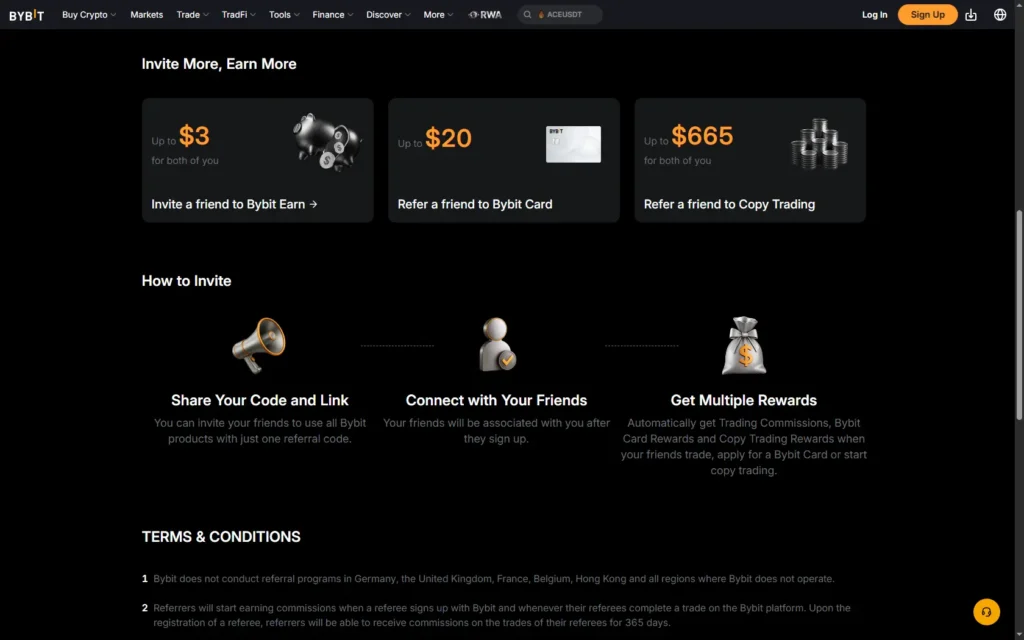
The card carries its own referral layer where a referrer commonly earns a fixed bonus when a referred user applies for the card and spends over a set minimum, usually around $100, within the first 30 days.
Why Bybit US isn’t a thing
Bybit does not offer services or products to residents of the United States. Hence every referral code, the Referral League, Squad Gold Rush, and the Bybit Card are all unavailable to US-based users regardless of VPN use.
The EU picture is different
In Europe, Bybit took the opposite approach. Its EU entity, Bybit EU received a MiCA crypto-asset service provider license from Austria’s Financial Market Authority on May 28, 2025. Bybit EU runs its own parallel referral and cashback promotions separate from the global platform’s campaigns, and new EEA users are directed to register there rather than on bybit.com.
You may also like: Coinbase Learn and Earn Review: What Replaced It in 2026
Alternatives to the Bybit Referral Program
Bybit’s structure isn’t unusual for the industry, but the specific numbers vary meaningfully by exchange. The figures below reflect each platform’s own published referral or affiliate terms as of mid-2026. They are self-reported by the exchanges themselves.
| Exchange | Standard Referral Reward | Affiliate Commission Ceiling | Notable Condition |
|---|---|---|---|
| Binance | Flat signup bonus varies by campaign | Up to 50% of trading fees (spot) | Excludes VIP 3+ referred accounts from commission calculations |
| OKX | Flat signup bonus varies by campaign | Up to 50% of trading fees | 180-day cookie/attribution window, longer than most competitors |
| Coinbase | Flat signup bonus, region-dependent | Lower base share than derivatives-focused exchanges | Stronger US availability and regulatory standing than Bybit |
| KuCoin | Flat signup bonus varies by campaign | Up to roughly 45% of trading fees | Comparatively low bar to entry for smaller referrers |
| MEXC | Flat signup bonus varies by campaign | Up to roughly 50-70% in some published tiers | Higher regional concentration in Asia-Pacific markets |
None of these platforms are immune to the same complaint like risk-based reward denial, unclear ban appeals, and referral fraud detection. The practical differences tend to come down to regulatory footprint and attribution window length.
Tax Implications of Crypto Referral Bonuses
Regardless of which exchange pays it, a crypto referral bonus is ordinary income in the eyes of most tax authorities. It’s taxable the moment you receive it, based on its fair market value in your local currency at that time.
The IRS states that the fair market value in US dollars of any digital asset received as income must be reported. Referral, staking, and similar reward-type income is reportable on Form 1099-MISC. When you later sell or spend the bonus coins, that’s a separate, second taxable event. A capital gain or loss event is triggered measured against the fair market value you already reported as income when you received it.
In Canada, referral rewards are taxable, typically as property income for casual referrers or business income if the activity is systematic, valued at fair market value when received. Disposing the tokens later triggers a separate capital gain or loss.
The United Kingdom (HMRC) generally treats referral bonuses as miscellaneous income, or as trading income where the activity rises to the level of a business. Australia’s (ATO) treats referral rewards as ordinary income at their market value on the date received.
In India, referral income is taxed twice. First, it is an ordinary income at your slab rate when received. Moreover it falls under the country’s flat crypto tax regime (commonly cited at a 30% rate plus a 4% cess) when the resulting tokens are later sold or transferred.
The common thread across every jurisdiction above: a bonus you didn’t have to pay for – a pure signup or referral reward – is still income the moment it lands in your wallet, distinct from cashback tied to a purchase, which some tax authorities treat more like a rebate. Keeping a simple record of the date received, the coin, and its dollar value that day will save considerably more time than reconstructing it later from an exchange statement.
Frequently Asked Questions
It’s a reward paid for inviting a new user to Bybit, made up of a flat signup bonus for the person who joins and, separately, an ongoing percentage of that new trader’s fees paid to whoever referred them.
It depends entirely on how much your referrals trade. Standard referrers start around a 20% share of a referred trader’s fees, scaling to 30% with more qualified referrals; the application-only Affiliate Program goes up to 50%. Flat signup bonuses in current campaigns tend to sit in the $10-$50 range per qualifying referral.
The most common causes are a shared IP or device with the referred account, low trading volume from the new account, or Bybit’s automated risk-review system flagging the pattern as potential abuse – even when both parties are genuine users.
No. Referral codes must be entered during the original registration flow; Bybit does not support retroactively attaching a code to an existing account.
No. Bybit does not offer services to US residents, which means every referral program, campaign, and the Bybit Card described here is unavailable in the United States.
In most jurisdictions, yes – it’s treated as ordinary income at fair market value on the date you receive it, separate from any capital gain or loss when you later sell the coins. Rules vary by country, so check current guidance for where you file.
