
You have heard about crypto airdrops and maybe many success stories of low-profile airdrop hunters who later see magnificent gains in their token holdings. For instance, in November 2024, a single wallet received 970,000 HYPE tokens, worth approximately $9.56 million at the token’s peak price of $9.80 in early December 2024. All this fuels your interest in collecting airdrops, but you are unaware of where to start. That’s where crypto airdrop websites come in.
Key Takeaways
- No single crypto airdrop website or aggregator is fully reliable on its own. The safest workflow combines two or three trackers with independent verification on the project’s own site.
- The top five airdrops of 2025 distributed a combined $4.5 billion at peak value, down sharply from $19 billion in 2024, according to Decrypt’s year-end aggregation.
- Learn about the top 7 crypto airdrop aggregator websites that provide much-needed information for your hunting needs.
- Uniswap’s 2020 drop is still the largest crypto airdrop ever by peak value at $6.43 billion, while Hyperliquid’s 2024 airdrop paid the highest average amount per wallet, close to $20,000.
- About 88% of airdropped tokens lose value within three months of launch, and 64% of recipients sell immediately at the token generation event, per CoinLaw’s on-chain research.
- Anti-sybil filtering now determines eligibility based more on raw activity.
This guide compares the most widely used crypto airdrop aggregators, so you know which tool actually fits your needs.
What is a crypto airdrop and why aggregators exist
A crypto airdrop is a free distribution of tokens sent to a wallet address, usually to reward early users, decentralize ownership, or build a community around a new protocol. Projects use airdrops as a distribution and marketing tool. Rather than selling their tokens, crypto projects will distribute them to wallets based on predetermined eligibility criteria.
Airdrops are mostly split amongst four formats including:
- Standard airdrops – registration plus light social tasks
- Bounty airdrops – rewarded for promotional or testing work
- Holder airdrops – based on wallet snapshots of an existing asset)
- Retroactive airdrops – rewarding historical on-chain activity nobody knew would count at the time.
The primary purpose of airdrop aggregators is not to replace the individual project’s official channels, but rather centralized discovery of airdrops. From the wide sea of available airdrops, a hunter can by themselves learn and choose which to participate in, using the feature-rich airdrop aggregators.
Best crypto airdrop websites and aggregators in 2026
The sites below cover different parts of the research process from discovery, protocol-quality checks, quest tracking, to cross-verification.
1. DeFiLlama Airdrops
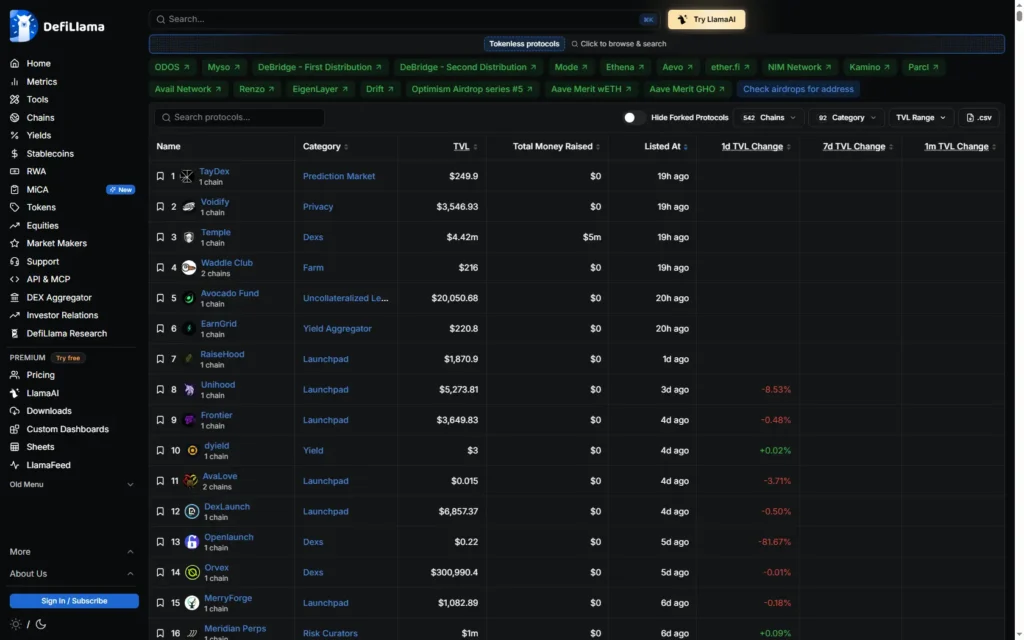
First in line are DeFiLlama airdrops.
The airdrops section of DeFiLlama is built on top of its DeFi analytics database. On the dedicated airdrops dashboard, DeFiLlama aggregates tokenless DeFi protocols with high potential of distributing airdrops. On top of that, DeFiLlama has a wallet address checker for verifying eligibility across various chains. Here you simply enter your EVM or SOL wallet address and note which airdrops you are eligible for.
In 2026, the dashboard is already tracking over 400 protocols without tokens. It checks aspects like TVL, Total money raised, TVL changes, chain, and categories. Simply;
- Visit defillama.com/airdrops
- Filter by tokenless protocols
- Check eligibility
- Track claims
Note that DeFiLlama does not confirm that an airdrop is coming; it only shows which protocols have the on-chain activity that historically precedes one.
Read also: The Code4rena Competitive Audit Model: What It Built and Where Wardens Go Now
2. CryptoRank Drop Hunting
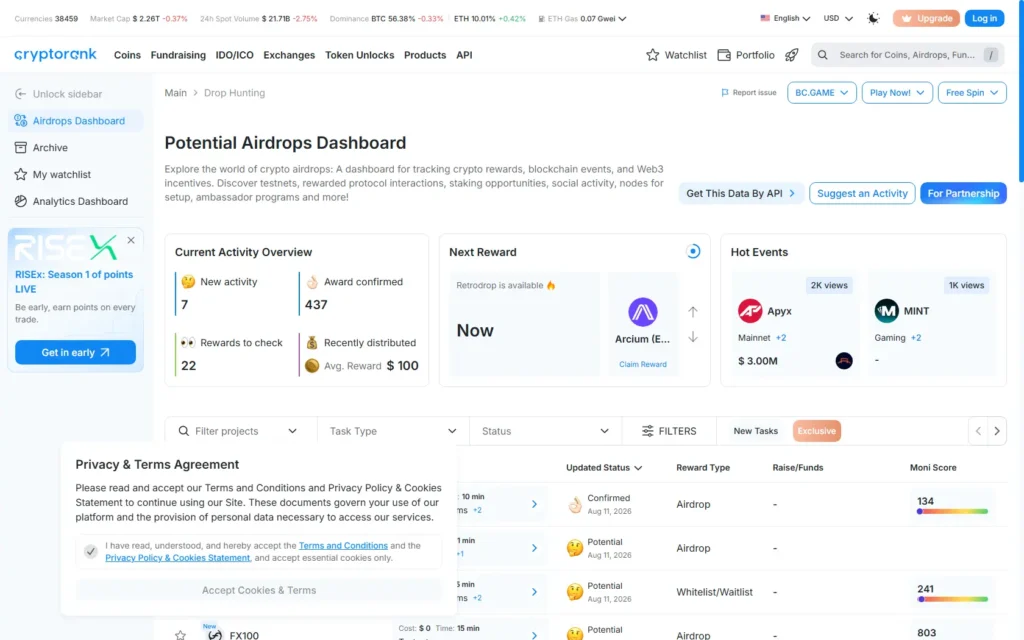
Cryptorank, like DeFiLlama, offers a dedicated airdrop tracking dashboard that tracks hundreds of upcoming airdrops. What’s more special is you get a step by step guide on how to actively participate in these airdrops. You get detailed instructions, task tracking status, and links to official project pages. A quick glance at the dashboard and you find 3 main widgets: current activity overview, near-term rewards, and hot activity.
There are already hundreds of campaigns; hence, the filter feature helps you sort the ones most likely good for you. The system allows filtering by task type, reward status, chain/category, and premium tasks.
Cryptorank’s own guidance recommends treating anything marked “potential” as speculative rather than confirmed. Best for: cross-checking a project’s funding and status before committing time to it.
3. CoinGecko Airdrops and Learn
If you want editorial airdrop guides and Curated lists, then CoinGecko offers you just that. You get articles like: “Top 10 Upcoming Crypto Airdrops.”
For instance, in one of the most recent guides, projects like Backpack, Polymarket, Metamask, Base, OpenSea, among others, were listed with potential airdrops.
4. CoinMarketCap Airdrops
CoinMarketCap’s airdrop portal mostly features campaigns directly integrated with the platform, including exchange-linked promotions and token campaigns tied to newly listed assets. Coverage is narrower than DeFiLlama or CryptoRank, but the campaigns listed tend to be easier to verify because they route through CoinMarketCap’s own listing process. Best for: quick, low-effort discovery of exchange-adjacent campaigns.
5. Airdrops.io

Airdrops.io is one of the oldest and most referenced general-purpose trackers, splitting campaigns into ongoing, upcoming, and potential categories with basic participation guides. Among its primary features are;
- Verified airdrop listings including active airdrops from various chains like Ethereum and Solana.
- Filters allow users to screen airdrops in categories like hot, latest, potential, upcoming, holder airdrops, community airdrops, amongst others.
- There’s a dedicated page where confirmed listings of officially announced airdrops are found.
- There are step-by-step guides for participating in each airdrop.
Compared to the likes of DeFiLlama and Cryptorank, Airdrops.io is fully free and retail-friendly.
6. AirdropAlert
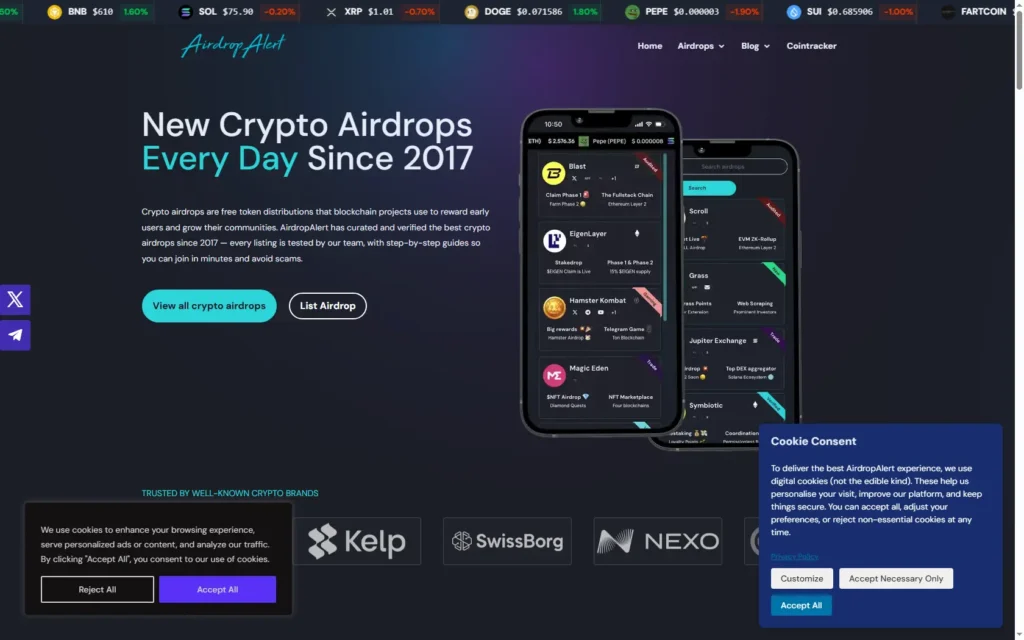
AirdropAlert positions itself as a curated tracker with beginner-oriented walkthroughs and its own yearly data report on total value distributed and chain-by-chain performance, the same report cited for several statistics in this guide. Like Airdrops.io, AirdropAlert comes with some strong features including;
- Verified airdrop listings, which bring live lists of new airdrops from categories like DeFi, gaming, trending, NFT, memes, testnet, amongst others.
- Step-by-step guide to participating in these already confirmed airdrops. The guide includes eligibility criteria, task breakdown, scam warnings, claim instructions, among others.
- Eligibility checker
- Advanced filter options.
Since dawn in 2017, AirdropAlerts has listed over 5000 different airdrops, and many have earned informantion from the site. This site is best for beginners who want participation guides alongside the listings.
7. Quest platforms: Galxe, Zealy, TaskOn, and QuestN
These are platforms projects use to run official quests, and they are often where the first credible signal of an airdrop appears. Completing a Galxe, Zealy, TaskOn, or QuestN campaign proves engagement, not a token reward. Some campaigns pay out points, badges, NFTs, or community roles with no token attached at all, so it’s worth confirming what the reward actually is before investing significant time.
| site | Best for | watch out for |
|---|---|---|
| DeFiLlama Airdrops | Spotting tokenless protocols with real usage | Doesn’t confirm an airdrop is actually planned |
| CryptoRank Drop Hunting | Funding and project-status checks | “Potential” listings are speculative |
| CoinGecko Airdrops | Historical peak-value data, editorial research | Broad list; still verify each campaign |
| CoinMarketCap Airdrops | Exchange-linked campaigns | Narrower coverage than dedicated trackers |
| Airdrops.io | General discovery, one of the largest listings | Thin, mixed third-party review record |
| AirdropAlert | Beginner guides plus curated listings | Still recommends independent verification |
| Galxe / Zealy / TaskOn / QuestN | Official, first-party project quests | Reward may be points or an NFT, not a token |
Are crypto airdrops worth your time?
It heavily depends on which airdrops, the level of effort, and market factors. However, since 2024, the trendline seems to point downwards towards smaller rewards. As per Decrypt’s aggregation, the top five 2025 airdrops distributed $4.5 billion combined, roughly a 76% drop from the $19 billion moved in 2024’s headline campaigns. At the same time, the number of global participants grew to about 199 million people. So, the pools are getting smaller while the number of participants is increasing.
The movement of the tokens soon after the drops is also a factor worth consideration. A study of two million airdrop addresses found that 64% of recipients sold immediately at the token generation event. Furthermore, between 50% and 70% of the total tokens distributed were sold within the first 30 days.
Coinlaw’s research indicates that 88% of airdropped tokens will lose value within the 3 months of launch. This is a sentiment widely supported by the crypto community. Several long-time airdrop hunters describe the free-money era as mostly over, noting that anything requiring little capital now gets “farmed to death” within days of discovery. Others point out that projects publishing real usage data, such as DeFiLlama’s protocol dashboards, remain a more reliable filter than chasing whatever is trending on social media.
When deciding whether to spend time on a certain airdrop campaign, check into factors like real product usage, a defined snapshot methodology, and a funding history. Those should help you decide which airdrop is worth your time.
People also read: Coinbase Learn and Earn Review: What Replaced It in 2026
Is airdrop hunting a real job?
For a small number of highly consistent, well-capitalized participants, airdrop farming can generate meaningful income in a given cycle. For most people treating it as a full-time pursuit, the economics are weaker, mainly due to aggressive anti-sybil filtering and rapid post-claim value decay.
Sybil filtering is the process projects use to detect and disqualify wallets operated by a single person. Yet, it has become the single biggest variable in who actually gets paid.
For instance, LayerZero Labs removed 803,273 wallets, or 59% of all applicants, before distributing its ZRO token. According to reports, LayerZero worked with on-chain analytics firms Nansen and Chaos Labs to cluster wallets by shared funding sources and near-identical transaction patterns.
Linea’s 2025 airdrop filtered a comparable number, roughly 800,000 wallets, before reaching its final list of 749,000 eligible claimants. Running many thin, low-effort wallets is now more likely to get an entire cluster disqualified than to multiply a reward.
The second issue is time versus payout. Since most airdropped tokens plunge immediately after token generation, the hourly return reduces vastly in days or weeks after claiming. This is especially important considering the months of on-chain activity, gas fees, and research time needed to avoid wasting effort on projects that never launch a token at all.
And then, there’s the tax man. In the United States, under IRS Notice 2014-21 and the agency’s published FAQ, airdropped tokens count as ordinary income at fair market value the moment you gain the ability to transfer or sell them, regardless of whether you actually claim or sell right away. That tax liability applies even to tokens that later drop 80% or more in value, which is common given how quickly post-airdrop prices fall.
Considering all the above downsides, some may conclude that airdrop hunting is worthless. Yet, the truth is, it only functions better as a selective, part-time activity layered on top of genuine interest in a handful of ecosystems than as a reliable primary income stream. The people who do best tend to concentrate on one or two chains, use real capital and varied on-chain behavior instead of copy-paste wallet farms, and treat every reward as a bonus on top of activity they would plausibly have done anyway.
Frequently Asked Questions
Uniswap’s September 2020 airdrop is the largest by peak value, worth an estimated $6.43 billion when UNI hit its all-time high, according to CoinGecko’s research team. ApeCoin’s 2022 airdrop is second at roughly $3.54 billion peak. By average payout per wallet, Hyperliquid’s 2024 drop is the highest on record at close to $20,000 per address.
Browsing an aggregator to see what’s listed is generally low-risk since you aren’t connecting a wallet. The risk appears once you click through to a claim page. Always verify the claim link through the project’s own official website or social account rather than trusting the aggregator’s outbound link alone, and use a separate, low-value wallet for the actual claim.
For nearly everyone, no. Sybil filters now disqualify more than half of applicant wallets on major campaigns, most airdropped tokens lose the bulk of their value within three months, and roughly two-thirds of recipients sell immediately rather than hold. It can be a worthwhile side activity for people already active in a handful of ecosystems, but the current data does not support treating it as a primary income source.
CoinGecko’s airdrop and learn pages are a reasonable starting point because the platform also functions as a data reference, not just a link list. From there, DeFiLlama is useful for judging whether a project has real usage behind it, and official quest platforms like Galxe or Zealy are the most direct way to confirm a campaign is genuinely run by the project rather than a copycat.
