
The idea of earning free crypto without spending a single dollar sounds appealing – and it is exactly what FaucetPay promises. Launched in 2019, FaucetPay has grown into one of the most recognized names in the crypto faucet and web3 faucet space, positioning itself as a micro-wallet that aggregates tiny cryptocurrency payouts from hundreds of external reward sites. The concept traces its roots back to 2010, when Bitcoin developer Gavin Andresen created the original Bitcoin Satoshi Faucet, giving away 5 BTC per user to introduce people to the then-unknown technology.
Key Takeaways
- FaucetPay is a legitimate crypto micro-wallet launched in 2019, letting users collect tiny payouts from faucets, PTC ads, surveys, and offer walls in one place.
- Earning potential is very low – casual users typically make between $0.30 and $3.00 per month, making it a learning tool rather than a real income source.
- The platform supports over 30 cryptocurrencies, including Bitcoin, Ethereum, Dogecoin, Litecoin, Tron, and USDT.
- Key risks include high minimum withdrawal thresholds, a custodial wallet structure, weak account security reported by some users, and an in-platform gambling feature.
- FaucetPay works best as a transit wallet and crypto education tool – withdraw funds regularly and never store large balances on the platform.
Today, bitcoin faucets and multi-coin faucet platforms like FaucetPay serve a different but still relevant purpose: letting beginners experience crypto wallets, transactions, and blockchain basics at zero financial cost. The question is whether the time investment is worth it. This article breaks down exactly how FaucetPay works, what you can realistically earn, where the genuine risks lie, and how it compares to similar platforms – drawing on real user experiences from Reddit, Trustpilot, and independent research.
What Is FaucetPay and How Does It Work?
FaucetPay.io is a centralized cryptocurrency micro-wallet operated by Basilisk Studio SRL and registered in Costa Rica. Rather than functioning as a full exchange or investment platform, it acts as an intermediary wallet – a single place where very small payouts from dozens of different external faucet websites and earning platforms are collected and held until the user is ready to withdraw.
The core mechanic is straightforward. You create a free account on FaucetPay, get a wallet address for each supported cryptocurrency, and then use that address on partner faucet sites to receive payouts directly into your FaucetPay balance. Internal transfers between FaucetPay-connected platforms are instant and fee-free, which is the main practical advantage over trying to receive micro-amounts directly on a mainnet wallet where on-chain fees would wipe out your earnings.
Supported Cryptocurrencies
FaucetPay supports over 30 cryptocurrencies. The most commonly earned through its faucet network include:
- Bitcoin (BTC)
- Ethereum (ETH)
- Dogecoin (DOGE)
- Litecoin (LTC)
- Tron (TRX)
- Dash (DASH)
- Tether (USDT)
- Digibyte (DGB)
- Feyorra (FEY) – FaucetPay’s own platform token
An important technical note: for networks like Ethereum and Tron, FaucetPay uses shared deposit addresses across multiple users. When depositing to these networks, your funds are credited based on your FaucetPay wallet ID, not your address alone. Always read the instructions on the deposit page before sending funds to avoid errors.
Ways to Earn Free Crypto on FaucetPay
FaucetPay offers several methods to earn free crypto, ranging from fully passive to more time-intensive tasks. Here is an honest breakdown of each.
Crypto Faucets
The original earning method. FaucetPay lists over 600 connected faucet sites across its supported currencies. You visit a partner faucet, solve a captcha or click a button, and the site sends a tiny payout directly to your FaucetPay balance. Most faucets operate on timers of 5 to 60 minutes between claims. Payouts are measured in satoshis for Bitcoin, or equivalent micro-amounts for other coins. As one Reddit user put it plainly: faucets are intended to let people test how blockchain works, not to generate meaningful income.
Paid-to-Click (PTC) Ads
FaucetPay has a built-in Paid to Click section where users earn tiny amounts of crypto for viewing advertisements for a fixed number of seconds. The earnings per click are extremely small. When this article was researched, the PTC section showed no available ads – a common occurrence that means income from this method is unreliable and inconsistent.
Offer Walls
FaucetPay integrates four offer wall providers: TimeWall, Monlix, CPX Research, and Lootably. These can pay significantly more than basic faucets – completing surveys or app trials through offer walls can theoretically earn several dollars per task. However, there is an important restriction: to access offer walls, your account must be at least one week old, must have received payments from at least 7 different faucets within the month, and must have collected at least $0.01 USD in faucet earnings. New accounts are locked out entirely. Survey availability is also highly region-dependent, and many users report not qualifying for available surveys regardless.
Wager Mining with Feyorra (FEY)
FaucetPay has its own platform token called Feyorra (FEY). Users earn FEY through a mechanism called Wager Mining: every $1 equivalent wagered on FaucetPay’s gambling games mines 0.07 FEY added to your wallet every 3 hours. FaucetPay also runs periodic FEY airdrops for users who participate. This is a speculative token with no guaranteed value and its earning method is directly tied to gambling activity.
Affiliate and Referral Program
FaucetPay runs an affiliate program that pays commission rewards when users you refer are active on the platform. Your dashboard shows a unique referral link and tracks total users referred and commission earned. Commissions are paid in USD value against your FaucetPay balance. For most casual users this generates very little; it is more relevant for content creators who can drive consistent referral traffic.
Coin Swap and Crypto Staking
FaucetPay includes an internal coin swap exchange that lets you convert between supported cryptocurrencies instantly. Some users use this to consolidate all their earnings into a single coin before withdrawing. FaucetPay also introduced a crypto staking feature, with Feyorra (FEY) currently listed with an estimated APR of 25.32% on a fixed-duration product. Staking is only available for proof-of-stake compatible assets and is optional.
You may also like: Freecash Web3 Faucet? What It Really Is and Whether It Is Worth Your Time
How Much Can You Actually Earn? Realistic Expectations
This is where honest context matters most. Based on independent analysis by findareferralcode.com, realistic monthly earnings on FaucetPay break down roughly as follows:
| Usage Level | Daily Time | Estimated Monthly Earnings |
|---|---|---|
| Casual user | 30 minutes/day | $0.30 – $3.00 |
| Active user | 1-2 hours/day | $1.50 – $7.50 |
| Dedicated user | 2-3 hours/day | $3.00 – $15.00 |
These figures are estimates and assume normal faucet activity without offer wall earnings. Add consistent offer wall task completion and the upper end of the range becomes more achievable. However, several Reddit users described earning as little as $0.10 per day from faucet claims alone – which is consistent with the lower end of the casual-user estimate. One user summarized the calculus clearly: the question is not whether FaucetPay pays, it is whether the time spent is worth what it pays.
A few key factors directly limit how much you can accumulate:
- Faucet timers mean you can only claim at fixed intervals, capping your daily claim volume
- Survey availability through offer walls varies heavily by country and user profile
- PTC ads are frequently unavailable, removing that earning stream entirely
- The Multiply BTC gambling section carries a real risk of losing accumulated earnings rather than growing them
Withdrawing Your Earnings: Thresholds, Fees, and Process
Understanding withdrawal minimums is critical before spending time earning on FaucetPay. Each cryptocurrency has its own minimum withdrawal amount and network fee. These vary and are displayed in your wallet dashboard. The frustration expressed by many users relates directly to this: one Trustpilot reviewer noted earning 1 USDT from faucets but facing an 8 USDT minimum withdrawal, making it functionally impossible to access those earnings without continuing to accumulate – which takes significant additional time.
For Dogecoin specifically, the minimum withdrawal has been reported by Reddit users at 30 DOGE with a 1 DOGE fee. One user described a workaround: swapping all earned coins to ZCash (ZEC) via the internal coin swap, since ZEC has one of the lowest withdrawal minimums and fees on the platform (minimum 0.00001000 ZEC, fee 0.00000500 ZEC).
Step-by-Step Withdrawal Process
- Log into your FaucetPay dashboard and open the Wallet section
- Find the coin you want to withdraw and click Withdraw
- Open your external wallet or exchange account and copy your deposit address for that coin
- Paste the address into FaucetPay’s withdrawal field, enter the amount, and check the displayed fee
- Choose Normal (lower fee, slower) or Priority (higher fee, faster) processing
- Confirm via email or 2FA prompt and wait for network confirmation
FaucetPay does not support direct withdrawal to bank accounts or PayPal. You must withdraw to a crypto wallet or exchange first. Always verify the receiving address and network before confirming – FaucetPay explicitly states it cannot recover transactions sent to the wrong network.
Is FaucetPay Safe? Security, Risks, and Warnings
FaucetPay is a custodial wallet, meaning the platform holds your private keys – not you. This is the most important structural risk to understand. “Not your keys, not your coins” is a principle that applies directly here. The platform provides standard security features including two-factor authentication (2FA), email confirmation for withdrawals, login history monitoring, and IP tracking. Despite this, a pattern of user complaints worth documenting includes:
Account Security Incidents
Multiple Trustpilot reviewers reported funds disappearing from accounts despite having 2FA enabled. One user described losing the equivalent of $230-240 AUD down to $6 AUD overnight while 2FA was active. Another described an account accessed from an unrecognized location in Russia, with all Dogecoin converted to BTC and bet away. FaucetPay’s official response to such complaints consistently attributes these incidents to compromised credentials – phishing, password reuse, or malware – rather than any platform breach. Whether that explanation is always accurate is impossible to verify from the outside.
Minimum Withdrawal Trap and Custodial Risk
Because minimum withdrawal thresholds are relatively high compared to individual earning rates, many users accumulate balances over extended periods without withdrawing. This is a risk: if the platform experiences issues, changes its policies, or closes – as the predecessor platform FaucetHub did – those accumulated balances could be inaccessible. A former FaucetHub user on Reddit noted that FaucetHub operated without issue for a long period before shutting down, and that FaucetPay has run without similar disruption since 2019. Still, the risk exists.
The Gambling Feature
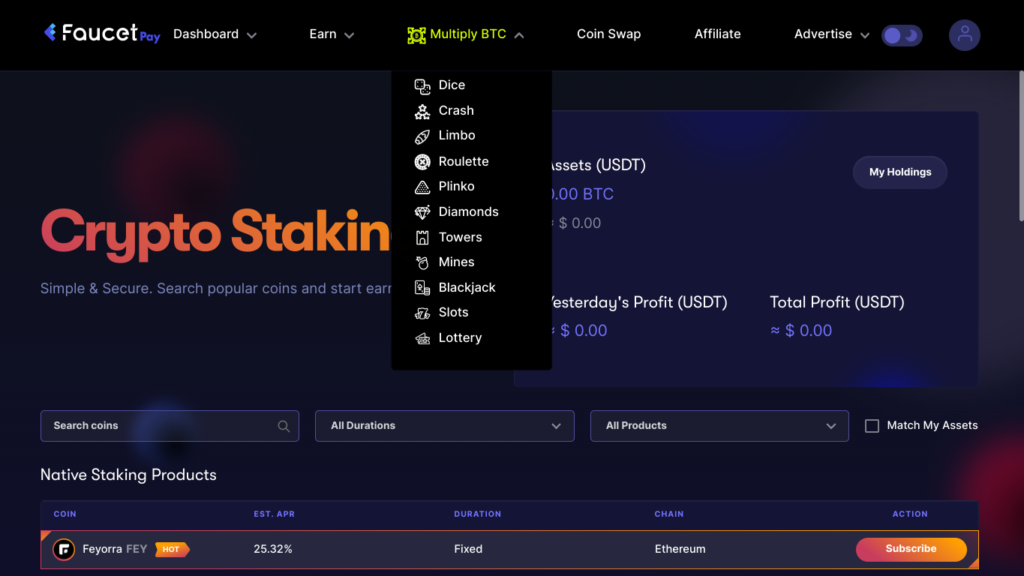
FaucetPay’s “Multiply BTC” section contains multiple casino-style games: Dice, Crash, Limbo, Roulette, Plinko, Diamonds, Towers, Mines, Blackjack, Slots, and Lottery. Several Trustpilot reviewers and Reddit users explicitly warned against using these games, with one noting they lost $20 USD on the Multiply game and never won. FaucetPay states these games are “provably fair,” but the house edge means consistent losses over time. One independent analyst described the gambling feature as a mechanism that tempts users into spending their micro-earned balances before they reach withdrawal minimums – resulting in those earnings effectively flowing back to the platform.
Regulatory Status
FaucetPay operates without verifiable registration with major financial regulators such as FinCEN (US), FCA (UK), or AUSTRAC (Australia). It does not mandate KYC for all users – identity verification is applied selectively, typically when higher withdrawal amounts or account review flags are triggered. This selective KYC model is consistent with a micro-earnings platform rather than a licensed financial institution, but it means users have fewer formal protections than they would with a regulated exchange.
People also like: Tronpick Faucet Review 2026: Earn Free TRX Hourly
How to Sign Up and Start Earning on FaucetPay
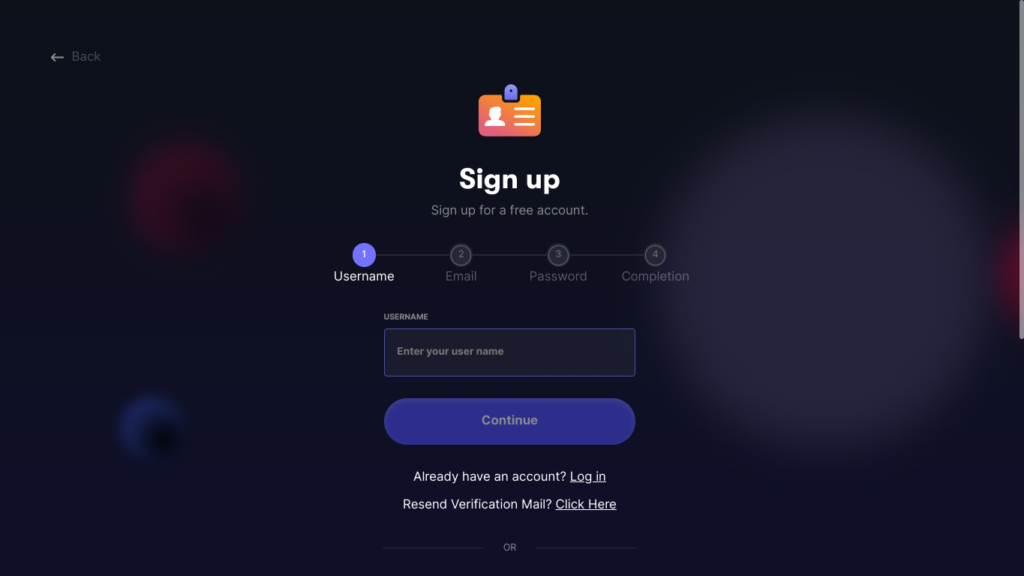
The registration process is simple and does not require identity verification upfront. The sign-up flow has four steps: choose a username, enter an email address, set a password, and on the final step optionally enter a referral or promo code before completing a captcha and submitting. Account activation is confirmed via email. Once inside, users see the dashboard with portfolio value, coins collected today, payouts received, and a reward points streak counter – which rewards consecutive daily logins with up to 100 reward points.
To start earning from faucets immediately, navigate to Earn > Faucet List, filter by your preferred cryptocurrency, and begin claiming from listed partner sites. Each site has a faucet health indicator and total paid data to help identify which faucets are currently paying reliably.
FaucetPay vs Other Faucet and Earning Platforms
FaucetPay is one of several well-known faucet aggregator and crypto-earning platforms. Here is how it compares to some of the commonly mentioned alternatives:
| Platform | Type | Primary Coins | Withdrawal Method | Known Strength | Key Limitation |
|---|---|---|---|---|---|
| FaucetPay | Micro-wallet + faucet hub | BTC, ETH, DOGE, LTC, 30+ others | External wallet/exchange | Wide faucet network, coin swap | Custodial, high withdrawal minimums |
| Cointiply | Faucet + tasks + surveys | BTC, DOGE | FaucetPay or direct | Daily loyalty bonus, stable | Survey availability varies |
| FreeBitcoin | Faucet + games + savings | BTC only | Direct BTC withdrawal | Long track record since 2013 | BTC only, gambling temptation |
| FireFaucet | Auto-faucet aggregator | Multi-coin | Direct wallet | Automated claiming | Interface heavy with ads |
| RollerCoin | Gamified mining simulation | BTC, ETH, DOGE | Direct wallet | Gamification, 4M+ users | Rewards depend on gameplay time |
Among these, FaucetPay is unique in that it functions primarily as a collection hub rather than a single earning site. Its value proposition is consolidating payouts from many external faucets into one balance, which reduces the number of individual withdrawals needed and avoids on-chain fee erosion of tiny amounts.
Who Should Use FaucetPay and Who Should Not
FaucetPay Is Worth Trying If You:
- Are completely new to crypto and want hands-on experience with wallets, addresses, and transactions at zero cost
- Are already using multiple faucet sites and want to consolidate payouts in one place
- Have spare time in small daily pockets and want to use it productively without any financial risk
- Are in a region where offer wall surveys are frequently available, which meaningfully increases earning potential
FaucetPay Is Not Suitable If You:
- Are looking for a meaningful additional income stream – the math does not support this use case
- Want a secure long-term crypto storage solution – it is a custodial micro-wallet, not a hardware or self-custody wallet
- Plan to use the Multiply BTC gambling features to grow earnings – losses are the statistically likely outcome
- Need a regulated or insured platform with formal consumer protections
Practical Safety Tips for Using FaucetPay
If you decide to use FaucetPay, applying these habits significantly reduces your risk exposure:
- Enable 2FA immediately after account creation – use an authenticator app, not just SMS
- Use a unique password not shared with any other platform
- Set up a dedicated email address specifically for FaucetPay to reduce phishing exposure
- Withdraw regularly to an external wallet as soon as you reach the minimum threshold – do not accumulate large balances
- Avoid the Multiply BTC and gambling sections entirely if your goal is to grow earnings
- Never download the Android APK from any source other than FaucetPay’s official website – third-party APK files are a common malware vector
- Be cautious with offer wall tasks that require submitting personal details or creating accounts on third-party services
Final Verdict: Is FaucetPay Worth It for Earning Free Crypto in 2025?
FaucetPay is a legitimate and operational platform. It does pay out, it does aggregate web3 faucet earnings efficiently, and for someone with no prior crypto experience it genuinely delivers on its educational promise. You can learn how wallets work, how blockchain transactions confirm, and how different coins compare – without risking any real money.
The honest limitation is that FaucetPay is not an income strategy. At the casual-use level, monthly earnings of under $3 require consistent daily effort. The custodial structure means your funds are always at some risk. The gambling features actively work against accumulation. And minimum withdrawal thresholds are high enough that many users spend weeks earning before they can access anything.
Treat FaucetPay as what it actually is: a practical introduction to earn free crypto and understand blockchain basics, combined with a useful micro-payment aggregator if you actively use multiple faucet platforms. For anyone hoping it is a path to meaningful passive income from bitcoin faucets or web3 faucet activity, the realistic data says otherwise. Use it with clear expectations and appropriate caution about where you store your balance.
Frequently Asked Questions
FaucetPay is a legitimate platform that has been operational since 2019 and does pay out earnings. It is not a scam in the traditional sense – it genuinely credits small amounts of crypto for completed tasks. However, it carries real risks: it is a custodial wallet, some users report security incidents, and the built-in gambling features can deplete earnings. It is not suitable for storing significant funds.
From faucet claims alone, most users report earning the equivalent of $0.01 to $0.10 USD per day. Add offer wall surveys and short tasks, and daily earnings can reach $0.50 to $2.00 in favorable conditions. Consistent earnings above that require multiple hours of daily effort and depend heavily on your region’s survey availability.
Minimum withdrawals vary by coin. For example, Dogecoin has historically required a minimum of around 30 DOGE with a 1 DOGE fee. USDT minimums have been reported at around 8 USDT by some users. Always check the current minimums on your withdrawal page, as these can change.
FaucetPay does not mandate KYC for standard account use or basic withdrawals. Identity verification may be triggered selectively for higher withdrawal amounts or during account reviews. The platform uses captcha and account age restrictions on offer walls as alternative anti-fraud measures.
FaucetPay has an Android APK available for download from its official website – it is not listed on the Google Play Store. For iOS users, there is no official app; you can access the platform through your mobile browser and save it to your home screen as a shortcut. Only download the APK from the official faucetpay.io website.
FaucetHub was a previous micro-wallet platform that operated similarly to FaucetPay. It shut down at some point before FaucetPay’s launch, and FaucetPay has been the primary successor in this space. This historical closure is a reason why Reddit users and experienced faucet users consistently recommend not accumulating large balances in FaucetPay.
