
The term Freecash Web3 faucet gets searched thousands of times a month, but it misnames what Freecash actually is. A traditional Web3 faucet drips out tiny amounts of a single token in exchange for solving a CAPTCHA or watching an ad. Freecash does something more complex: it connects advertisers and game developers with users who complete tasks, then pays out a share of that revenue in cash, gift cards, or cryptocurrency. The distinction matters if you are trying to understand what you are signing up for and what risks come with it.
Key Takeaways
- Freecash is a Get-Paid-To (GPT) platform, not a traditional crypto faucet – it pays crypto as one of many cashout options.
- Earning methods include mobile games, surveys, app installs, and daily bonuses – not passive token drips.
- Crypto withdrawals are supported for Bitcoin, Ethereum, Litecoin, and Dogecoin with a minimum of $0.50.
- In April 2026, Freecash was removed from both the App Store and Google Play over data harvesting and misleading marketing allegations.
- Realistic earnings are $2 to $5 per hour for most users – treat it as side money, not income.
According to Crypto.com’s 2025 Market Sizing Report, global crypto ownership reached 741 million people in 2025 – a figure that has driven demand for low-barrier entry points into crypto, including faucets and GPT platforms. Freecash sits at that intersection, offering crypto payouts without requiring users to buy any coins. That positioning has attracted tens of millions of users worldwide, but it has also attracted serious scrutiny. In April 2026, Apple and Google removed the Freecash app from their stores following investigations by Wired, Malwarebytes, and TechCrunch into alleged data harvesting and deceptive marketing.
This article covers what Freecash actually is, how its crypto earning model works, what the Reddit community and real users say about payouts and problems, what the 2026 controversy means for new users, and how Freecash compares to genuine Web3 faucets and alternative GPT platforms.
What Is Freecash and Why Is It Called a Faucet
Freecash was launched in 2020 by Berlin-based Almedia GmbH. It began as Freeskins.com before rebranding and expanding into a full rewards platform. The site operates as a Get-Paid-To (GPT) platform – meaning companies pay Freecash to deliver users who will install their apps, play their games, complete surveys, or sign up for services. Freecash takes a cut and passes a portion to the user in coins, where roughly 1,000 coins equals $1.
The faucet label is applied loosely because Freecash offers crypto as one of its payout options. But it does not function as a crypto faucet in the traditional sense. A classic faucet – like the original Bitcoin faucet created by Gavin Andresen in 2010 – distributed small fixed amounts of BTC automatically, usually on a time-based schedule, funded by the faucet operator as a promotional or onboarding tool. Freecash is funded by advertiser spend, not crypto reserves, and the task list is far more involved than clicking a CAPTCHA every hour.
The confusion is understandable. Freecash does let users accumulate Bitcoin, Ethereum, Litecoin, or Dogecoin as withdrawal options, and the low minimum of $0.50 for crypto withdrawals means it functions similarly to a faucet from the user’s perspective – small amounts of crypto, low commitment. But the mechanism behind it is closer to a micro-task marketplace than a faucet.
People also read: Fire Faucet Review 2026: Earn Free Crypto the Easy Way
How the Coin and Payout System Works
When a user completes a task on Freecash, the advertiser confirms the action and Freecash credits coins to the user’s balance. The payout timelines vary by offer type:
- Surveys and small tasks: Often credited within minutes to 24 hours.
- Mobile game milestones: Can take 7 to 14 days to release for withdrawal after the milestone is reached.
- App install and trial offers: Usually credited after 24 to 72 hours once the advertiser confirms.
Once coins are available, users can cash out to PayPal, bank transfer, crypto wallets, Stake.com balance, Visa prepaid cards, or gift cards. The PayPal minimum is $5 and carries a 5% fee. Crypto withdrawals start at $0.50 with no Freecash-added fee – only standard network fees apply. Gift cards and Stake transfers are also free of platform fees.
How to Earn Crypto on Freecash
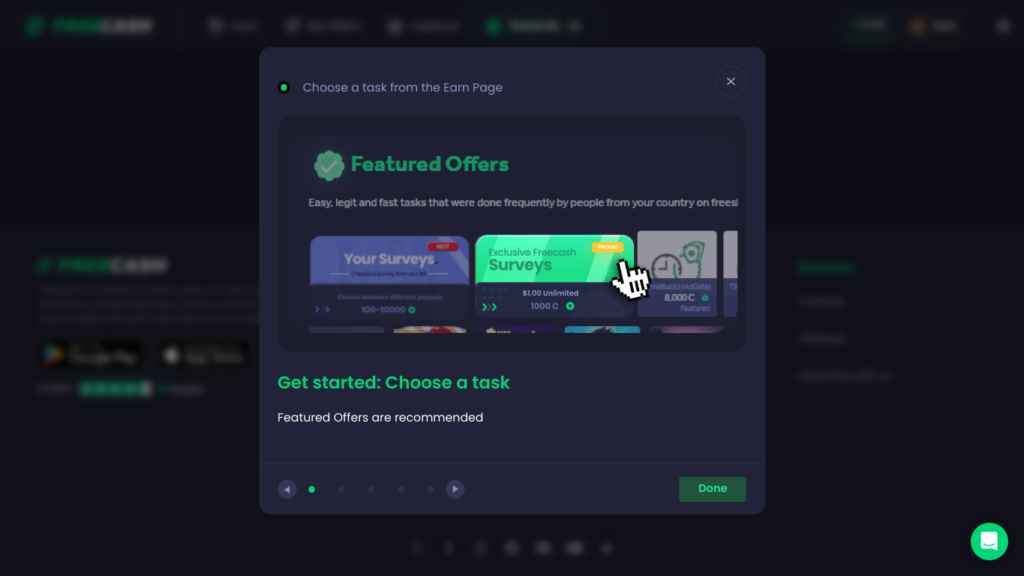
Freecash organizes its offers into categories. New users start in Lite Mode, which limits access to a smaller offer set until they earn $20, at which point Advanced Mode unlocks the full library. This onboarding barrier exists, according to the platform, to reduce fraud from users creating throwaway accounts to claim high-value offers. Some Reddit users view the Lite Mode as unnecessarily restrictive for new earners.
Mobile Game Offers
Mobile game offers are where the highest individual payouts sit. A game developer pays Freecash to acquire players who will reach specific in-game milestones – for example, reaching City Level 15 in a strategy game or completing 500 levels in a match-3 puzzle. Payouts range from $1 to over $100 per game, with some top-tier offers advertised at $500 or more for deep progression milestones.
The catch is time. Reddit threads on r/beermoneyglobal are filled with users calculating the actual hourly rate on game offers. Games like Rise of Kingdoms, Call of Dragons, Raid Shadow Legends, and Monopoly GO appear repeatedly – some users report completing a $20 to $40 offer in a week of casual play, while others note that deeper milestones can require 20 to 40 hours or in-app spending to reach within the allowed window. One user noted spending $25 on in-app purchases for a game and netting $26.40 back before also completing a $64 milestone, while another reported reaching a game milestone only to have the reward denied due to alleged VPN use they denied. The experiences are genuinely mixed.
A consistently cited concern is that time-limited offers expire before completion if the game’s progression gates the user through pay-to-win mechanics. Several Reddit users described watching an offer expire at exactly the moment they were about to hit the final milestone, with support tickets going unresolved. Others completed the same games without issue. The platform’s tracking relies on advertiser-side confirmation, which means disputes are hard to prove.
Surveys
Surveys on Freecash come from third-party survey walls – partner companies like CPX Research, BitLabs, and Branded Surveys. Individual surveys pay between $0.10 and $3.00 depending on length and target audience. The platform claims surveys pay up to 40% more than competitors, a claim it makes without independent verification.
The most common complaint across Reddit threads is disqualification after completing part of a survey. Users frequently report answering 15 to 20 minutes of questions only to be screened out at the end, receiving nothing or a small consolation credit. One user in r/beermoneyglobal spent an entire week on surveys to accumulate $26.72 CAD – barely above the withdrawal threshold – before having their account frozen at the point of cashout.
One tactic that some long-term users report is answering demographic questions consistently and in ways that qualify them for more surveys. This is not advice Freecash itself gives, but it appears in community discussions as a practical workaround for low qualification rates.
App Installs and Trial Offers
Shorter task offers – install an app, sign up for a service, or try a free trial – typically pay $1 to $5 and complete quickly. Some finance-linked offers require a credit card for a free trial signup and pay $10 to $50 or more. These carry meaningful risk: if the user forgets to cancel the trial, the subscription charge will exceed the reward earned. Reddit discussions specifically flag these offer types as traps for users who are not organized about cancellation deadlines.
Daily Bonuses and Leaderboards
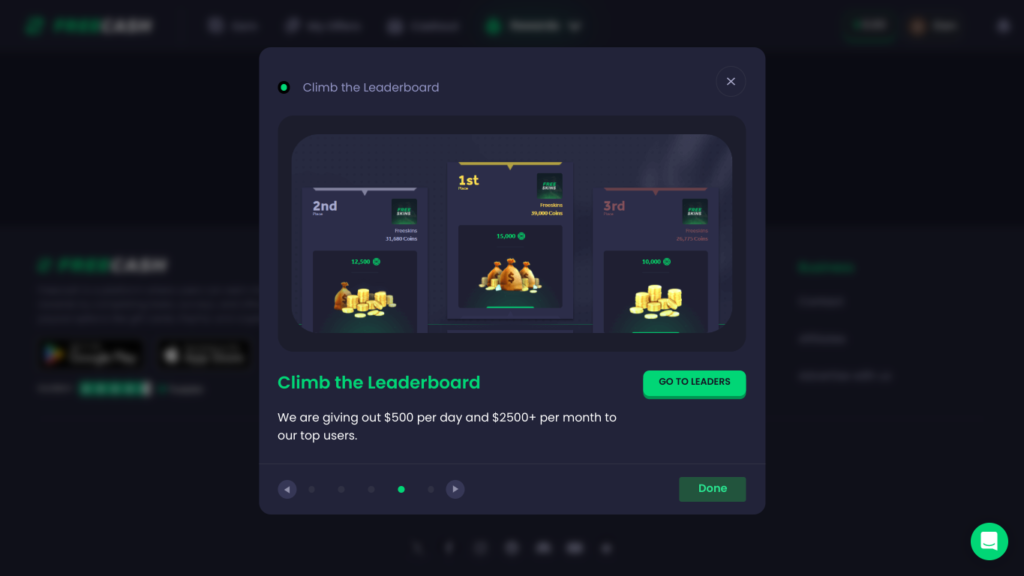
Freecash runs a daily login bonus that starts at $0.01 per day and increases as the streak continues. The platform also operates a daily leaderboard paying $500 per day distributed to top earners, and a monthly leaderboard paying $2,500 to the top user and tiered amounts to others. These competitive bonuses benefit heavy users disproportionately and are not a realistic income source for casual users.
Referral Program
Freecash pays a percentage of referred users’ earnings as a bonus – funded by Freecash itself, not deducted from the referred user’s earnings. The exact percentage is not publicly standardized and appears to vary by account level. This is a meaningful income stream for content creators and affiliates, which is one reason the platform generates so many promotional review articles across the web.
You may also like: SatsFaucet Review 2026: Legit Sats Faucet or Scam?
Freecash Crypto Withdrawal Options Compared
For users whose primary interest is earning crypto rather than cash, here is a breakdown of how Freecash’s crypto options work in practice:
| Crypto | Min. Withdrawal | Network Fee | Freecash Fee |
|---|---|---|---|
| Bitcoin (BTC) | $0.50 | Standard BTC network fee | None |
| Ethereum (ETH) | $0.50 | Standard ETH gas fee | None |
| Litecoin (LTC) | $0.50 | Standard LTC network fee | None |
| Dogecoin (DOGE) | $0.50 | Standard DOGE network fee | None |
Important note: Freecash only supports mainnet withdrawals on the native chain for each asset. It does not support BSC (BEP-20), Tron (TRC-20), Polygon, or Arbitrum versions of these tokens. Sending a withdrawal to a wrong network address results in permanent loss of funds, with no refund possible.
How Much Can You Realistically Earn
The figures shared by users online span an enormous range, which creates genuine confusion for newcomers. On one end, some Reddit users claim to have earned $1,000 to $2,400 total over months of intensive play, while others report earning less than $3 after weeks of effort. The gap is explained by time invested, geographic location, game selection, and willingness to use in-app purchases to hit game milestones.
A realistic range for most users, based on community reports and third-party review testing, is:
| User Type | Typical Daily Earnings | Typical Hourly Rate |
|---|---|---|
| Casual (surveys only) | $0.50 – $2.00 | $1 – $3 per hour |
| Active (surveys + small offers) | $2.00 – $5.00 | $2 – $5 per hour |
| Power user (games + offers + grind) | $5.00 – $20.00+ | $5 – $15 per hour |
| Game grind with in-app purchases | Highly variable | Net profit depends on spend |
The platform itself reports having paid out over $300 million to 70 million+ users since 2020 (self-reported by Freecash/Almedia, not independently verified). A third-party review site, Firstcard, also noted Freecash was ranked third on the 2025 Financial Times FT1000 list of Europe’s fastest-growing companies, suggesting the business itself is real and growing – even as individual user experiences vary significantly.
One important factor for international users: offer availability drops sharply outside the US, UK, Canada, Australia, and Germany. Users from Eastern Europe, Latin America, and Southeast Asia consistently report fewer surveys and lower game payouts than US-based users. A user in Romania reported earning $6.40 in 20 days of casual use – a fair reflection of what non-Tier-1 users can expect.
The April 2026 App Store Removal – What Happened and What It Means
In January 2026, Freecash was downloaded 5.5 million times across iOS and Android, reaching number 2 on the US App Store. The surge was driven by a wave of TikTok ads that showed users apparently earning money by scrolling TikTok content – a claim that was completely false. The ads promised earnings of up to $35 per hour for watching videos, a figure that has no basis in how Freecash actually works.
In January 2026, Wired published an investigation and Malwarebytes released a security report alleging that Freecash was collecting highly sensitive user data – including race, religion, sexual orientation, health information, and biometrics – through the mobile games it pushed users to install. The reports characterized Freecash as functioning as a data broker, connecting advertisers with users segmented by this personal data.
TikTok removed Freecash’s ads in January for violating its financial misrepresentation policies. Apple took no action at that point. The app was finally removed on April 13, 2026 from the App Store – only after TechCrunch contacted Apple directly for comment. Apple cited violations of App Store Review Guidelines 3.1.2(a) and 2.3.1, covering scam practices, bait-and-switch tactics, and misleading marketing. Google Play followed on April 15, 2026.
There was a further finding from Appfigures data cited by TechCrunch: Almedia had originally submitted Freecash to the App Store in March 2024, only for it to be removed in June 2024 after approximately 69,500 downloads. The version that later surged to prominence was submitted under a different developer entity – Cyprus-based 256 Rewards Ltd – which had its existing app rebranded as Freecash. Industry researchers describe this as a common ban-evasion tactic.
Almedia denied wrongdoing in statements to multiple media outlets. Freecash returned to Google Play in May 2026 following a policy review, though it remained unavailable on the App Store as of the same date. The freecash.com website remained operational throughout and continues to function, with the app removal affecting only mobile store distribution.
What This Means for Users
For existing users with balances, the web version at freecash.com remains accessible and withdrawals were reportedly processing, though some users reported delays. For new users, the absence from mobile stores means onboarding now requires accessing the site through a browser. The data collection allegations are the more serious concern: if the Malwarebytes findings are accurate, the app was harvesting sensitive personal data in ways users likely did not consent to meaningfully.
At the same time, it is worth noting that Almedia has not faced criminal charges and disputes the characterizations of its business. The platform has paid out verified amounts to millions of users, and many of the negative experiences documented in Reddit threads relate to task tracking and support quality – not fraud in the traditional sense. Users should weigh both realities.
What Reddit Users Say – Community Experiences Unfiltered
The Reddit record on Freecash is extensive and genuinely divided. Across r/beermoneyglobal, r/passive_income, r/FreeCash, and r/CryptoScams, several clear patterns emerge from hundreds of posts.
The Positive Case
Users who report consistent success on Freecash tend to share a few characteristics. They focus on game offers rather than surveys, they screenshot and document their progress at every step, they cash out frequently rather than letting balances accumulate, and many are in Tier-1 countries with high offer availability. One user on r/beermoneyglobal reported $1,800 earned over six months playing strategy and puzzle games with minimal spending. Another reported $400 in games in less than a month in the UK. Several users specifically praised the Stake.com withdrawal option, which provides a 30% bonus on cashouts at the cost of routing funds to a gambling platform.
The Negative Case
The complaints cluster around consistent themes: offers not being credited after completion, support responses that feel automated and unhelpful, accounts frozen at the point of reaching the withdrawal threshold, and the KYC identity verification process – requiring a government ID and selfie – triggering bans rather than unlocking payouts. Several users reported losing balances of $50 to $200 to account freezes they could not appeal.
The most consistently cited red flag is the pattern of accounts being banned precisely when they reach a significant payout amount. Whether this reflects a platform designed to avoid paying high earners, aggressive fraud detection catching legitimate users, or simply a vocal minority of unhappy users in a large base is not definitively answered in the available data. All three explanations appear in the community discussions.
The Bot Controversy
A recurring accusation in Reddit threads is that positive Freecash reviews – including some appearing in the same discussion threads – are written by paid bots or affiliate accounts. Several users point to accounts with posting histories limited to Freecash promotion, and to Trustpilot’s rating being inflated by invited reviews from users who were incentivized to rate the platform. This is worth noting when weighing the platform’s 4.7/5 Trustpilot score: the methodology for that rating includes a high proportion of invited reviews, which typically skew positive.
Freecash vs Traditional Web3 Faucets vs Alternative GPT Sites
To understand where Freecash fits, it helps to compare it against both traditional faucets and competing GPT platforms:
| Platform | Type | Crypto Payout | Min. Withdrawal | Earning Method |
|---|---|---|---|---|
| Freecash | GPT Platform | BTC, ETH, LTC, DOGE | $0.50 | Games, surveys, app installs |
| FreeBitco.in | BTC Faucet | BTC only | 30,000 satoshis | Hourly roll, ads, games |
| Cointiply | GPT/Faucet Hybrid | BTC (via COIN) | $3.50 | Faucet, surveys, videos, games |
| Swagbucks | GPT Platform | Limited (gift cards primary) | $3 (gift card) | Surveys, shopping cashback, videos |
| Prolific | Survey Platform | None | $5 (PayPal/Payoneer) | Academic surveys |
| Mistplay | Game Rewards App | None (gift cards only) | Varies by card | Play mobile games |
Key distinctions: Freecash offers the widest crypto selection among GPT platforms, with a genuinely low minimum withdrawal. Prolific pays significantly better per hour (typically $8 to $15/hour) but only for surveys, with no crypto. Cointiply is closer to a traditional faucet in structure but includes GPT elements and pays in Bitcoin. Swagbucks has a longer track record and broader earning methods but weaker crypto support.
Key Risks and What to Watch Out For
Whether you are considering Freecash as a crypto faucet alternative or as a general GPT earner, several specific risks should shape your approach:
Data Privacy
The Malwarebytes and Wired investigations in January 2026 raised specific concerns about the volume and sensitivity of data collected through the Freecash ecosystem, particularly through mobile game partners. Even on the web version, completing offers will involve sharing personal information with third-party survey and offer wall providers who have their own privacy policies. Almedia disputed the characterizations but did not offer a detailed rebuttal of the data categories cited.
Identity Verification
Freecash requires KYC verification before the first withdrawal – a government-issued photo ID and a selfie. This is standard for financial platforms and legally required under anti-money-laundering regulations. However, users should be aware that submitting biometric data to a platform with an active data privacy controversy carries real risk. Several Reddit users reported having their verification rejected and accounts frozen immediately after submitting their ID, with no successful appeal.
No VPN
Freecash prohibits VPN use explicitly. Accounts flagged as using a VPN – even inadvertently through shared networks or ISP routing – can be banned with balances forfeited. Multiple Reddit users reported bans they attributed to VPN flags that they deny having triggered.
One Account Only
Multiple accounts from the same device or household are a terms of service violation and result in bans. This is standard for GPT platforms but worth emphasizing because family or shared-device situations can accidentally trigger the detection.
In-App Purchase Risk
Several game offers encourage users to spend money in-game to accelerate progress and hit milestones before the timer expires. While some users have calculated a net profit from this approach, it introduces real financial risk. If a payout is denied after in-app spending, the user loses both the time invested and the money spent. Freecash support has been documented rejecting tickets from users in exactly this situation.
Who Should Use Freecash and Who Should Not
Based on the full picture of community reports, platform structure, and the 2026 controversy, here is an honest assessment:
Freecash may be worth trying if you
- Already play mobile games and would earn from time spent anyway.
- Are in a Tier-1 country (US, UK, Canada, Australia, Germany) with high offer availability.
- Want to accumulate small amounts of BTC or ETH without buying crypto.
- Are comfortable with low-stakes trial and error and read terms carefully.
- Cash out frequently at low thresholds rather than letting a balance grow.
Freecash is probably not right for you if you
- Are in a region with limited offer availability – earnings will be very low.
- Want reliable hourly income – the rate is too inconsistent and task-dependent.
- Are uncomfortable with identity verification tied to a data-privacy controversy.
- Have limited time and need to maximize the value of your earning hours.
- Expect to build meaningful crypto holdings – the amounts are genuinely small.
A Note on the Freecash Business Model
Understanding why Freecash can pay users anything at all clarifies why it behaves the way it does. Mobile game developers pay cost-per-acquisition (CPA) fees to acquire users who will install and spend in their games. Survey companies pay for market research respondents. App developers pay for installs and signups. Freecash aggregates these advertiser budgets and distributes a share to users. The platform earns money when users engage; users earn a fraction of that advertiser spend.
This means Freecash’s incentive is to maximize the volume of engagements, not to maximize individual user earnings. High-earning users who complete every available offer and cash out immediately are actually less valuable to the platform than users who spend time exploring and occasionally convert to in-app spenders in the games they play. The model also explains why the platform segment that generates the most controversy – large game milestone offers – carries the highest risk of non-payment: the advertiser only confirms payment if the user’s behavior matches their acquisition criteria.
Conclusion
Freecash is not a Freecash crypto faucet in the traditional sense – it is a GPT platform that offers crypto as a withdrawal option among many. That distinction matters for setting expectations. A classic faucet drips out tiny amounts of a single token passively; Freecash requires active task completion and rewards users from advertiser budgets, not from crypto reserves.
The platform does pay real users real money, including in Bitcoin, Ethereum, Litecoin, and Dogecoin. The $0.50 minimum crypto withdrawal is genuinely low. Many users in Tier-1 countries have accumulated meaningful side income – not wealth, but real supplemental dollars. At the same time, the community record is clear that task tracking failures, support quality, and account bans at high balances are persistent problems that affect a significant portion of users.
The April 2026 removal from the App Store and Google Play – driven by data harvesting allegations and deceptive marketing – adds a layer of risk that users should not ignore. The web platform continues to function, but the underlying concerns about data collection practices have not been resolved by Almedia’s denials alone. Go in with realistic expectations: treat any earnings as a bonus, never a primary income source, cash out at the lowest available threshold to validate the platform before committing time, and protect your personal data as you would on any third-party platform.
Frequently Asked Questions
Not in the traditional sense. Freecash is a GPT (Get-Paid-To) platform that offers crypto as one of several withdrawal options. A traditional crypto faucet pays small fixed amounts of a single token on a time schedule for minimal tasks. Freecash pays users from advertiser budgets for completing more involved tasks like game milestones, surveys, and app installs.
Freecash supports withdrawals in Bitcoin (BTC), Ethereum (ETH), Litecoin (LTC), and Dogecoin (DOGE). All withdrawals go to external wallets on each coin’s native mainnet. Alternate networks like TRC-20, BEP-20, or Polygon are not supported.
The crypto withdrawal minimum is $0.50 (500 coins). This is lower than most competing GPT platforms. Standard network gas fees apply depending on the blockchain; Freecash itself charges no additional withdrawal fee for crypto.
As of May 2026, the freecash.com website is operational and accessible via browser on desktop and mobile. Freecash returned to Google Play in May 2026 following a policy review. It remains unavailable on the Apple App Store. Almedia has appealed Apple’s decision. Users should access the platform through the official website rather than unofficial APK files.
For most casual users in Tier-1 countries, realistic monthly earnings range from $20 to $100 depending on time invested. Power users who actively grind game offers report significantly higher amounts, though this often involves in-app spending to hit milestones within the time limits. Users outside Tier-1 regions typically earn much less due to limited offer availability.
In January 2026, Malwarebytes reported that the Freecash app collected sensitive user data including race, religion, sexual orientation, health information, and biometrics, operating as a data broker for mobile game advertisers. Wired reported that Freecash TikTok ads were falsely promising $35 per hour for watching videos – a function that does not exist on the platform. TikTok removed the ads; Apple removed the app in April 2026 citing scam practices and misleading marketing. Almedia disputed the reports.
