
The best crypto mining browsers in 2025 and 2026 let you earn small amounts of crypto while browsing normally – no hardware investment, no technical setup. The concept is appealing, but the reality splits sharply: some browsers deliver on the promise quietly and reliably, while others have built reputations around withdrawals that never arrive.
Key Takeaways
- Browser crypto earnings are small – electricity costs frequently exceed mining income, making ad-reward models like Brave the more practical choice for most users.
- Brave Browser is the most credible option here, with 100 million monthly active users and a proven track record of paying BAT rewards for opt-in ad viewing.
- CryptoTab Browser carries serious, documented payout failures in 2025/2026 – avoid paid subscriptions entirely.
- Opera and Presearch offer Web3 wallet integration and search-based token rewards respectively – neither mines crypto.
- No browser replaces dedicated mining hardware – treat any earnings as a passive bonus on top of normal browsing.
This guide covers four of the main options – Brave, CryptoTab, Opera, and Presearch – explaining exactly how each earns, what you can realistically expect, and where the risks are, so you can choose the one that fits your situation.
How Browser Crypto Mining Works
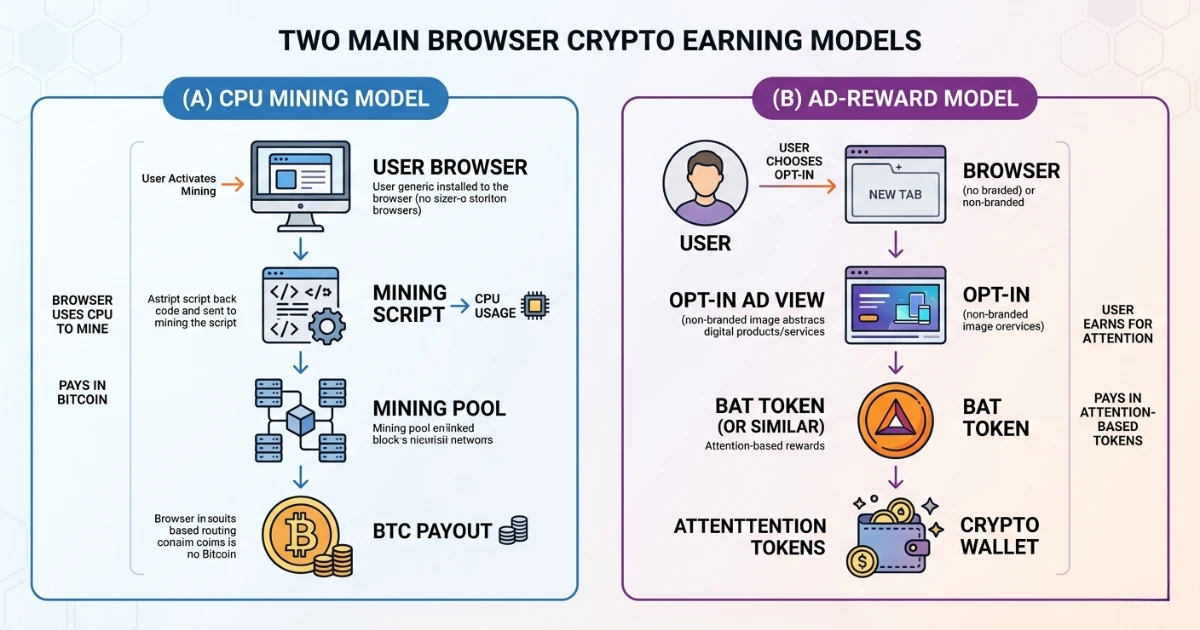
Browser-based crypto mining uses your computer’s CPU (and sometimes GPU) to perform cryptographic calculations that validate transactions on a blockchain – typically a Proof-of-Work (PoW) cryptocurrency. The concept first went mainstream in the late 2010s through tools like Coinhive, which let websites mine Monero using visitors’ CPU power. It collapsed in 2019 after widespread abuse for unauthorized cryptojacking – mining users’ devices without consent. In 2025, the space has returned in a more controlled, opt-in form, supported by improved Web3 tooling and a new generation of users curious about passive crypto earning (Coin Telegraph, 2025).
The process generally involves four components working together:
- Script execution. The mining algorithm runs either as code built directly into a dedicated browser, or via an extension installed on a standard browser like Chrome or Firefox. The script handles communication with the blockchain and coordinates computation.
- Cryptographic hashing. The script performs hash calculations – mathematical operations that attempt to solve a computational puzzle. Each successful hash contributes to validating a transaction block on the network.
- Mining pool integration. A single browser has far less computational power than dedicated mining hardware. Most browser miners join a mining pool, combining their hashrate with others. Rewards are then distributed proportionally to each participant’s contribution.
- Reward distribution. When the pool finds a block, the reward is split across all pool members based on their share of the total hashrate. For a browser miner, this share is extremely small – which is why earnings are modest.
The Honest Ceiling: What a Browser Can Realistically Contribute
A modern ASIC miner like the Antminer S19 Pro generates up to 110 terahashes per second (TH/s) – several orders of magnitude higher than what any browser script can deliver (Coin Telegraph, 2025). Even the best crypto mining browsers are not competitive in the traditional mining sense. They are a low-barrier entry point, useful for learning how the process works or accumulating very small amounts of crypto passively, but not a viable replacement for dedicated hardware.
The ad-reward model used by Brave Browser takes a different and more realistic approach entirely: instead of mining, users earn Basic Attention Token (BAT) for viewing opt-in privacy-respecting advertisements. This model avoids the electricity cost problem and has proven more sustainable than direct CPU mining.
The Best Crypto Mining Browsers at a Glance
| Browser | Earning Mechanism | Token / Reward | Best For | Key Risk |
|---|---|---|---|---|
| Brave Browser | Opt-in ad viewing (Brave Rewards) | BAT (Basic Attention Token) | Privacy-focused users wanting passive ad rewards | Regional restrictions; low monthly earnings ($1-$5) |
| CryptoTab Browser | CPU/GPU mining via built-in algorithm | BTC (via Monero conversion) | Curious beginners – free tier only | Serious and widespread payout failures reported in 2025/2026 |
| Opera Browser | Built-in Web3 wallet; no mining | Multi-chain wallet (BTC, ETH, SOL+) | Web3 users wanting dApp access + wallet integration | No mining or passive earning built in |
| Presearch Browser | Earn PRE tokens per search query | PRE token | Users who search frequently and want passive crypto | High withdrawal threshold (1,000 PRE); token volatility |
Brave Browser
Brave Browser is the most credible and widely adopted crypto-friendly browser available in 2025. Developed by Brave Software Inc., it reached 100 million monthly active users in September 2025 and surpassed $100 million in annualized revenue in Q1 2025 – making it one of the few privacy-first technology products to have achieved genuine commercial scale (Sacra, 2025; Stan Ventures, 2025). It has 42 million daily active users as of October 2025.
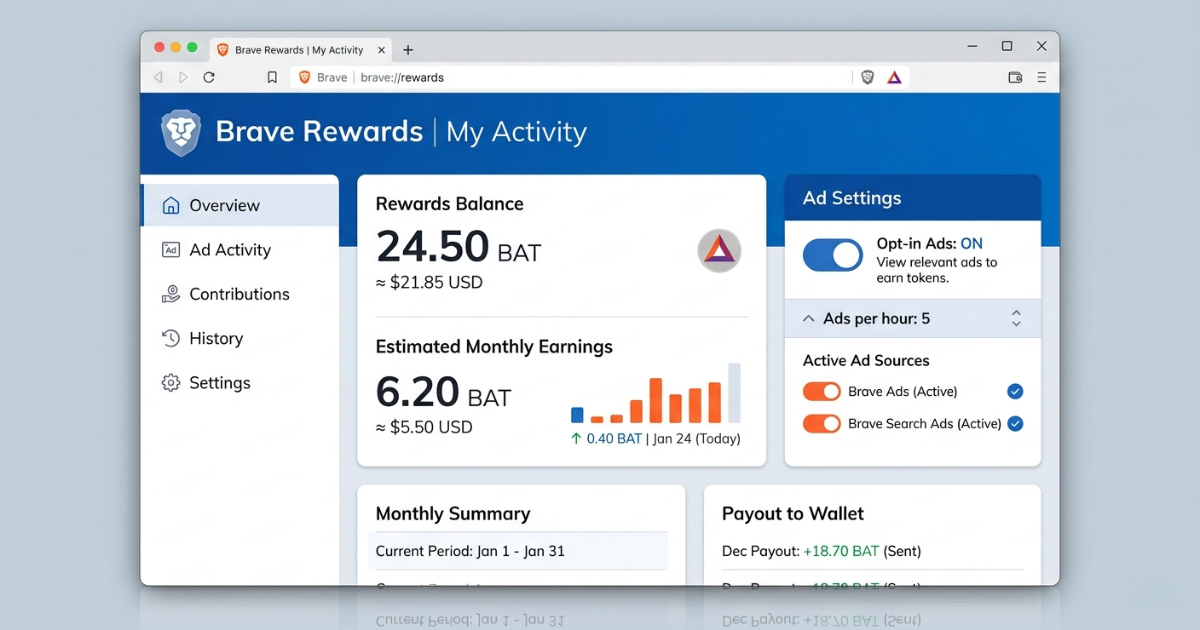
It is important to be precise: Brave does not mine cryptocurrency. Instead, it operates an opt-in advertising system called Brave Rewards, where users who choose to see privacy-respecting ads earn Basic Attention Token (BAT) for their attention. All ad matching happens on the device – browsing data never leaves your browser. Brave retains 30% of ad revenue; users receive 70% in BAT. The browser also blocks all third-party ads and trackers by default, which is why it loads pages significantly faster than Chrome.
What You Can Realistically Earn
Earnings from Brave Rewards vary by region, the number of ads available, and how much you browse. User reports and community data consistently suggest most active Brave users earn between $1 and $5 per month in BAT, with heavy browsers in high-value advertising regions occasionally earning more. As of mid-2025, BAT traded at approximately $0.13 per token with a market cap of around $201 million (Sci-Tech Today, 2025). Earnings are deposited monthly via connected payout accounts (Uphold, Gemini, or direct crypto wallets).
Strengths
- Privacy and security by default. Blocks ads, trackers, and cryptojacking scripts without any configuration required.
- Established and profitable platform. $100M+ annualized revenue and 100M users confirm Brave is not a speculative project.
- Clean interface. Fast, minimal, and familiar to Chrome users – no performance degradation from the rewards system.
- Built-in Web3 wallet. Brave Wallet lets users manage crypto assets, connect to dApps, and swap tokens without extensions.
Weaknesses
- Regional restrictions. Not all countries support payout connections. Users in unsupported regions can accumulate BAT but cannot withdraw it without a supported custodial account.
- Modest earnings. $1-$5 per month is a realistic ceiling for most users. Brave Rewards should be thought of as a bonus, not an income strategy.
- Customer support limitations. Community forums and GitHub are the primary support channels. Direct support is limited for individual account issues.
- Privacy settings require some manual adjustment for users who want full control over specific shield settings or wallet integrations.
Who Is Brave Best For
Among the best crypto mining browsers and crypto-earning browsers covered in this guide, Brave is the strongest all-round choice for most users – particularly those who prioritize privacy and want a small, genuinely passive crypto reward without changing their browsing behavior. It is the only browser in this list backed by a profitable, auditable company with a proven track record of actually paying users.
Check out also: Mobile Crypto Mining: What It Is and Why Most Apps Are Scams
CryptoTab Browser
CryptoTab Browser, launched in 2018 and built on Chromium, is the most widely recognized dedicated crypto mining browser, with over 35 million users globally (self-reported). It mines Bitcoin by leveraging your computer’s CPU and GPU – specifically, the browser mines Monero (XMR) and converts the proceeds to Bitcoin for payouts. Features include a mining speed dashboard, a multi-level referral program, a Cloud.Boost subscription that routes additional hash power through CryptoTab’s cloud infrastructure, and an optional CT Pool for pool mining.
The concept is straightforward and the interface is genuinely familiar to Chrome users. For users on the free tier who do not invest money into paid subscriptions, CryptoTab does work – in the sense that mining runs and small amounts accumulate. The critical issue is what happens at the withdrawal stage, and this is where the picture in 2025/2026 has become significantly darker.
The Payout Problem: What User Reviews Actually Show
CryptoTab Browser carries a 1.8-star rating on Sitejabber and deeply negative reviews across Trustpilot and Capterra as of 2025/2026. The pattern documented across hundreds of independent reviews is consistent and specific: the platform pays out small amounts reliably in the early stages, building user confidence. When users attempt larger withdrawals – particularly after purchasing paid subscriptions like Cloud.Boost – payouts enter a “processing” status that persists for months or years without resolution. Support responses, when they come at all, are scripted and non-specific.
On Trustpilot, examples include users reporting Bitcoin withdrawals stuck in processing for over two years, paid Cloud.Boost subscriptions that stopped paying after 4 months, and support emails that go unanswered for months. Multiple reviewers specifically describe the pattern of small initial payments followed by complete withdrawal failure as consistent with a deliberate design rather than a technical issue. A paid subscription that stops paying mid-term without explanation represents real financial loss for affected users.
Strengths
- Easy setup. Chrome-like interface; mining begins within minutes of installation.
- Multi-device linking. Users can connect multiple devices to pool their hashrate.
- Referral program. Multi-level referral structure can extend earning potential for users who actively recruit others.
Weaknesses
- Widespread, documented payout failures. Hundreds of independent user reviews across multiple platforms describe withdrawals stuck in processing for months to years with no resolution.
- Cloud.Boost is a high-risk purchase. Paid subscriptions that fail to pay before expiry represent direct financial loss. Multiple users report this exact experience.
- Minimal earnings on the free tier. CPU mining in a browser generates very small amounts – often less than the electricity cost of running it.
- Support is effectively non-functional for withdrawal issues based on consistent user reports across review platforms.
Who Is CryptoTab Best For
Based on the volume and consistency of payout complaints documented in 2025/2026, CryptoTab is the riskiest pick among the best crypto mining browsers in this guide – and not recommended for users who plan to invest money into paid subscriptions. If you choose to use the free tier purely out of curiosity – with no financial investment and realistic expectations about earnings – the risk is limited to electricity costs and device wear. Do not purchase Cloud.Boost or any paid subscription tier without carefully researching current user experiences.
Opera Browser
Opera’s relationship with crypto has evolved significantly. In 2022, Opera launched a dedicated Crypto Browser as a separate product. In early 2024, Opera consolidated its Web3 features – including the crypto wallet, dApp access, and Wallet Selector – directly into its main flagship browser and delisted the standalone Crypto Browser. This means Opera’s crypto functionality is now available to all Opera users without needing a separate download.
Opera is important to understand clearly: it does not mine cryptocurrency and does not offer passive earning in the traditional sense. What Opera provides is a fully integrated, non-custodial crypto wallet supporting Bitcoin, Ethereum, Solana, and multiple other blockchains, built directly into the browser. This wallet – now called the Opera Wallet – allows users to manage assets, interact with dApps, connect to decentralized exchanges, and manage NFTs without installing any extensions. Opera also launched Opera Points, a cashback-style system where users earn points for online shopping that can be redeemed for fiat or crypto.
Strengths
- First major browser with a built-in non-custodial wallet (since 2018). The Opera Wallet has a long track record and supports multi-chain assets including BTC, ETH, and SOL.
- Wallet Selector. Opera’s industry-first feature that lets users switch between multiple connected wallets (including MetaMask) without managing conflicting extensions.
- Built-in VPN, ad blocker, and tracker blocker. Privacy tools come pre-installed across desktop and mobile.
- Cryptojacking protection. Opera actively blocks unauthorized mining scripts, protecting users from having their device resources hijacked.
- Crypto Corner dashboard. Live crypto prices, gas fees, news, and airdrop alerts available from the browser’s sidebar.
Weaknesses
- No passive mining or ad-based earning. If you are specifically looking for a browser that earns crypto for you, Opera is not that product.
- Opera Points system is limited in scope. It applies to partner shopping activities, not general browsing.
- Less popular than Chrome or Brave for most users – the dApp ecosystem within Opera is smaller than what Brave or dedicated Web3 wallets provide.
Who Is Opera Best For
Opera suits users who want a full Web3 browsing experience with a built-in wallet and dApp integration, without needing to install separate extensions. It is the best choice among these options for active DeFi users, NFT collectors, and anyone regularly interacting with dApps across multiple chains. It is not a fit for users whose primary goal is passive crypto earning.
Presearch
Presearch is a decentralized search engine with over 4.5 million users and approximately 1 million searches per day (CoinMarketCap). It rewards users with PRE tokens for conducting searches – earning 0.01 PRE per eligible search up to a daily limit. It is not a browser in the traditional sense; users access it as a search engine via the web, browser extension, or the Presearch Android app, and can set it as their default search engine for address-bar searches.
The PRE token is an ERC-20 token on Ethereum. Beyond search rewards, it is used for keyword staking (advertisers stake PRE to rank in search results) and can be staked by node operators who help run the decentralized search infrastructure. Presearch does not profile users or sell search data, positioning itself as a privacy-first alternative to Google. Search results are sourced from a combination of its own index and multiple configurable providers.
What You Can Realistically Earn
Earnings are strictly capped. At 0.01 PRE per search, reaching the 1,000 PRE withdrawal threshold requires approximately 100,000 qualifying searches – a significant volume for most users. The PRE token currently trades at around $0.002 per token (CoinMarketCap, April 2026), meaning 1,000 PRE has a market value of roughly $2. Token price volatility means this figure can change substantially. There is also a maximum claim of 1,000 PRE every 90 days, plus a 24-hour hold in the PRE wallet before withdrawal, and an Ethereum gas fee to move tokens off-platform.
Strengths
- Genuinely passive. Simply setting Presearch as your default search engine means you earn PRE without changing any behavior.
- Privacy-focused by design. No tracking, no user profiling, no data sold to advertisers.
- Decentralized infrastructure. Search queries are processed by community-run nodes, not centralized servers.
- Keyword staking and node operation offer more advanced earning mechanisms for users willing to go deeper into the ecosystem.
Weaknesses
- Very high withdrawal threshold. 1,000 PRE is a large number of searches at current reward rates, and the token’s current market value makes the effort-to-reward ratio challenging.
- Token liquidity is limited. Multiple user reviews note that PRE is difficult to sell at scale due to thin trading volume on supported exchanges.
- Search quality lags Google. Presearch does not have Google’s index depth for location-specific, map-based, or highly detailed queries.
- Reported withdrawal delays and account suspensions for alleged terms of service violations without clear explanations, based on user reviews. Support response times are slow.
Who Is Presearch Best For
Presearch makes the most sense for privacy-conscious users who are comfortable using a non-Google search engine and want the small bonus of PRE token accumulation over time. As a pick among the best crypto mining browsers and earning tools, it is not suitable as a primary earning strategy. The withdrawal threshold, token price, and liquidity limitations mean the financial return for most users will be negligible. Treat any PRE earned as a byproduct of a privacy preference, not as an income source.
How to Choose the Right Crypto Browser for Your Situation
Not all best crypto mining browsers earn the same way. The table below matches your goal to the right option so you can skip the ones that do not fit your situation.
| Your goal | Best option |
|---|---|
| Earn small passive crypto with zero behavior change | Brave Browser (BAT rewards for opt-in ads) |
| Experience a Web3 wallet and dApp browsing natively | Opera Browser (built-in multi-chain wallet) |
| Get paid for searching privately | Presearch (PRE per search, with caveats about threshold) |
| Mine crypto in a browser | CryptoTab free tier only – and with very realistic expectations about earnings and payout reliability |
| Maximize crypto income from a browser | None of the above – no browser replaces dedicated mining hardware for meaningful income |
The Electricity Problem: Why Browser Mining Earnings Are Hard to Justify
This section belongs in any honest guide on the best crypto mining browsers because it is the piece most promotional content omits. Browser mining consumes real electricity. A mid-range laptop running a browser mining script all day uses approximately 0.1 to 0.2 kWh per hour. At average US electricity rates, that adds up to over $10 per month in power costs – against typical browser mining earnings of $1 to $2 per month at the hashrates a browser can generate (Coin Telegraph, 2025). For most users in most regions, the net result of CPU mining is a negative return once electricity is factored in.
This does not mean browser mining is worthless for everyone. In regions with very low electricity costs, or where a device is running anyway for other purposes, the marginal cost is lower. But the ad-reward model used by Brave avoids this problem entirely – it earns BAT without adding any computational load to the device. For users who want to earn crypto through their browser with minimal cost and friction, Brave’s Rewards model is the more rational choice than CPU mining for most people.
A Note on Cryptojacking: The Browser Mining Risk You Need to Know
Not all browser mining is consensual. Cryptojacking is the practice of running mining scripts in a user’s browser without their knowledge or permission – through malicious websites, compromised browser extensions, or injected code. It was widespread during the Coinhive era (2017-2019) and remains an active threat in 2025.
Ironically, the browser best equipped to protect against cryptojacking is Brave Browser, which blocks cryptojacking scripts by default as part of its Brave Shields functionality. Opera also includes cryptomining protection. If you are using a browser that does not have these protections built in, a trusted browser extension like MinerBlock can help detect and block unauthorized mining scripts.
The rule is simple: any mining that happens without your explicit consent is cryptojacking. All of the best crypto mining browsers covered in this guide operate on opt-in models – that distinction matters.
Frequently Asked Questions
A small amount, yes. Brave Rewards users typically earn $1-$5 per month in BAT depending on region and ad availability. CPU mining browsers like CryptoTab generate less – and when electricity costs are factored in, the net gain is often negative on paid subscriptions. No browser-based earning mechanism comes close to dedicated mining hardware for income.
The browser itself is built on Chromium and functions as a standard browser. The primary risks are financial, not device safety: the volume and consistency of unpaid withdrawal reports in 2025/2026 represent a material risk for anyone who invests money in paid subscriptions. Some users have also noted antivirus alerts during installation. Use the free tier with caution if you choose to try it, and do not invest in paid plans.
No. Brave does not mine any cryptocurrency. It earns Basic Attention Token (BAT) through an opt-in advertising model where users receive 70% of ad revenue for ads they choose to view. This is categorically different from CPU/GPU mining.
Opera merged its crypto-specific features – the wallet, dApp access, Crypto Corner, and Wallet Selector – into its main Opera browser in early 2024 and discontinued the standalone Crypto Browser. All of those features are now accessible to all Opera users in the main browser and Opera GX.
Browser mining puts continuous load on your CPU, which increases heat generation and can accelerate wear on components over time if sustained for long periods. Modern laptops with thermal throttling will reduce mining performance when they overheat, limiting earnings further. For desktop machines with adequate cooling, the risk is lower but the electricity cost remains.
Browser mining puts continuous load on your CPU, which increases heat generation and can accelerate wear on components over time if sustained for long periods. Modern laptops with thermal throttling will reduce mining performance when they overheat, limiting earnings further. For desktop machines with adequate cooling, the risk is lower but the electricity cost remains.

Stefan is enthusiastic about the new technologies, including blockchain. He got to know cryptocurrencies more than 15 years ago, when he mined his first cryptocurrencies on graphics cards. His latest goal is to spread new ways to use cryptocurrencies in the real world.