
Perhaps one of the most searched phrases in the crypto industry, is Binance referral program. Its most primary appeal is the reward structure which is a lot more complicated than a single promo code.
Key Takeaways
- The Binance referral program splits into two separate tracks, Referral Lite for a one-time voucher and Referral Pro for ongoing trading fee commission, and a new account can only ever be tied to one.
- Referral marketing did not start with crypto. PayPal’s 1998 to 2002 referral bonus program set the template that Binance and most exchanges still copy.
- Regulators now treat refer-a-friend crypto bonuses as an investment incentive rather than harmless marketing. The UK’s FCA banned them outright on 8 October 2023.
- Binance referrals do not work in the UK, Nigeria, Turkey, Hong Kong or Japan, and as of 1 July 2026 the entire European Economic Area lost access after Binance failed to secure a MiCA license.
- Most “my commission never arrived” complaints trace back to unpaid trading fees, VIP tier cutoffs or reward splitting, not necessarily a broken system.
Referral-based growth is not new to finance. PayPal ran the earliest large-scale version of this exact model between 1998 and 2002. Users would earn cash for every signup. Nielsen research has repeatedly found that around 92 percent of consumers trust a recommendation from a friend or family member over any paid advertisement. This is the underlying reason referral programs across banking, fintech and crypto keep getting reinvented rather than abandoned.
This guide breaks down Referral Lite and Referral Pro from Binance Exchange.
What Is the Binance Referral Program
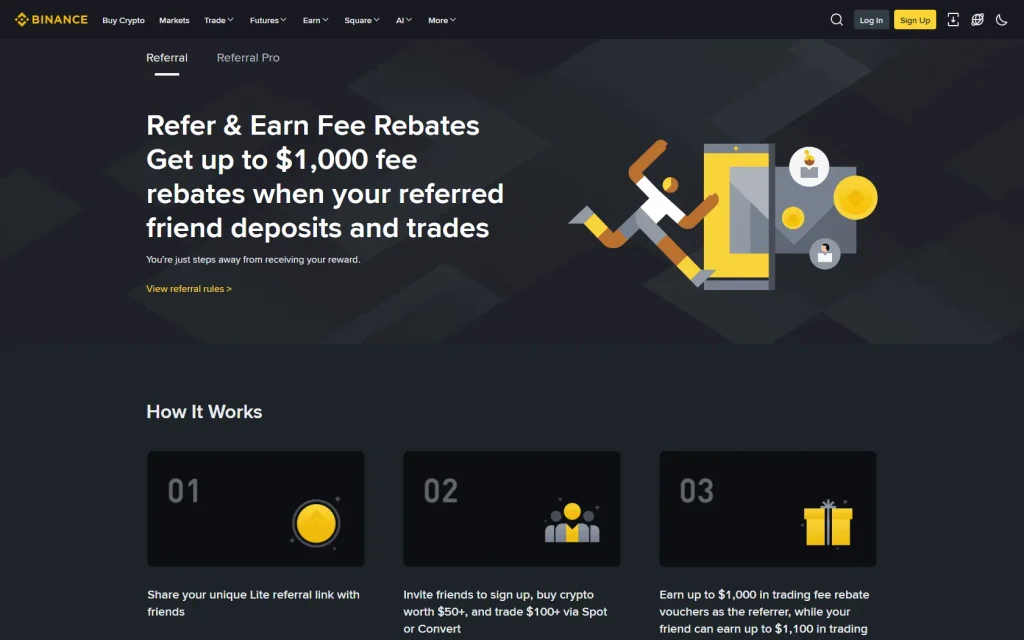
At its simplest, the Binance referral program is a field on the signup form. During registration, new users see an optional Referral ID box, and entering a code there links the new account to whoever shared it. That link is not cosmetic. Binance’s own Referral Program Terms and Conditions state that once a referral relationship is established it generally cannot be changed or removed, which is why the moment of signup matters more than most new users realize.
Depending on which mode the code belongs to, that link unlocks one of two very different reward paths, a one-time voucher or an ongoing cut of trading fees. Both require identity verification (KYC) before anything is paid out, and both are ultimately funded by fees the referred user actually pays, not by Binance handing out free capital.
Referral Lite Mode vs Referral Pro Mode
Referral Lite Mode is built for a quick, one-off invite. The referred friend signs up, completes KYC, and typically needs to buy or trade a qualifying amount of crypto, often more than fifty dollars, within about fourteen days. Once that task clears, both sides can unlock a trading fee rebate voucher rather than withdrawable cash, and the voucher usually has to be claimed inside the Rewards Hub within a set window before it expires.
Referral Pro Mode works differently. Instead of a single voucher, the referrer earns an ongoing share of the trading fees their referred users pay on Spot, Margin and Futures. Under Binance’s quarterly performance evaluation, that commission rate can climb toward the higher end of the published range as a referrer brings in more active traders and volume. Binance settles it in USDC, calculated hourly and credited to the referrer’s Spot wallet within roughly six hours.
| Feature | Referral Lite | Referral Pro |
|---|---|---|
| Reward type | One-time trading fee rebate voucher | Ongoing commission on eligible trading fees |
| Typical requirement | KYC plus a qualifying crypto purchase within about 14 days | KYC plus fee-paying trades from the referred user |
| Reward basis | Fixed campaign voucher, varies by promotion | Percentage of Spot, Margin and Futures fees under quarterly tiers |
| Settlement | Claimed in Rewards Hub, time-limited once activated | Calculated hourly, credited in USDC to the Spot wallet |
| Best fit | Casual, one-off invites | Communities and referrers with active, recurring traders |
A detail that trips up a lot of referrers: Spot and Margin commission generally only applies while the referred user sits at Regular through VIP 2. Once that trader reaches VIP 3 or higher, the commission on their activity stops, regardless of how much volume they generate afterward.
The Easiest Way to Sign Up on Binance With an Invite Code
The mechanics are simple, but the code has to go in at the right moment. Applying a referral link that already has the code embedded is the least error-prone route, since it fills the field automatically and removes any chance of a typo.
- Decide on Referral Lite or Referral Pro first, since a new account can only be bound to one mode for its lifetime.
- Open registration on Binance’s website or app and start creating the account with an email address or phone number.
- Enter the code in the “Referral ID (Optional)” field before finishing signup, since it generally cannot be added afterward.
- Complete KYC and finish the specific deposit, purchase or trade the active campaign requires.
There is a narrow exception for people who forgot to enter a code. Binance allows a referral relationship to be bound within 30 days of registration, but only if the account has no deposits, no trades, no existing referral link, and its identity information has not been used on another account in the previous 180 days. Miss that window and the account stays unlinked permanently.
You may also like: Binance Learn and Earn: How It Works and What to Watch Out For in 2026
Binance Spot vs Futures Codes
There is only one referral relationship per account, so a Spot and a Futures referral code are not two separate signups, they are two sides of the same relationship with different rules attached. A referee’s Spot and Margin trading generates commission on an open-ended basis as long as they stay below VIP 3, while their Futures trading is treated as a separate, time-limited stream.
| Aspect | Spot and Margin referral | Futures referral |
|---|---|---|
| Commission ceiling | Scales upward under quarterly performance tiers | Scales upward under quarterly performance tiers |
| Time limit on the referee | No fixed expiry below VIP 3 | Generally limited to about 12 months from when the referee opens a Futures account, unless the referrer clears a higher tier |
| Extra requirement | None beyond the standard referral link | Referrer generally needs their own Futures account activated before the referee opens theirs |
This is also why a referrer can see Spot commission arriving normally while Futures commission stays at zero. If the referrer’s own Futures account was opened after the referee’s, or if the twelve-month window on that specific referee has quietly expired, Futures commission stops even though the referral relationship itself is still active.
Why Referral Programs Became the Backbone of Fintech Growth
Long before crypto exchanges had referral dashboards, PayPal effectively wrote the playbook. Between 1999 and 2000, PayPal paid new users ten dollars for signing up and another ten dollars for every successful referral, briefly testing twenty dollars on each side, according to a detailed account from finance newsletter Net Interest.
The company reportedly spent tens of millions of dollars on signup and referral bonuses within its first year, and the payoff was a daily growth rate of roughly 7 to 10 percent, taking PayPal from around one million users in March 2000 to more than 100 million users by the time eBay acquired it for 1.5 billion dollars in 2002.
PayPal eventually tapered the bonus down to five dollars and then phased it out once the payout curve stopped being sustainable, a pattern that echoes in how Binance has repeatedly adjusted its own commission tiers rather than keeping them fixed.
The reason referral programs keep outliving almost every other acquisition channel is not really about the money itself. Long-running research from Nielsen, covering tens of thousands of respondents across dozens of countries, has found that 92 percent of consumers trust a recommendation from someone they know above any paid advertisement, a figure a later wave of the same research put at 89 percent globally.
A cash reward layered on top of that existing trust is what turns an ordinary product recommendation into a repeatable acquisition channel, which is the exact mechanic Referral Lite and Referral Pro are built around.
Referral economics matter more in fintech than in most other industries, because acquiring a financial customer is expensive and slow. Referral platform Extole’s 2026 benchmark research on referral program performance found that referred customers retain at a 37 percent higher rate than customers acquired through other channels, and that referral channels typically produce a lower acquisition cost than paid search or influencer marketing.
Separately, Accenture’s 2025 Banking Consumer Study, cited by Global Banking and Finance Review, found that customers who actively recommend their bank hold roughly 17 percent more products with that institution, suggesting a referral also signals loyalty rather than functioning as a pure growth tactic. Crypto exchanges sit inside that same logic.
Getting a new trader through KYC, funding and a first trade is expensive and heavily regulated, so a referral that arrives pre-trusted through a friend is worth protecting, even as the specific commission percentages an exchange like Binance offers keep shifting from one evaluation period to the next.
The Regulatory Side of Binance Referrals
Not every regulator sees a referral bonus the way a growth team does. The UK’s Financial Conduct Authority (FCA) reclassified cryptoassets as Restricted Mass Market Investments and, as part of that regime, banned firms from offering retail clients any monetary or non-monetary incentive to invest, a rule the FCA states explicitly covers refer-a-friend schemes and new joiner bonuses.
The rule took effect on 8 October 2023, alongside mandatory risk warnings and a 24-hour cooling-off period for first-time crypto buyers. The FCA’s own reasoning, published alongside the rule, was that its research showed many people regretted crypto purchases made in the moment, and incentive-driven decisions were part of that pattern.
Binance’s own Referral Program Terms and Conditions confirm it responded by removing future commissions from both new and existing UK-based users to comply. Turkey’s Capital Markets Board ordered the retail referral program discontinued for Turkish users effective 19 September 2024. Nigerian residents or nationals are disqualified from participating as either a referrer or a referred user owing to a regulatory dispute between Binance and Nigerian authorities over unlicensed operations.
The clearest recent example of how fast this can move is the European Economic Area. Binance withdrew its Markets in Crypto-Assets license application in Greece on 24 June 2026, days before the bloc’s 1 July 2026 compliance deadline. CoinDesk reported that Binance told users across multiple EU countries it would suspend new registrations, new spot orders and Earn products for EEA residents.
Because a referral program cannot legally onboard customers a platform is not licensed to serve, EEA users lost eligibility for the Binance referral program in any capacity from 1 July 2026 onward. Binance has said it is not leaving Europe permanently and intends to reapply through another member state, but for now the referral program and the underlying account services are frozen together.
Countries Where Binance Referral Rewards Do Not Work
Pulled together from Binance’s own program terms, the current picture of where Binance referrals simply do not function looks like this:
| Country or region | Referral status | Why |
|---|---|---|
| United Kingdom | No referral incentives for retail users | FCA financial promotions regime, effective 8 Oct 2023 |
| Nigeria | Referrer and referee both disqualified | Regulatory dispute with Nigerian authorities over unlicensed operations |
| Turkey | Retail referral program discontinued | Capital Markets Board (SPK) decision, effective 19 Sept 2024 |
| Hong Kong | No commission if the referee is a Hong Kong resident | Regulatory restriction under Binance’s referral terms |
| Japan | New users barred from joining through a referral | Restriction in place since August 2023 |
| European Economic Area | Entire referral program unavailable | No Binance MiCA license as of 1 July 2026 |
This list is not static. Nigeria’s naira services were suspended separately in February 2024 on top of the referral disqualification, and the EEA restriction only exists because of a licensing decision made weeks before this article was written. Anyone relying on a specific referral code should check Binance’s current Referral Program Terms and Conditions rather than assume last year’s rules still apply.
Read also: Bybit Referral Bonus: How It Works and What It Pays
What Users Actually Complain About With Binance Referrals
The Reward Progress Bar That Never Quite Reaches 100 Percent
A widely discussed Reddit complaint describes chasing a milestone reward, worth up to 0.003 BTC in that campaign, only to watch the progress bar crawl from 97 percent to 98.77 percent after a second successful referral.
Other commenters in that thread pointed to the campaign’s own terms, which stated each referral adds somewhere between 0.01 percent and 10 percent of progress, with the exact figure weighted by the referrer’s account history rather than moving in flat, predictable steps.
One commenter reasoned that the curve is effectively designed so early referrals move the bar quickly while later ones add smaller increments, which produces exactly the “always close, never quite there” complaint that shows up across multiple campaigns.
A separate complaint about an Invite Friends and Earn USDC task described a first referral bonus of 2.05 USDC followed by two smaller payouts of 0.82 and 0.27 USDC. Neither thread shows the reward being withheld outright. Both describe real vouchers or USDC landing in the account, but the underlying complaint is legitimate; the weighting behind these progress bars is rarely explained anywhere the user can see it before they start referring.
My Friend Signed Up but I Never Got a Commission
This is the single most common Binance referral complaint, and it almost always comes down to a mechanical requirement rather than a broken system. Referral Pro only generates a commission once the referred user completes a trade that actually pays a fee, so a friend who deposits, holds and never trades produces nothing, no matter how large the deposit was.
A referred user who reaches VIP 3 or higher also stops generating Spot and Margin commission entirely, and Futures commission is capped at roughly twelve months from account opening unless the referrer has cleared a higher performance tier. On top of that, referrers choose how much of their own commission to share back with the referee as a rebate, so a referrer expecting the full percentage sometimes discovers part of it was already routed to their friend under a split they configured earlier.
One Reddit thread captures this exact confusion well: a user reported that a friend had registered and traded through their link, the referral appeared correctly in the dashboard, yet no kickback showed up. Other commenters pointed out that commissions post automatically once a qualifying, fee-paying trade happens, so the likely explanation was either that the friend had not yet placed such a trade, or that the referrer’s own sharing ratio had routed the reward differently than expected.
For anyone trying to audit a missing commission, the underlying math is simpler than the dashboard makes it feel: expected commission equals the referred user’s eligible net trading fees multiplied by the referrer’s active commission rate, not a fixed bounty for the signup itself. A referral who trades a large volume on a fee-free promotion can generate nothing, while a smaller trader paying ordinary fees can generate more.
The Binance referral program is not a scam in the way some frustrated Reddit threads suggest, but it is also not the flat, guaranteed payout the marketing language sometimes implies. Referral Lite pays a one-time voucher for a specific task, Referral Pro pays a genuine but fee-dependent commission, and both are increasingly shaped by regulators who treat crypto referral incentives as an investment risk rather than harmless marketing.
Anyone comparing Binance referrals against a competing exchange should check the current country restrictions and the fee-based commission math before assuming a code, a discount or a claimed bonus percentage will actually apply to their account.
