
Anyone researching Phemex Learn and Earn faces the question of its genuinity. Are we earning real, withdrawable crypto, or something else dressed up to look like it?
Key Takeaways
- Phemex Learn and Earn pays users for finishing short crypto lessons and quizzes, but the reward usually lands as a cashback voucher tied to future trading fees, not free withdrawable crypto.
- Completing identity verification (KYC) is required before Phemex releases any Learn and Earn reward, and the trading-bonus version of the program is only confirmed for North America, the UK, Australia, Germany, Japan and South Korea.
- Reddit and Trustpilot complaints about Phemex mostly target withdrawals, voucher expiry and repeated verification requests, not the quiz content itself.
- Phemex’s most Phemex-specific data point is not a reward number. It is the $69.1 million hot wallet hack from January 2025 and the Ontario Securities Commission penalty from December 2024, both of which shape how much trust the exchange deserves.
- Because the reward is a fee rebate voucher rather than a token airdrop, Phemex Learn rewards are less exposed to price crashes than programs that pay out in a volatile altcoin.
Phemex describes the program as a way to pick up small rewards for reading a lesson and passing a quiz. It is similar in format to what Coinbase used to run before its quiz-based Learning Rewards program was retired. Well again, does it pay real money? This article walks through how the program actually works while breaking down the complaints that are unique to Phemex.
What Is Phemex Learn and Earn and How Does It Work
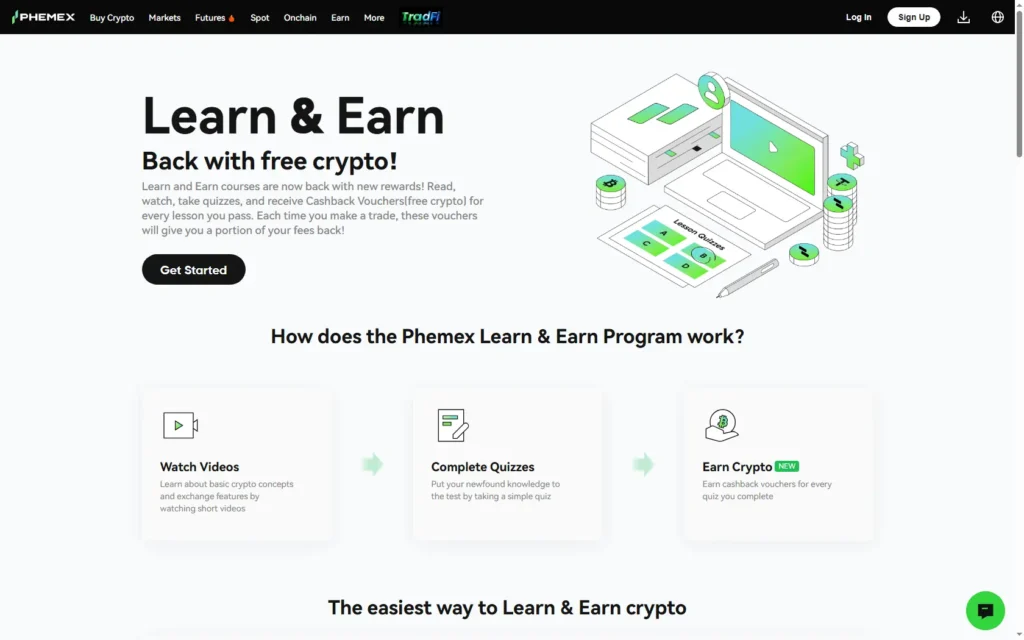
Phemex Learn and Earn is an in-app education program. Users open the Learn section of the Phemex platform, choose an available course, read a short lesson or watch a short video about a Phemex product, then answer a multiple-choice quiz.
Passing the quiz triggers a reward, which Phemex currently describes as a reward tied to the course rather than a fixed cash payout that applies forever. Community threads and course archives show past reward amounts such as $0.20 to $2 per lesson, with totals across a full course historically landing between roughly $3.20 and $4.40, though Phemex itself notes these older figures are historical and should not be assumed to still apply.
The mechanical steps are consistent across most versions of the program that Reddit users and Phemex’s own help pages describe:
- Log in to a registered Phemex account.
- Open Learn, then Learn and Earn, and pick an available course.
- Read the lesson or watch the short video.
- Answer the quiz questions, with retries generally allowed if you get one wrong.
- Complete Phemex’s identity verification (KYC) if it has not already been done, since Phemex’s help documentation states this must happen before a reward is released.
- Check the reward in the Rewards Hub or My Rewards section rather than the main spot wallet, since many Learn and Earn payouts arrive as vouchers rather than a spendable balance.
That last step is where a lot of confusion starts. Phemex frequently issues the reward as a cashback voucher that offsets a portion of eligible trading fees the next time the user places a trade, rather than crediting an amount of USDT that can be withdrawn immediately. That distinction is the single most important thing to understand before treating Phemex Learn as free money.
| Detail | What Phemex documentation and user reports indicate |
|---|---|
| Reward format | Usually a cashback voucher applied to future trading fees, sometimes a trading bonus or crypto amount depending on the campaign. |
| KYC requirement | Required before the reward is released, according to Phemex’s own help article. |
| Stated eligible regions | Phemex’s Learn and Earn help page lists North America, the UK, Australia, Germany, Japan and South Korea for the trading-bonus version of the program. |
| Typical credit window | Third-party guides commonly report rewards appearing within 48 hours of passing a quiz, though Phemex does not publish a universal guaranteed timing. |
| Voucher expiry | Some vouchers are reported to be valid for as little as 7 to 14 days after issue. |
Read also: Crypto.com University Review 2026: Diamonds Rewards Explained
Is There a Phemex Learn and Earn KYC Trap
The phrase KYC trap shows up repeatedly in Reddit threads about Phemex, but it is worth being precise about what it does and does not describe. There is no verified evidence that Phemex built Learn and Earn specifically to harvest identity documents with no intention of paying rewards.
Evidence however points to a sequencing problem. A user can generally start the lessons and quizzes before verifying their identity, then discover only afterward that KYC is mandatory to actually receive the reward.
That sequencing creates a predictable pattern. A user spends time reading lessons and passing quizzes, assuming the reward is close to guaranteed. Only when they try to claim it do they learn that Phemex’s help documentation requires completed identity verification first. Furthermore, they learn that the country they are verifying from may not appear on Phemex’s list of eligible regions for the trading-bonus version of the program. And the reward itself might be a voucher rather than a cash-equivalent balance.
None of that is illegal or unusual among centralized exchanges. Yet it does mean the perceived value of the reward at the start of a lesson is higher than the realistic value once the KYC and eligibility requirements are factored in.
A separate and unrelated pattern, also referred to informally as a KYC trap in some Reddit posts, involves Phemex’s general withdrawal and account-verification flow rather than Learn and Earn specifically. Users report depositing funds without needing KYC, then being asked for advanced verification once they attempt a larger withdrawal or trigger Phemex’s risk control system.
That is a broader account-level concern, not something caused by taking a quiz, and it should not be conflated with the Learn and Earn reward flow. The practical takeaway is the same either way: treat any Phemex reward as conditional on successful KYC and regional eligibility, and do not submit identity documents purely on the promise of a reward worth a few dollars without confirming both requirements first.
Complaints That Are Genuinely Unique to Phemex Learn and Earn
Most public complaints about Phemex concern the exchange broadly: withdrawal delays, account freezes, and support quality. Far fewer complaints are specific to the Learn and Earn quizzes themselves. The ones that are specific tend to come from how the reward is structured and delivered, not from the quiz content.
1. “Free Crypto” Is Actually a Trading Fee Voucher
Phemex’s marketing language leans on the idea of earning free crypto, but the current product is described as a cashback voucher that rebates part of eligible spot or futures trading fees. That means a user who never places another trade may never realize any value from the reward at all. The gap between what it is advertised as and what it technically is is the root of most of the confusion Reddit users describe.
2. KYC Appears After the Educational Work Is Already Done
Because the lessons and quizzes can typically be completed before identity verification, users invest their time first and learn about the KYC requirement second. Phemex’s help article confirms identity verification must be completed before the reward is issued, and its regional eligibility list for the trading-bonus program does not cover every country, so a user outside North America, the UK, Australia, Germany, Japan or South Korea may finish an entire course only to find they were never eligible for the trading-bonus version in the first place.
3. Rewards Sit in a Separate Rewards Hub, Not the Main Wallet
Phemex operates a Rewards Hub or My Rewards interface that is distinct from the spot wallet balance. A reward that has been issued as unused, used or expired will not show up as a wallet credit, which leads some users to conclude the reward never arrived when it is actually sitting, unclaimed or already consumed, in a separate section of the account.
4. Short Voucher Expiry Windows
Some Phemex cashback and welcome vouchers are reported to carry expiry periods as short as 7 to 14 days from issue. A user who passes a quiz but does not place an eligible trade within that window can lose the practical value of the reward entirely, even though the quiz itself was completed successfully.
5. The Rebate Rarely Equals the Advertised Voucher Value
Because the voucher rebates a percentage of eligible trading fees rather than paying out a fixed amount, the realized value is capped by how much the user actually pays in fees during the voucher’s validity window. A voucher advertised at a certain face value, for example around $5, only delivers that full amount if the qualifying trade generates at least that much in fees. A smaller trade that only generates a fraction of that in fees means only that smaller fraction is rebated, and the rest of the voucher’s stated value is not paid out in cash.
6. Confusion With Other Phemex Bonus Programs
Phemex simultaneously runs welcome bonuses, futures trading bonuses, copy-trading vouchers and separate Rewards Hub campaigns, all of which appear in similar promotional areas of the app. Users sometimes attribute a missing bonus to Learn and Earn when the reward in question actually belongs to a different program with its own expiry and eligibility rules, which makes individual complaints hard to interpret without knowing exactly which product, campaign, and voucher type is involved.
What none of the available evidence supports is a deliberate scheme to withhold Learn and Earn rewards, a measured failure rate for KYC applications tied to the program, or a documented pattern of Phemex demanding payment to release a quiz reward. The strongest fair criticism is structural: the program can make a small educational reward look like withdrawable free crypto while the underlying product is a KYC-gated, time-limited trading-fee voucher.
Why Phemex Learn and Earn Has Less Dependence on Token Price
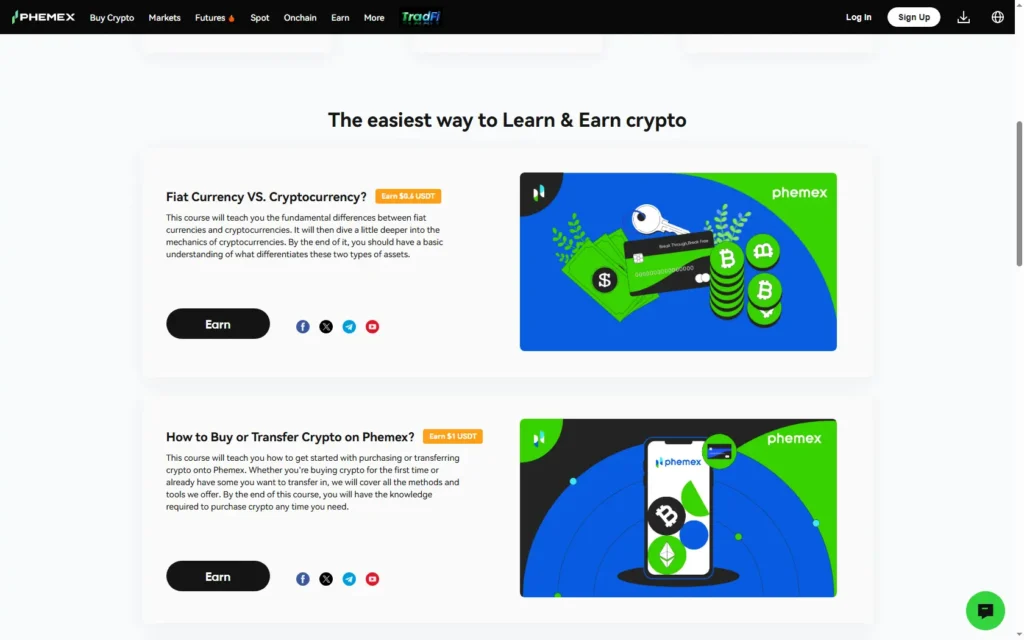
One genuine structural advantage of the Phemex model is that the reward is denominated as a fee rebate rather than a native or promotional token. Many learn-and-earn programs across the industry pay out in a project’s own token. Hence the value of the reward is only as stable as that token’s market price on the day it is claimed or the day it can be withdrawn. If that token drops sharply between when the quiz is passed and when the reward becomes usable, the effective reward shrinks or can become close to worthless.
A cashback voucher tied to trading fees does not carry that same exposure in the same way. Because the reward offsets a fee that is already denominated in a stable unit relative to the trade itself, its practical value does not swing with a token’s price chart the way an airdropped altcoin would.
The trade-off is that this model introduces a different kind of risk. Instead of market risk, the user faces usage risk, meaning the reward is only realized if the user actually places a qualifying trade before the voucher expires. Phemex swaps volatility risk for a use-it-or-lose-it condition rather than removing risk altogether.
For someone who already trades on Phemex regularly, this is a meaningful advantage over programs that pay in a token that could fall 20 to 30 percent in the days after a campaign. The voucher’s value is anchored to the trader’s own fee spend rather than to a floating market price. For someone who does not plan to trade on Phemex at all, the advantage disappears, because a rebate on fees the user was never going to pay has no realizable value in the first place.
Phemex Learn and Earn Compared With Binance Learn and Earn
| Feature | Phemex | Binance Learn and Earn |
|---|---|---|
| Reward format | Cashback voucher rebating a share of eligible trading fees. | Typically token vouchers or fixed crypto amounts credited toward a wallet. |
| Course structure | Multiple lessons per course, with a reward tied to each passed lesson. | Often one claim per course or campaign window. |
| Stated eligible regions | North America, the UK, Australia, Germany, Japan and South Korea for the trading-bonus version. | Varies by campaign and is frequently limited to a capped number of participants. |
| Value exposure | Tied to the user’s own trading fees rather than a token’s market price. | Tied to the market price of the reward token at the time it becomes usable. |
You may also like: How to Use Layer3 xyz: A Complete Beginner’s Guide to Learning & Earning
The Bigger Picture: Phemex’s Verified Track Record
A reward worth a few dollars is only meaningful in the context of how much trust the exchange issuing it has actually earned. Two independently documented events are far more informative about Phemex than any industry-wide crypto adoption figure, because they are specific to Phemex rather than to the crypto market as a whole.
First, blockchain security firm PeckShield confirmed that Phemex’s hot wallets were drained of approximately $69.1 million across multiple blockchains, including Ethereum, Solana, XRP and Bitcoin, in an attack that began on January 23, 2025. Recorded Future News reported the same figure and noted Phemex paused withdrawals while investigating. Phemex stated its cold wallets were unaffected and later published a proof-of-reserves snapshot; at the time, industry coverage described it as the largest crypto exchange hack recorded so far in 2025.
Second, Ontario’s Capital Markets Tribunal found, in a merits decision dated December 18, 2024, that Phemex Limited and Phemex Technology Pte. Ltd. sold securities to Ontario investors without registering or filing a prospectus, in violation of the Ontario Securities Act. At least 117 Ontario investors traded through the platform. In the subsequent sanctions decision, the Tribunal ordered the Phemex entities to disgorge US$39,712.43 and pay an administrative penalty of $300,000, jointly and severally, along with a permanent ban from participating in Ontario’s capital markets.
Neither event is a reason to assume Learn and Earn rewards themselves are fraudulent. They are, however, directly relevant for anyone deciding whether it is worth completing KYC and leaving funds on the platform in order to claim a reward measured in single-digit dollars.
Frequently Asked Questions
Yes. Phemex’s help documentation states that identity verification must be completed before a Learn and Earn reward is released, regardless of whether the lessons and quiz were completed first.
Often not directly. Many current rewards are issued as cashback vouchers that rebate a portion of eligible trading fees rather than as an amount credited to the withdrawable spot wallet balance.
Because lessons and quizzes can typically be started before verification, users sometimes complete the educational work first and only discover the KYC and country-eligibility requirements afterward, which can make a reward feel smaller or less accessible than it initially appeared.
Phemex’s help page lists North America, the UK, Australia, Germany, Japan and South Korea for the trading-bonus version of the program. Availability can change, so it is worth checking the live course page after logging in rather than relying on older guides.
Yes. Phemex lost approximately $69.1 million in a hot wallet hack in January 2025, confirmed by PeckShield and reported by Recorded Future News. Separately, Ontario’s Capital Markets Tribunal found in December 2024 that Phemex sold unregistered securities to Ontario investors and later ordered the company to disgorge US$39,712.43 and pay a $300,000 penalty.
