
A crypto data aggregator offering education opportunities for rookies. Well, that is the promise of Coingecko Learn and Earn. The Coingecko platform has been tracking data for over 18 thousand different crypto assets across over 1000 cryptocurrency exchange sites. And its services have attracted a monthly visit number exceeding 20.4 million in May 2026.
Key Takeaways
- CoinGecko Learn and Earn runs on the platform’s Candy Rewards system, requiring users to spend daily-collected candies (commonly 60) to unlock quizzes tied to partner crypto projects.
- Multiple users report completing CoinGecko Learn campaigns such as Aleph Zero, Zeebu, and Baby Doge without ever receiving the promised tokens, months after submission.
- Some campaigns, like the Tezos Learn and Earn, required setting up a new wallet and paying gas fees to mint an NFT, eating into the advertised reward.
- Geographic restrictions can block eligible-looking users mid-campaign, even outside CoinGecko’s official Excluded Countries list, because individual partner dApps run their own compliance filters.
- Independent traffic data and CoinGecko’s own reporting show a platform used by millions of people monthly, which is exactly why reward failures on Learn and Earn campaigns affect a large user base.
CoinGecko’s big numbers matter. A Learn and Earn program built on top of a platform with millions of monthly visitors means reward-delivery problems could touch a very large number of people. This article covers exactly how CoinGecko Learn and Earn works and the past complaints.
What Is CoinGecko Learn and Earn
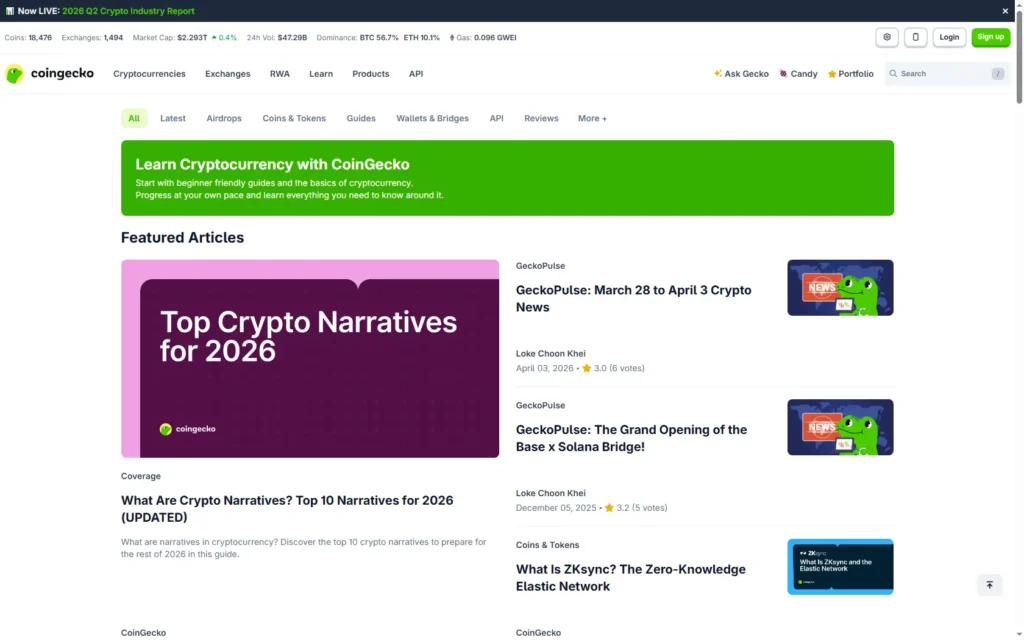
CoinGecko Learn and Earn is not a permanent, standalone education portal in the way Coinbase’s Learn & Earn once was. Instead, it is folded into CoinGecko’s Candy Rewards system. Users claim free candies daily, and those candies can be redeemed for e-books, discount vouchers, NFT mints, or entry into a Learn and Earn quiz.
Campaigns are sponsored by individual blockchain projects rather than run continuously by CoinGecko itself. Past and recent campaigns referenced across CoinGecko’s own Candy Rewards store and user reports include Tezos, IOTA, Mode, Aleph Zero, Zeebu, Baby Doge, and MANTRA. Each has its own quiz, token reward, and terms.
How CoinGecko Earn Campaigns Work
According to CoinGecko’s own Help Center, participating in a Learn and Earn campaign follows a fixed sequence, and CoinGecko is explicit that completing the steps does not guarantee a reward.
- Register a CoinGecko account and collect daily candies from the Candy Jar.
- Open the Candy Rewards store and check whether a Learn & Earn campaign is currently live.
- Spend the required candies to unlock the quiz for that project.
- Complete the reading material and answer every quiz question correctly; most campaigns require a perfect score.
- Submit a compatible wallet address and, in many cases, an email address through a third-party page such as SweepWidget.
- Wait for the distribution window – often stated as within two weeks of the campaign closing – for tokens to arrive.
That last step is where most user complaints originate, because the wallet-submission and token-distribution stages sit outside CoinGecko’s own interface, split between the sponsor project and a claim tool.
You may also like: Bybit Learn and Earn: What It Pays, and Where It Breaks Down in 2026
Recent CoinGecko Learn and Earn Campaigns
| Campaign | Candy Cost | Reward Token | Reported Issue |
|---|---|---|---|
| Tezos | 60 candies | XTZ (approx. $10 value) | Required new wallet setup and gas fees to mint on AkaSwap |
| IOTA | 60 candies | IOTA | $20,000 pool shared among 2,000 winners via raffle; SweepWidget submission required |
| Mode | 60 candies | MODE | Capped at 3,000 qualified participants selected by raffle |
| Aleph Zero | 60 candies | AZERO | Users report no tokens received after completion |
| Zeebu | 60 candies | ZBU | Users report no tokens received after completion |
| MANTRA | Candies (amount varies) | OM | Geo-restriction message blocked a US-based user after wallet connection |
Audit: Why CoinGecko Learn & Earn Rewards Fail (Aleph Zero, Zeebu, Tezos)
Looking specifically at Aleph Zero, Zeebu, and Tezos, the failures break down into two distinct categories: eligibility and distribution friction on one side, and technical or hidden-cost friction on the other.
Aleph Zero and Zeebu: eligibility and distribution friction
Both campaigns follow CoinGecko’s standard format: spend 60 candies, pass the quiz, then wait. The Aleph Zero campaign describes the network as a high-throughput, privacy-focused Layer 1, while Zeebu’s campaign required the same registered-account and candy-spend steps.
In both cases, the reported failure is a quiz marked complete with no on-chain token delivery afterward. Plausible causes include backend distribution jobs that are delayed or capped by a fixed prize pool, wallet or chain mismatches where a user connects an unsupported address format, and eligibility filters that silently exclude an account without telling the user why.
Tezos: technical friction and hidden costs
The Tezos campaign, documented in a first-hand Publish0x walkthrough, offered roughly $10 in rewards for 60 candies. But it required participants to create a Tezos-specific wallet and mint an NFT on AkaSwap to prove completion, a costly step despite being marketed as free.
For a first-time participant with zero XTZ in a newly created wallet, that meant acquiring XTZ, funding the wallet, and completing an unfamiliar minting flow before the reward could even be claimed, on top of the usual quiz.
Across all three campaigns, the common thread is multi-party dependency: CoinGecko, the sponsoring project, and sometimes a third-party dApp or NFT marketplace all have to function correctly for a reward to land. A break at any single point in that chain shows up to the user as a simple non-payment, with no error message pointing to where it actually failed.
Payment Delays and Non-Receipt of Rewards
In a Reddit thread a user reports completing three separate Learn and Earn campaigns i.e., Aleph Zero, Zeebu, and Baby Doge. Yet the user did not receive any tokens after several months, and asked whether anyone in the community has actually been paid. No confirmed success story appears in the visible replies. This suggests either a low payout completion rate or a process opaque enough that users who did get paid don’t return to confirm it.
CoinGecko’s own Help Center anticipates this exact complaint: it instructs users who never received a reward to file a support request and select the specific “CoinGecko Learn & Earn” category, rather than treating it as a guaranteed payout. That built-in dispute path is a tacit acknowledgment that non-delivery happens often enough to need a dedicated support category.
Regional Blocks and Eligibility Barriers
CoinGecko’s own Terms and Conditions state that access to the site and its services is conditioned on the user not residing in, being domiciled in, or accessing the platform from any jurisdiction sanctioned by a governmental authority, including the U.S. Treasury’s Office of Foreign Assets Control (OFAC), as reflected on CoinGecko’s separately maintained Excluded Countries page. The same clause is repeated in CoinGecko’s API Terms of Service, confirming this is a platform-wide policy rather than a one-off restriction.
That baseline policy is separate from what individual Learn and Earn users have run into. In the MANTRA campaign, a user based on the US East Coast reported connecting a Keplr wallet and receiving a message stating the products and services were not intended for individuals in their location.
This came despite the United States not typically appearing on general crypto-exchange sanctions lists the way Iran, North Korea, Cuba, or occupied Ukrainian regions do. That points to the block originating from the sponsor project’s own dApp-level compliance filter, not from CoinGecko’s baseline exclusion list.
CoinGecko’s support team, when asked about this specific case, directed the user to file a formal support ticket rather than offering an immediate resolution, underlining that geo-blocks triggered by partner dApps are largely outside CoinGecko’s direct control.
Read more: Crypto.com University Review 2026: Diamonds Rewards Explained
Is CoinGecko Learn and Earn Worth the Effort
For readers weighing whether to try CoinGecko Learn, the honest framing is that it functions as a low-stakes educational bonus, not a reliable income source. The candies themselves cost nothing but daily engagement, so the downside of a failed campaign is mostly time, not money – except in cases like Tezos, where real gas fees are required upfront. The upside, when a campaign pays out, is usually a small amount of a specific project’s token, capped and shared among a limited pool of winners via raffle rather than guaranteed to every participant.
- Prioritize campaigns with no extra minting or gas-fee steps beyond the quiz itself.
- Check whether the reward token and chain are ones you already hold a wallet for, avoiding new wallet setup.
- Search for recent, campaign-specific payout confirmations from other users before spending candies on it.
- Expect a raffle-style distribution rather than a guaranteed reward for every participant who passes the quiz.
Ultimately, treating CoinGecko Earn as a nice-to-have rather than a dependable payout changes how disappointing a missed reward feels – and given the documented delays and regional blocks, that expectation setting matters more here than on most Learn & Earn programs.
Frequently Asked Questions
It is a rewards program inside CoinGecko’s Candy Rewards system where users spend collected candies, usually 60 at a time, to unlock a quiz about a partner blockchain project and become eligible for that project’s token reward.
Most campaigns documented require 60 candies per entry, though the exact cost is set individually by each campaign and shown on the Candy Rewards store page.
Users have reported completing campaigns such as Aleph Zero and Zeebu without receiving tokens months later. CoinGecko’s Help Center advises filing a support ticket under the Learn & Earn category, since the platform does not guarantee delivery simply because the quiz was completed.
No. CoinGecko’s Terms and Conditions exclude jurisdictions sanctioned by bodies such as OFAC, and individual sponsor projects can apply their own additional geo-restrictions at the dApp level, which have blocked users outside CoinGecko’s official excluded-countries list.
Candies themselves are free to collect, but some campaigns – such as the Tezos Learn and Earn – have required setting up a new wallet and paying gas fees to mint an NFT before the reward can be claimed.
