
Key Takeaways
- Crypto bounty programs reward users with tokens for completing promotional or development tasks.
- Tasks may include social media promotion, content creation, translations, testing, or community support.
- Crypto bounties are often offered before or shortly after token launches.
- Rewards vary widely and may depend on campaign success.
- Some crypto bounties are legitimate, while others never distribute rewards.
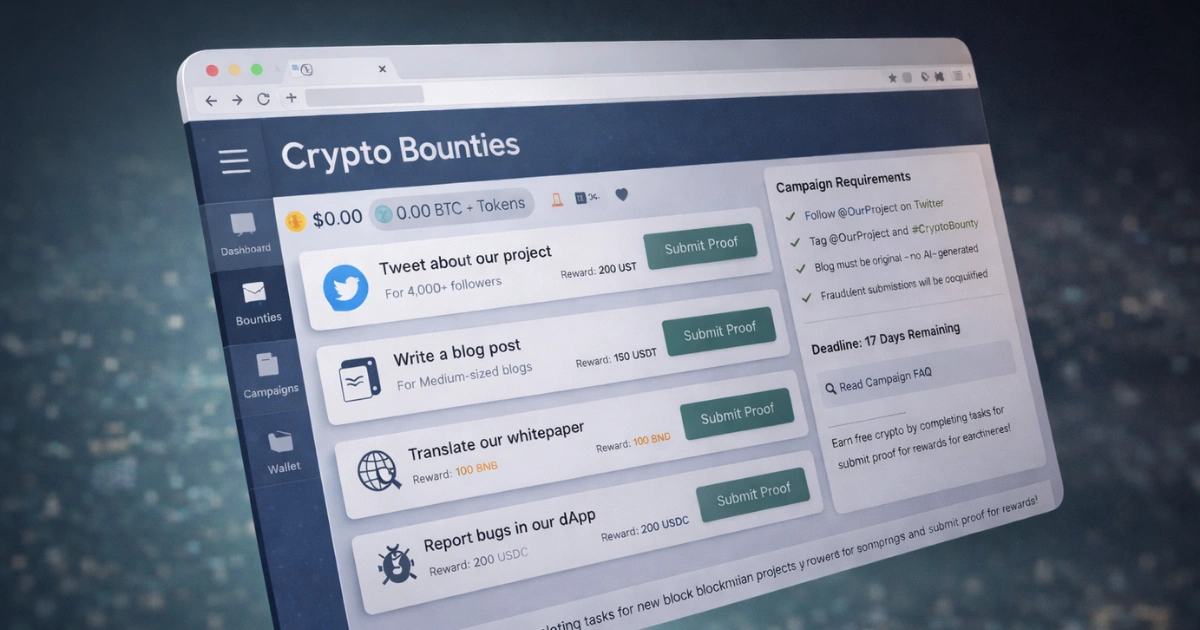
Have you ever heard of bounty programs? If yes, perhaps you remember the 2018 Facebook bounty program, with the price pool of $50k. Or maybe, a little closer to your mind is Microsoft’s later bounty program that had prices of $20k. Whatever the case, be it you have prior knowledge or bounty programs or not, this guide is for you.
What Are Crypto Bounty Programs
A crypto bounty program is a structured reward system where a blockchain project distributes tokens to contributors who complete defined tasks. The incentives by blockchain projects reward network participants for their completion of simple tasks. In bounty campaigns, the goal of the crypto project is to engage the community in completing tasks.
In 2018, during the much spoken of ICO season, bounty campaigns were the buzzing topics. The goal of bounty campaigns at inception was to act as a marketing tool, in a bid to attract more participation from users. Projects use bounty programs to:
- Increase brand awareness
- Grow online communities
- Encourage early adoption
- Improve platform testing
- Generate marketing content
Rewards are usually paid in the project’s native token.
A common class of bounty programs is bug bounty campaigns. In these, ethical hackers audit the system to detect any vulnerabilities. Their audits often include deploying malware or attacks against a system.
Types of Crypto Bounties
Crypto bounties reward participants with tokens or crypto for completing tasks that promote or improve blockchain projects. These programs help startups build communities, expand globally, and enhance security without high upfront costs.
Social Media Bounties
Participants promote crypto projects on social networks like Telegram, X (Twitter), Facebook, and Discord. They do that through posts, likes, retweets, memes, and discussions. Depending on the scale of engagement, follower count, and post reach, the participant receives rewards in the form of project tokens.
Content Creation Bounties
These types of bounty campaigns require participants to produce original materials. Among them are videos, podcasts, infographics, and project memes.
The platform in question will give you the specific topics, formats, word counts, and even the intended view count. In some cases, the quality of the content matters most.
Translation Bounties
In this model, participants will translate websites pages, whitepapers, announcements, or docs from one language to another. The goal? Supporting the global expansion of things.
In normal cases, the pay is calculated based on the word count. A popular average is $30 for every 1k words. Once approved and published, the rewards become claimable.
Development Bounties
Mostly, crypto bug bounties.
These, unlike the above mentioned, focus on spotting vulnerabilities in smart contracts, protocols and even applications. The payouts in most cases depend on the severity of the bouties found. For instance, on Athena, payouts for critical issues exceeded $3 million.
Ambassador Bounties
These are crypto bounties handled by Ambassadors who handle tasks like community management, promotions, events, and even content through tiered programs. In their dut, ambassadors receive bonuses, referral commissions, and sometimes monthly stipends.
How Crypto Bounties Work
Crypto bounty programs follow a common process, summarized as completing tasks and earning rewards. The standard process can be broken down into:
1. Join the Project’s Bounty Campaign
You need to explore active bounty program campaigns. Most projects will announce their bounty campaigns on forums like Bounty 0x, Bitcointalk, Telegram, Discord, project blogs, and social media accounts.
In these announcements, you will get to see the goals of the campaign, available tasks, and reward structure. It is important that the participants register before starting the activities.
2. Review Task Requirements and Reward Structure
Once you register, begin a review of the rules of these campaigns. In the rulebook, you will get specifics about tasks, rewards, submission requirements, deadlines, and quality standards.
Depending on the platform, you will get one or more types of crypto bounties advertised at the same time. Your skill set and time will help you determine which buy bounty tasks you can complete.
3. Complete Tasks Within the Campaign Deadline
Every task given must be completed within the required timeframe. If its publishing articles, sharing posts, participating in discussions, reporting vulnerabilities or improving codes, finish every task within the given time.
Depending on the requirements, the crypto tasks could have deadlines within the campaign period, testnet phase, or run throughout the development lifecycle.
4. Submit Proof of Completion
Once you finish every task, you simply need to prove the completion by submitting the proof of conclusion. Is it linked to social posts, screenshots, blog URLs, GitHub pull requests, bug reports among others?
The project actively reviews all the submissions. The higher the quality, the higher the chance of being accepted.
5. Receive Token Rewards After Campaign Ends
Once the campaign concludes and submissions are verified, the project distributes rewards to participants.
Rewards are typically paid in the project’s native token after:
- Token generation events (TGE)
- Exchange listings
- Official campaign completion
Some transparency focused platforms will hold funds in autonomous smart contracts/escrows to automate payouts on the verification of a task.
Top 5 Crypto Bounty Platforms (2026)
| Platform | Best For | Payout Potential | Difficulty | Our Rating |
| Immunefi | DeFi & smart contracts | Extremely high | Very high | ⭐⭐⭐⭐⭐ |
| HackerOne | General + Web3 | High | High | ⭐⭐⭐⭐☆ |
| HackenProof | Crypto security | Medium–High | Medium–High | ⭐⭐⭐⭐☆ |
| Bugcrowd | Mixed (Web2 + crypto) | Medium–High | Medium | ⭐⭐⭐⭐☆ |
| Gitcoin | Dev/content bounties | Low–Medium | Low–Medium | ⭐⭐⭐☆☆ |
1. Immunefi
Primarily focused on Web3, smart contracts, and DeFi, ImmuneFi has already paid over $100 million in bounty campaigns. This network has hosted major crypto networks including Chainlink and MakerDAO.
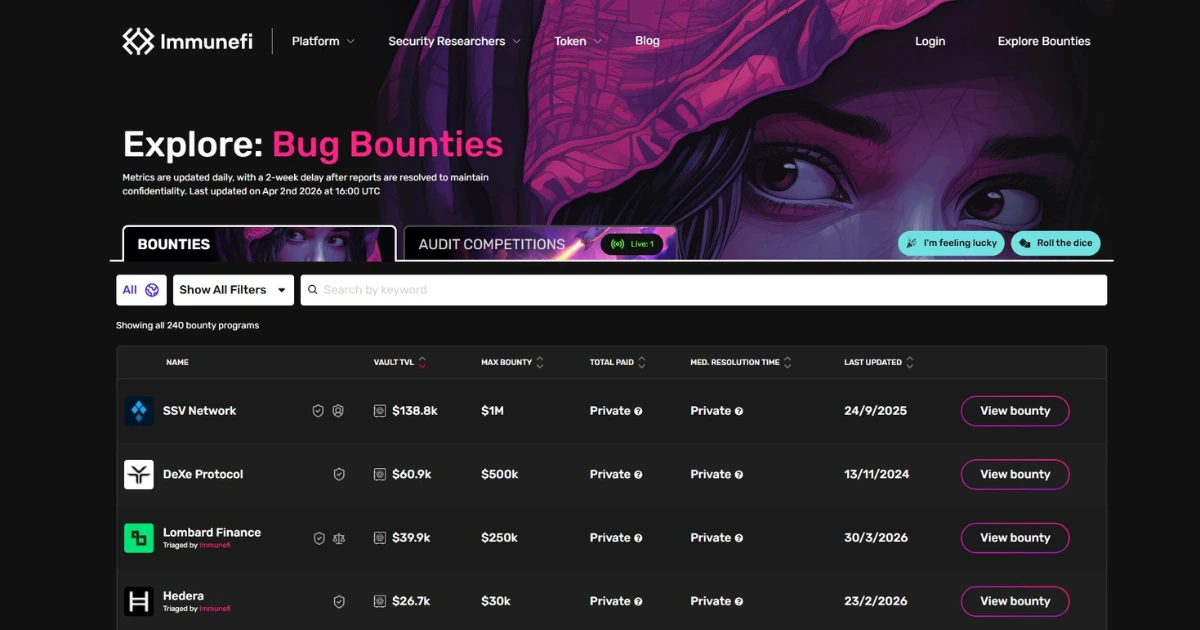
Immunefi is vastly praised for its very high payouts and crypto native security. However, it demands high skill levels to participate.
2. HackerOne
This stands among the largest global platforms, having paid over $300 million historically. It hosts bounties for both Web2 and Web3 programs. Hackerone is known as a very competitive platform because of its wide usage.
In general, a huge number of platforms use HackerOne, with the payout ceilings standing above $100k. Owing to its wide usage, the market is saturated with many duplicate reports.
3. HackenProof
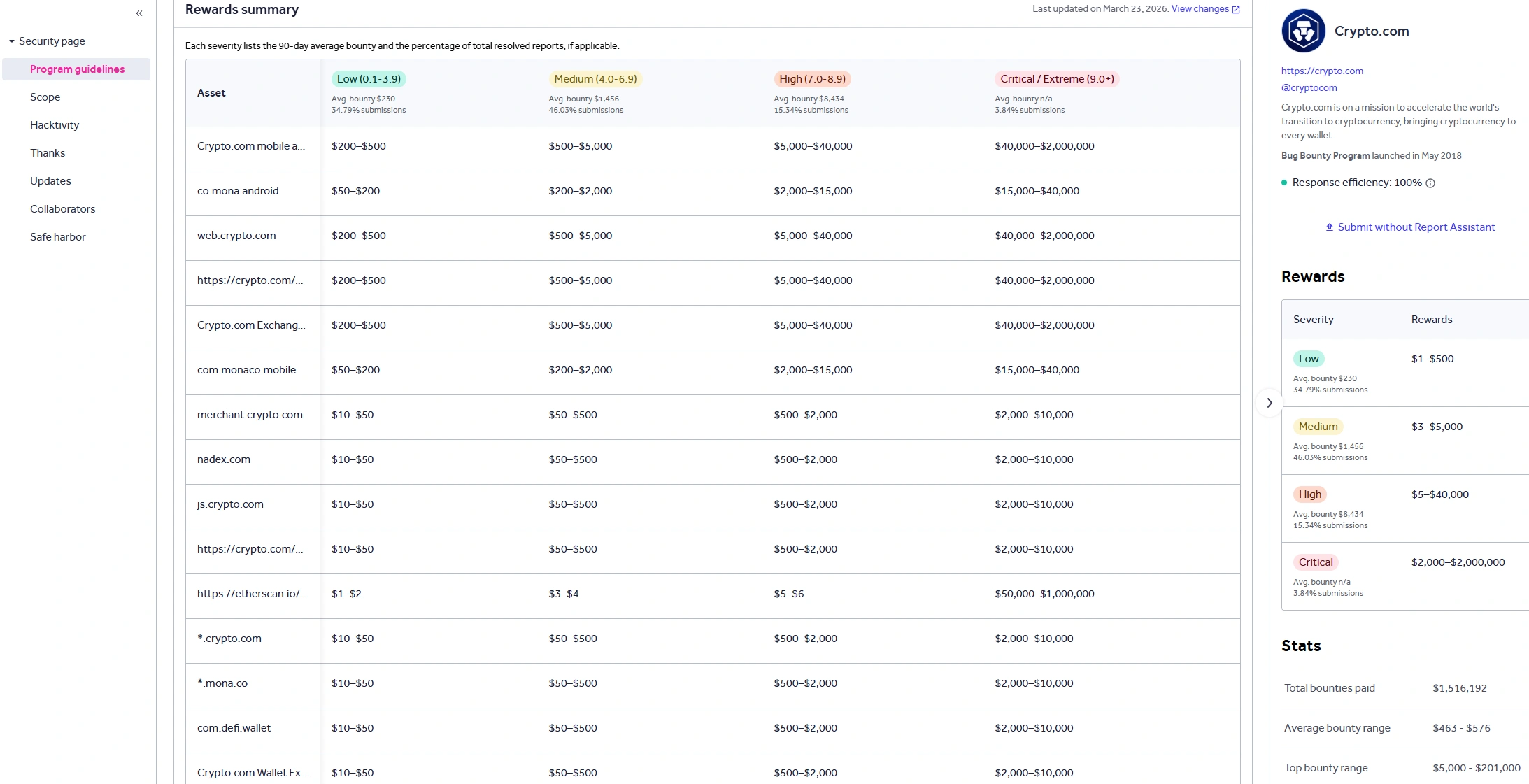
HackenProof takes keen specialization in blockchain, exchanges, and smart contracts, with a great history of hosting projects like 1inch and Polygon ecosystems. Unlike HackerOne, HackenProof is a little less saturated.
The platform has a focus on crypto, with a good mix of projects involved. It is relatively smaller when compared to HackerOne.

4. Bugcrowd
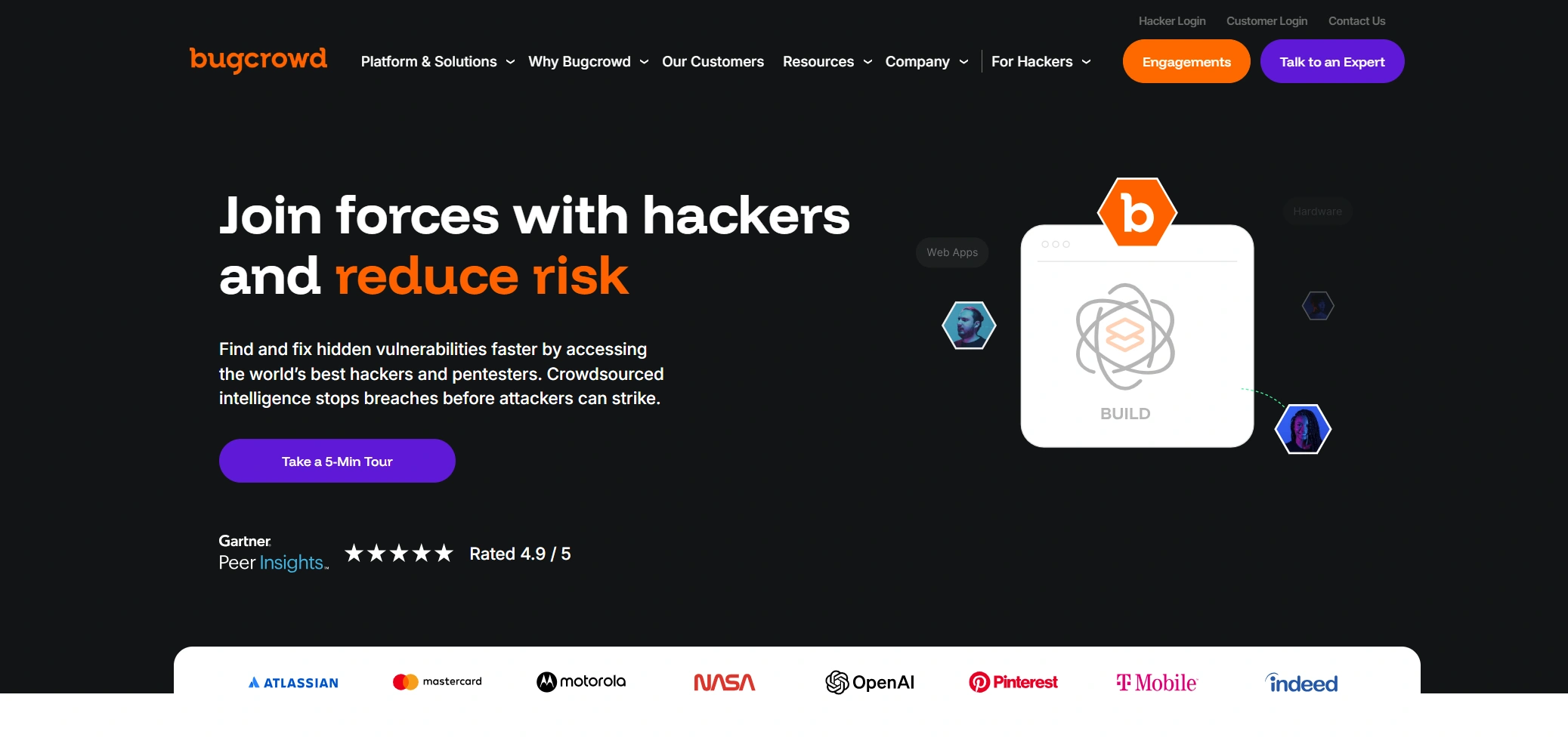
A multi industry bounty platform, Bugcrown supports a myriad of crypto exchanges and Web3 companies. It offers broad opportunities with no limits to crypto only. It is good for beginners transitioning into crypto bounties.
5. Gitcoin
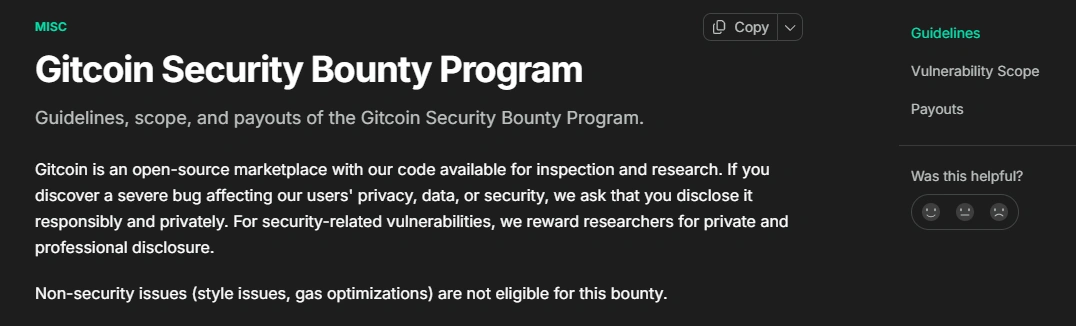
Closing our top 5 is Gitcoin, a platform focused on bounty programs for development tasks, content creation and open-source contributions. The crypto bounties are funded directly in crypto via Ethereum escrow. People often earn between $100 and $200+ from guides, content, and dev work. Seeing that it’s not bug focused, it has lower entry barriers.
How Much Can You Earn?
The amounts you can earn participating in bounty campaigns depend on many factors including:
- Project quality
- Token value after listing
- Campaign allocation
- Number of participants
- Effort required
Yet, even after inputting high levels of effort, you may still fall short. Why? Crypto bounty campaigns tend to reward the top hunters. In fact, expert bounty hunters, the top 1%, could earn an upward of $10k per month.
The other thousands if not millions of hunters struggle to even spot small bugs. In fact, most of them end up getting duplicates of bugs already found by bigger hunters. Crypto bounty earnings range from small token allocations, moderate returns, to even worthless tokens.
Are Crypto Bounties Worth It?
The answer could be both yes and no. There are situations where participation in crypto bounties may be or not be worthwhile.
Here are some factors that could make crypto bounties worth your time:
- Dealing with high-end projects with strong fundamentals.
- Transparent teams with identifiable developers, and public communication channels bolster credibility. Furthermore, with good teams, there will be more structured campaigns and proper transparency.
- Project tokenomics. If the token supply is too large when likened to the bounty distribution, hunters could use a lot of time to only earn a few dollars. This makes these projects less attractive.
- Projects with clear distribution timelines display transparency and will hence attract large participation.
On the contrary, project bounty campaigns with the attributes below are not worth your time:
- The project lacks credibility
- Reward structure is unclear
- Token supply is inflated
- There is no clear roadmap
Risks of Crypto Bounty Programs
Projects failing before token distribution
In many cases, new projects offering bounty campaigns will fail to survive their development cycles. This in turn means, anyone who participated lost time chasing false promises.
Tokens never being listed
Other projects could issue tokens that never get listed in any exchange. This means the tokens cannot be traded, and will lack value.
Excessive participant dilution
The large numbers of participation in these reward pools often dilutes the value of the distribution. In effect, participants earn very small payouts for their efforts.
Fake bounty managers
With bounty campaigns offering opportunities for free crypto, there has been a rise in fake bounty campaign managers, who take advantage of unknowing investors. They could impersonate legitimate projects, ask for your information, and escape with your rewards.
Phishing attempts
Scammers are quite common in crypto, with malicious actors looking to gain access to your wallets. To stay clear of phishing scams, you should often verify the projects and channels of crypto bounty sites. Also, avoid paying a single cent to join any campaign.
Bounties vs Other Free Crypto Earning Methods
Compared to airdrops
When likened to airdrops, bounties are more task based, and hence require regular and active participation. However, the eligibility is perhaps less automatic.
Compared to referral programs
- No need to bring new users
- More time investment
- Higher uncertainty
Compared to surveys:
- Higher potential upside
- Less predictable rewards
- More project-dependent risk
Frequently Asked Questions
Yes! In many cases, technical expertise is important to complete tasks demanded and earn bounties. For instance, bug bounty programs are not for just anyone. Rather, only those with strong computing, coding and ethical hacking background can spot such vulnerabilities. Crypto bounty programs require a deep understanding of smart contracts, cryptography, software security and blockchain architecture.
Some of the most common tasks in bounty programs include bug hunting, code testing, translations, social media promotion, article writing, design work, and community moderation. Some like bug crypto bounties and code testing reward more than others.
Usually in the project’s own token, though some programs pay in Bitcoin, Ethereum, or stablecoins. Before signing up for any bug bounty event, it is crucial that you check the mode of reward payment, and perhaps the market value of the payment token.
A lot can go wrong actually. Common issues include spammy or low-quality work, token price pressure from hunters selling rewards, and scam campaigns that exploit participants.